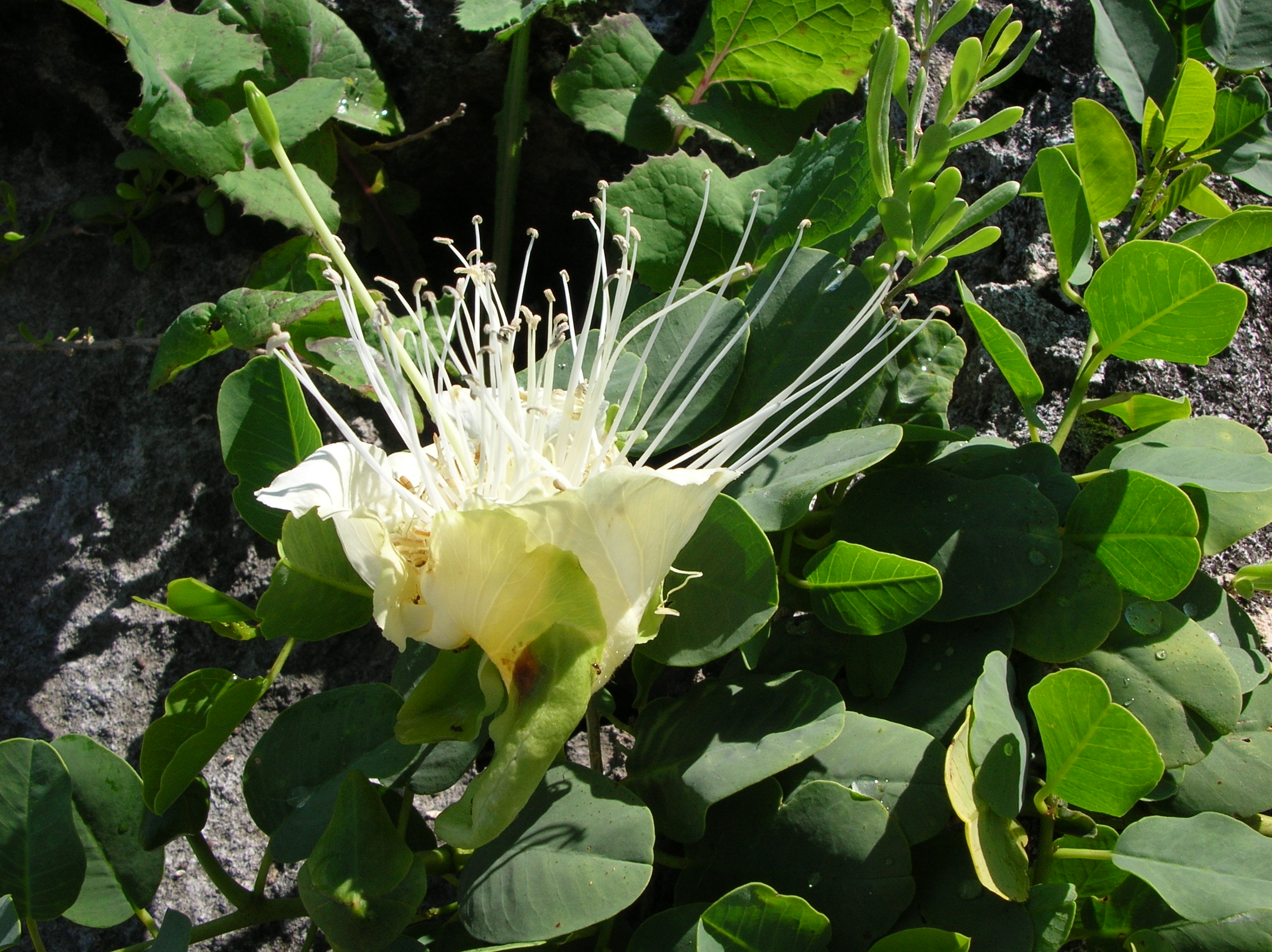
Capparis L. is a genus of approximately 146–245 species of flowering shrubs and lianas in the family Capparaceae, order Brassicales. First published by Linnaeus in Species Plantarum in 1753, the genus is the namesake of its family and is best known as the source of capers, the pickled flower buds of Capparis spinosa that have been used as a culinary seasoning and condiment since antiquity.
Plants in the genus typically bear simple, entire leaves and bisexual flowers with four sepals and four petals. The flowers are often large and showy, opening early in the morning and fading by midday. Fruits are globose to ellipsoid berries. Many species are spiny shrubs or sprawling lianas adapted to harsh, dry environments. Growth habit varies from low-spreading evergreen shrubs roughly 1 metre tall and 2 metres wide to larger climbing forms.
The genus is distributed across subtropical and tropical regions worldwide, spanning Africa, southern Europe, the Middle East, South and Southeast Asia, Australia, and the Pacific islands. Several species are highly tolerant of arid conditions, colonising rock outcrops, old walls, and cliffs in the Mediterranean basin, and rocky hillsides up to 3,600 metres elevation in the Himalayas. Their role in stabilising soils in arid landscapes makes them ecologically significant beyond their culinary fame.
Capparis species are important host plants for the caterpillars of many butterflies in the subfamily Pierinae (whites and yellows), and their seeds and fruits are consumed by birds and lizards, contributing to seed dispersal. Larger-flowered species attract specialist pollinators such as the Crimson Rose butterfly (Atrophaneura hector).
Etymology
The genus name Capparis derives from the Ancient Greek word kápparis (κάππαρις), which referred to the caper plant in classical texts. This name was adopted by Linnaeus when he formally described the genus in Species Plantarum (1753). The family name Capparaceae is derived directly from the genus name.
Distribution
Capparis occurs across subtropical and tropical regions of Africa, Eurasia, Australasia, and the Pacific islands. In Europe, the genus reaches its northern limit in the Mediterranean basin, where Capparis spinosa grows on old walls, cliffs, and rocky hillsides. The range extends through the Middle East, the Indian subcontinent (with species recorded to 3,600 metres in the Himalayas), East and Southeast Asia, tropical Africa, Australia, and the Pacific islands including Hawaii (Capparis sandwichiana). The genus has also been introduced to the Canary Islands and other arid regions outside its native range.
Ecology
Capparis species occupy some of the driest and hottest habitats available to flowering plants — rocky outcrops, cliff faces, old masonry walls, and arid scrublands. Many species exhibit exceptional drought tolerance and, in arid regions, play an important role in preventing soil erosion and supporting afforestation efforts. The genus serves as a key larval food plant for butterflies of the subfamily Pierinae (the whites and yellows). Birds and spiny-tailed lizards (Uromastyx) consume the seeds and fleshy fruits, acting as dispersers. In tropical Asia, large-flowered Capparis species attract specialist pollinators such as the Crimson Rose butterfly (Atrophaneura hector).
Cultivation
Capparis thrives in hot, well-drained positions in full sun and is intolerant of waterlogged soils. It adapts to a wide range of soil textures — sandy, loamy, and clay — and tolerates pH from mildly acidic to highly alkaline. Mature plants can withstand short periods of frost down to approximately −5 °C to −10 °C, though they are best suited to frost-free Mediterranean and subtropical climates. The genus is grown ornamentally for its attractive, ephemeral flowers and as a culinary crop (Capparis spinosa) in Mediterranean countries. The spineless cultivar C. spinosa inermis is preferred commercially because it simplifies harvesting.
Propagation
Capparis can be propagated from seed or cuttings. Seeds should be sown fresh or when ripe in a warm greenhouse, as germination can be erratic. Semi-ripe cuttings taken in July or August root well when placed in a sand medium with bottom heat. Established plants resent disturbance and are best grown in their permanent positions from an early age.
Cultural Uses
The genus Capparis has been intertwined with human food and medicine since antiquity. The unopened flower buds of Capparis spinosa, pickled in brine or vinegar, are the capers familiar in Mediterranean cuisine and are used widely as a condiment and flavouring. Young shoots of the same species are cooked and eaten like asparagus, and immature fruits are also pickled. The species was historically attributed aphrodisiac properties.
Beyond the common caper, Capparis masaikai (Mabinlang) from southern China has seeds consumed as sweets and used in Traditional Chinese Medicine. In Australia, the fruits and edible parts of Capparis decidua and Capparis mitchellii are harvested as bush food. The root bark of Capparis spinosa has a long history of use in traditional medicine, attributed analgesic, anthelmintic, and antihaemorrhoidal properties.
Conservation
Several Capparis species face threats from habitat destruction, particularly the loss of Mediterranean maquis and arid scrubland. The IUCN Global Invasive Species Database does not list any Capparis species as problematic invaders, suggesting the genus does not present significant invasive risks in its introduced range. Some individual species endemic to island or restricted habitats are at elevated extinction risk, though no genus-wide conservation assessment exists.
Taxonomy
Capparis L. was formally described by Carl Linnaeus in Species Plantarum (1753) at page 503, placing it in the family Capparaceae, of which it is the type genus. GBIF recognises 245 descendants (species and subspecies) under the accepted name Capparis L., while some circumscriptions recognise approximately 146 species after the segregation of genera such as Cynophalla and Quadrella. The genus belongs to the order Brassicales. Multiple former Capparis species have been transferred to segregate genera in molecular-phylogenetic revisions of Capparaceae, and the exact boundaries of the genus remain subject to ongoing taxonomic work.










