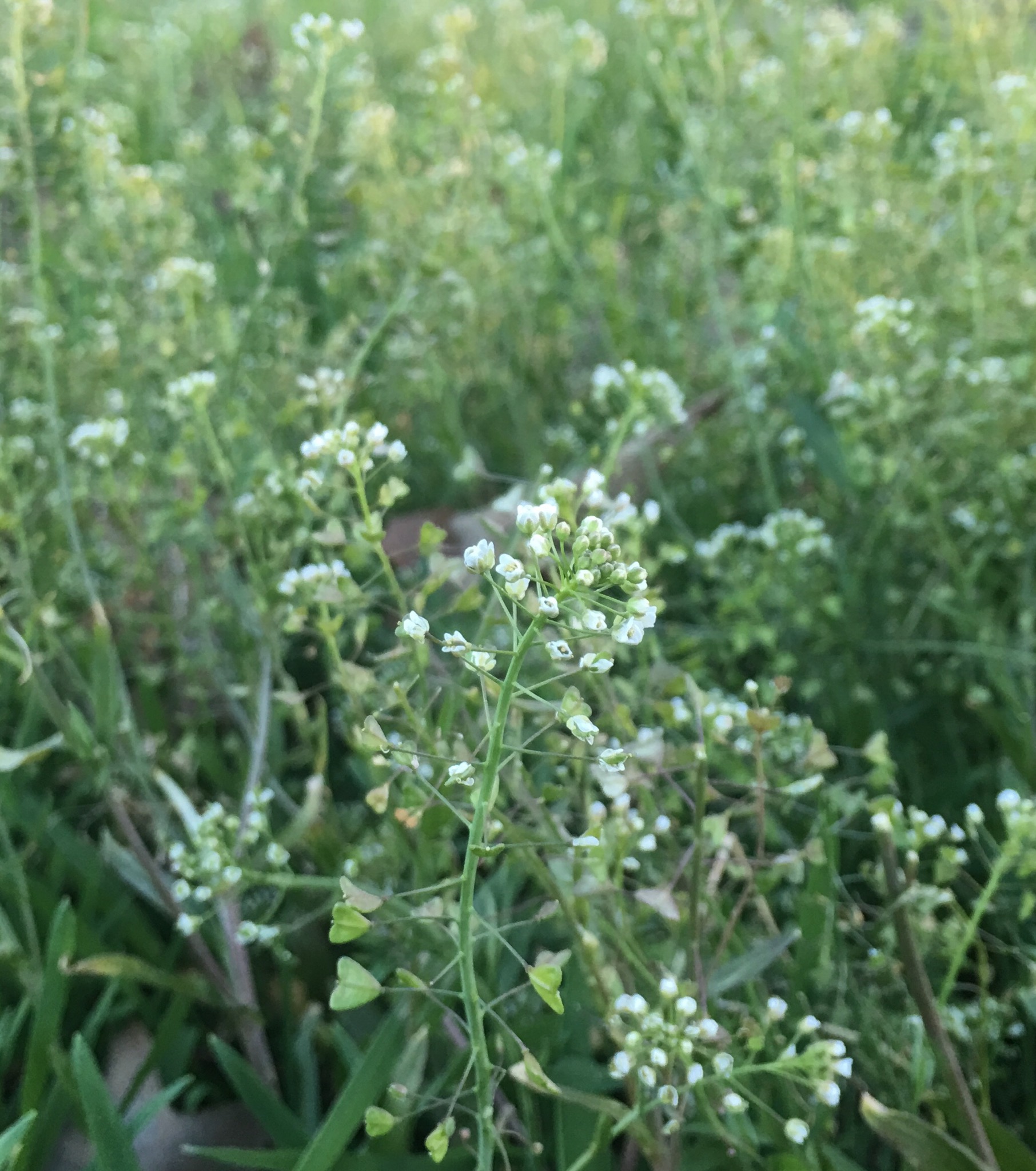
Capsella is a small genus of herbaceous annual and biennial flowering plants in the mustard family, Brassicaceae, placed within the order Brassicales. The genus is closely related to the model plant Arabidopsis as well as to Neslia and Halimolobos. Depending on the taxonomic authority, Capsella contains between three and eight species; Kew's Plants of the World Online recognizes eight species, while some authors restrict the genus to the three most widely studied: Capsella bursa-pastoris, Capsella rubella, and Capsella grandiflora.
The best-known member, Capsella bursa-pastoris (shepherd's purse), is among the most widespread weedy plants on Earth, found on every inhabited continent. It takes its common name from the distinctive triangular, heart-shaped fruits that resemble the leather pouches once carried by European shepherds.
Capsella rubella has attracted considerable scientific attention as a model for understanding the evolution of self-fertilization. It became self-compatible an estimated 50,000 to 100,000 years ago, derived from the outcrossing species C. grandiflora. The transition from cross-pollination to selfing is one of the most frequent evolutionary shifts in flowering plants, and Capsella provides a tractable system for studying its genetic and demographic consequences.
Etymology
The genus name Capsella derives from the Latin capsa, meaning a box or case, referring to the characteristic small, heart-shaped, pouch-like seed pods. The diminutive suffix -ella gives the meaning "little box" or "little purse" — an allusion also captured in the common name shepherd's purse for the most widespread species.
Distribution
Capsella bursa-pastoris, the dominant species of the genus, is one of the most widely distributed flowering plants in the world, occurring on all inhabited continents as a common weed of disturbed soils, roadsides, and cultivated fields. The genus as a whole spans temperate and Mediterranean regions of Europe and Asia, with some species extending into the Americas and Australasia; Capsella tasmanica is native to Tasmania.
Taxonomy Notes
The genus Capsella belongs to the family Brassicaceae (order Brassicales) and sits close to the model plant genus Arabidopsis within that family. Species delimitation in the genus has been contested: some authorities recognize as few as three species, while Kew's Plants of the World Online lists eight. Capsella rubella is of particular evolutionary interest as a recently derived selfing lineage whose outcrossing progenitor, C. grandiflora, is still extant, making the pair a live example of a mating-system transition.

