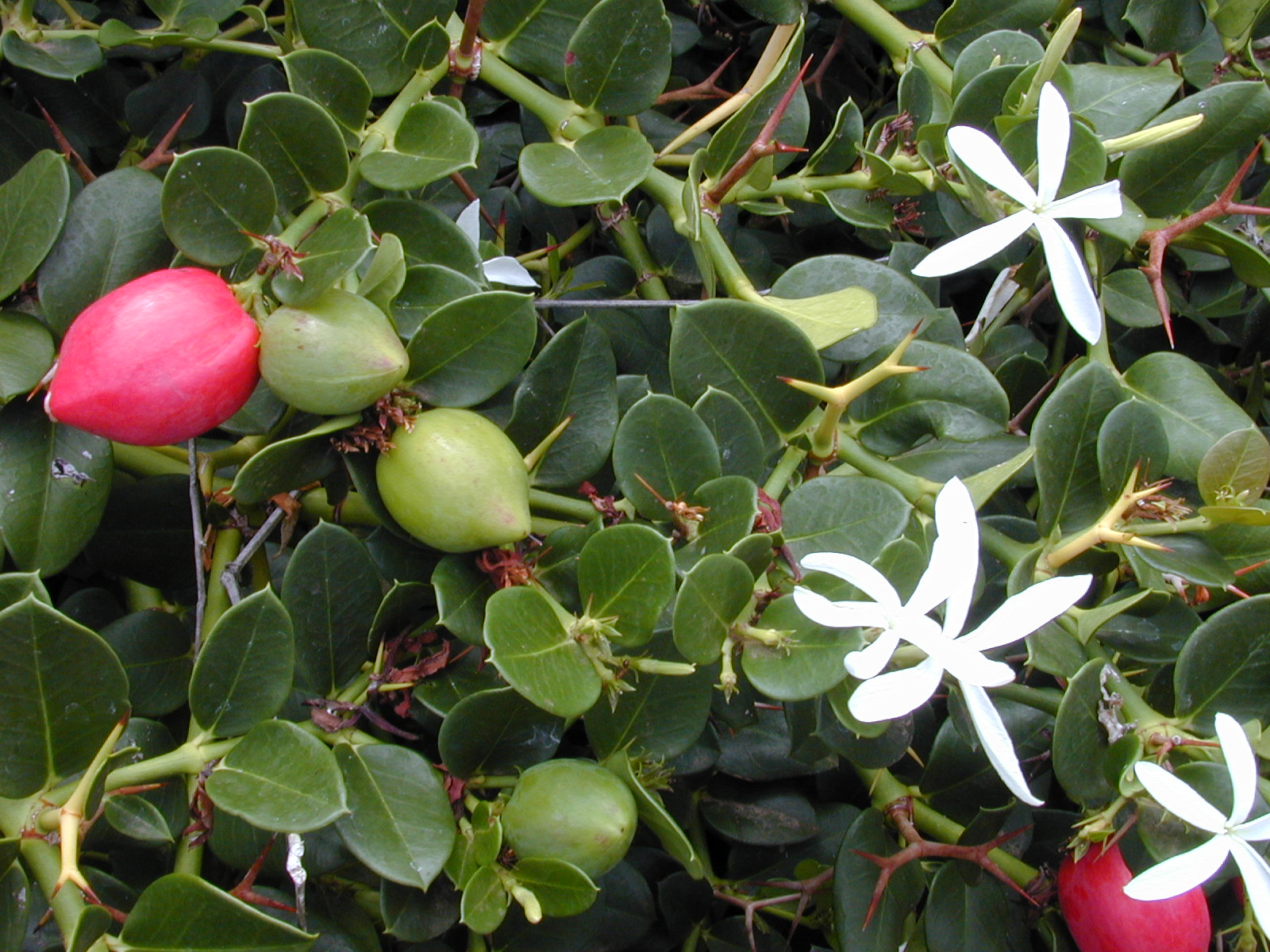
Carissa is a genus of thorny shrubs and small trees in the family Apocynaceae (order Gentianales), native to tropical and subtropical regions of Africa, Asia, and Australia. The genus once encompassed roughly 100 species, but taxonomic revision has reduced this substantially, with many names relegated to synonymy or transferred to related genera such as Acokanthera.
Plants in the genus range from compact shrubs to small trees reaching 2 to 10 metres in height. A defining feature is their stout, smooth botanical thorns — true thorns in the morphological sense, being modified branches rather than outgrowths of bark. Thorn form varies by species: simple in Carissa spinarum, dichotomously forked in Carissa bispinosa, and dichotomously branched in Carissa macrocarpa. The leaves are glossy, leathery, elliptic to ovate, 2–8 cm long, and deep green. Flowers are nearly sessile, 1–5 cm in diameter, with a five-lobed white or pink-tinged corolla, borne singly or in umbel- or corymb-like clusters; several species carry a Gardenia-like fragrance. The fruit is a plum-shaped berry, red or glossy purple-black at maturity, 1.5–6 cm long, and contains between 1 and 16 flat brown seeds.
The genus has a wide pantropical range spanning Africa, the Arabian Peninsula, the Indian subcontinent, Southeast Asia, New Guinea, Australia, and New Caledonia. Carissa carandas (karonda) is an important edible and hedging plant across South and Southeast Asia. Carissa macrocarpa (natal plum), native to southern Africa, is widely grown as an ornamental and fruiting hedge in warm-temperate and subtropical gardens worldwide.
Distribution
Carissa is native to tropical and subtropical Africa, Asia, and Australia, with individual species spanning the Arabian Peninsula, the Indian subcontinent, Indochina, New Guinea, New Caledonia, and eastern Australia. Several species — notably C. carandas and C. macrocarpa — have become naturalised far beyond their native ranges, including the West Indies, Hawaii, Florida, and parts of East Asia.
Cultivation
Several Carissa species are cultivated in tropical and subtropical gardens for their ornamental value — dense, thorny habit suited to hedging, fragrant white flowers, and edible berries. Carissa macrocarpa (natal plum) is particularly popular as a fruiting hedge in warm climates. The flowers' Gardenia-like fragrance adds to their appeal as garden plants.

