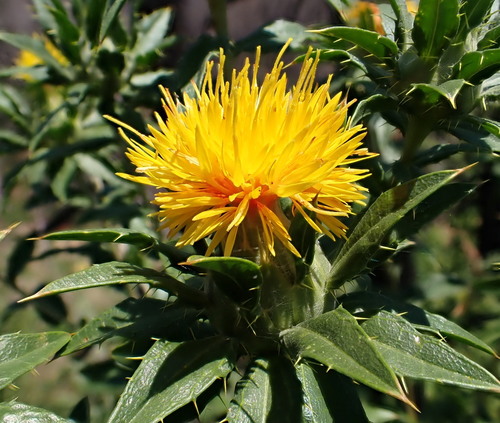
Carthamus is a genus of thistle-like flowering plants in the family Asteraceae (order Asterales), commonly known as distaff thistles. The genus comprises roughly a dozen species native to Europe, North Africa, and parts of Asia, and includes one of humanity's oldest cultivated plants — the safflower (Carthamus tinctorius).
Members of the genus are typically herbaceous annuals with a branched, erect growth habit, often resembling thistles in appearance. They produce globular composite flower heads (capitula) containing many individual florets in yellow, orange, or red — occasionally white or cream. Leaves are elongated and serrated, with the uppermost leaves forming spiny bracts around the flower heads. Plants develop a strong taproot, which allows them to thrive in dry, seasonally arid environments. Wild and cultivated forms share a diploid chromosome count of 2n = 24.
The best-known member is safflower (Carthamus tinctorius), which has been cultivated since at least 2500 BC in Mesopotamia and is documented in ancient Egyptian textiles and the tomb of Tutankhamun. Today safflower is primarily grown for its seed oil, used in cooking, cosmetics, and as a paint medium. The dried flower petals yield two natural dyes — the red pigment carthamin and a yellow pigment — which were widely used in textile dyeing before synthetic dyes became available.
Etymology
The genus name Carthamus derives from the ancient Greek word kárthamos (κάρθαμος), which appears in Linear B tablets from Mycenaean Greece, distinguishing two parts of the safflower plant: the pale seeds and the red florets. The word itself is likely of Semitic origin, entering Greek from ancient Near Eastern trade routes.
Distribution
Carthamus is native to Europe, North Africa, and parts of Asia, with its center of diversity in the Mediterranean and Middle East. Safflower (C. tinctorius) in particular originates from arid environments with seasonal rainfall and has been cultivated across a broad belt from the Middle East to South Asia and North Africa since antiquity; today it is grown commercially on every inhabited continent.
History
Safflower (Carthamus tinctorius) is among humanity's oldest crops, with possible cultivation traces in Mesopotamia dating to around 2500 BC. Chemical analysis of ancient Egyptian textiles from the Twelfth Dynasty (1991–1802 BC) identified safflower dyes, and safflower garlands were found in the tomb of Tutankhamun. The ancient Greek name kárthamos appears multiple times in Mycenaean Linear B tablets. Before aniline dyes became available in the 19th century, safflower provided widely traded red (carthamin) and yellow dyes for textiles across Europe and Asia.
Cultural Uses
Carthamus species, principally safflower, have been used since antiquity as sources of dye, food, and medicine. The petals yield the red pigment carthamin (C.I. Natural Red 26) and a yellow dye, historically used on cotton and silk without a mordant. The dried petals are used as a cheaper substitute for saffron in cooking and as an herbal tea. Safflower oil — extracted from the seeds — is used as a cooking oil, in salad dressings, margarine, and cosmetics, and as a non-yellowing alternative to linseed oil in oil painting. In Philippine cuisine the dried petals are known as kasubha and used as a saffron substitute.
Cultivation
Safflower (Carthamus tinctorius), the principal cultivated species, prefers warm temperatures (optimally 28–35°C), well-drained neutral-to-slightly-alkaline soils (pH 5–8), and tolerates drought due to its deep taproot. It is grown as a winter crop in South-Central India, an early-summer crop in California, and a mid-summer crop in the Northern Great Plains of the United States. The growing season ranges from 120 to 200 days depending on cultivar. Plants are typically direct-seeded in spring once soil temperature exceeds 4.5°C. Safflower is susceptible to fungal diseases (Botrytis cinerea, Alternaria spp.) under humid conditions and requires crop rotation of at least four years to reduce disease pressure.

