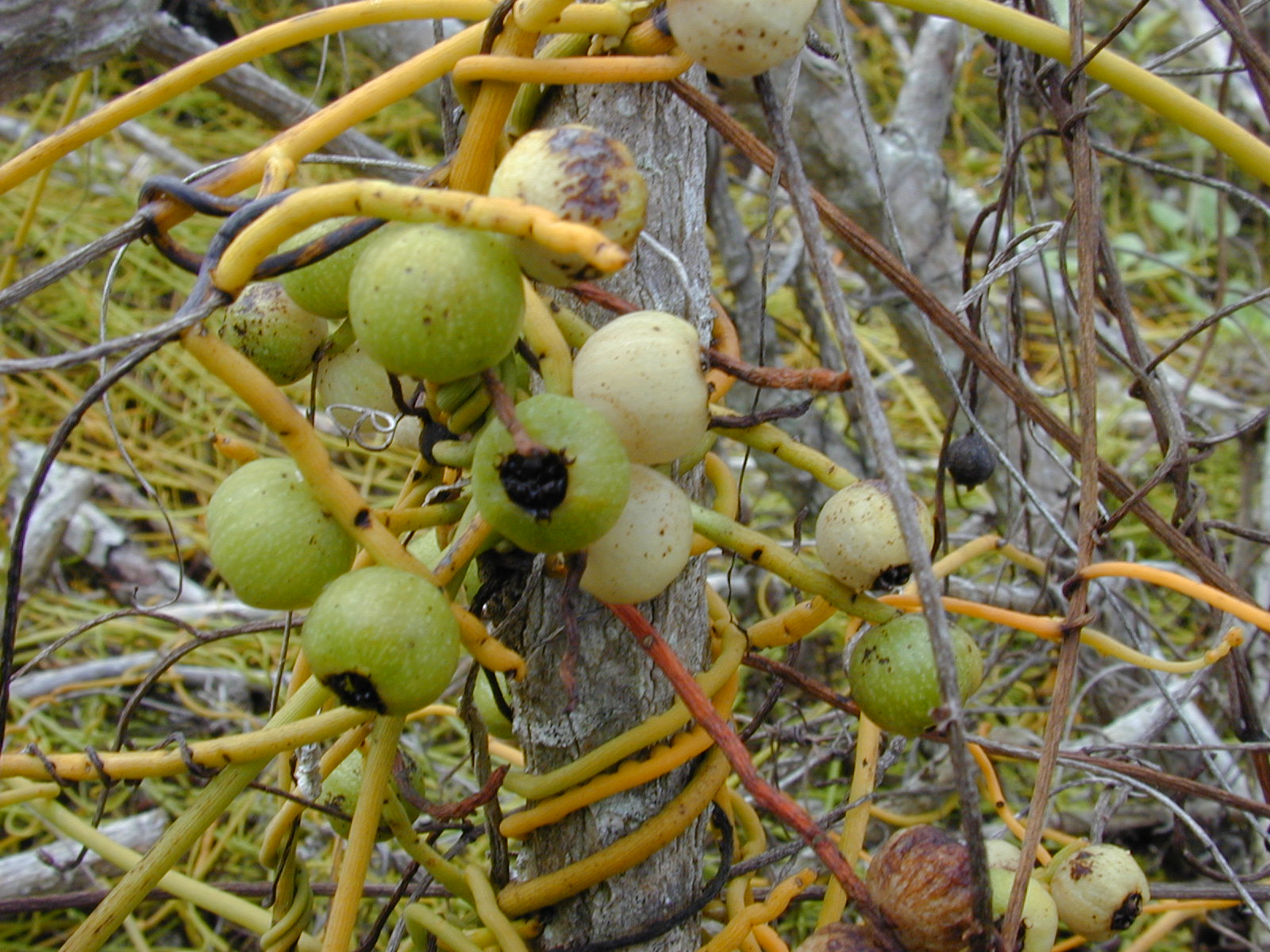
Cassytha is a genus of approximately 23 species of obligately parasitic vines belonging to the family Lauraceae (order Laurales). Although firmly placed within Lauraceae on the basis of both morphological and molecular evidence, Cassytha is the only parasitic genus in that family and stands in stark contrast to its relatives, which are overwhelmingly woody shrubs and trees. Its thread-like, twining stems and general appearance so closely resemble the unrelated dodder genus Cuscuta (family Convolvulaceae) that the two genera are considered a classic example of convergent evolution.
Plants bear minute, scale-like leaves and small hermaphroditic flowers arranged in racemes, spikes, or heads. The fruit is a tiny drupe: the receptacle gradually envelops the ovary to form a fleshy covering, while the bony endocarp protects the single seed. This hard endocarp is ecologically significant — it allows seeds to pass unharmed through the guts of birds and mammals, and then persist in the soil for years before germination, forming long-lived seed banks.
Cassytha establishes itself by means of haustoria that penetrate the stems of host plants. Young shoots are green, but once the haustoria are well-established, plants typically lose most of their chlorophyll and become yellowish or orange. The genus is considered obligately parasitic: when all hosts die, the parasite dies too. A few species can photosynthesize marginally during seasonal host dormancy, making them technically hemiparasitic, but autotrophic contribution is minor.
The genus was formally described by Carl Linnaeus in 1753 in Species Plantarum, with Cassytha filiformis as the type species. Most species are native to Australia, which is also the only region where Lauraceae has native representatives in temperate climates. Several additional species occur in Africa, southern Asia, Pacific islands, and the Americas. Cassytha filiformis has the widest range and is now effectively pantropical, spreading via fruit-eating birds and inadvertent human introduction.
Etymology
The genus name Cassytha is derived from the Greek name for Cuscuta, the dodder genus that Cassytha closely resembles in appearance and parasitic habit. The authorship of the name belongs to Carl Linnaeus, who provided the description in 1753, although it is sometimes also attributed to Pehr Osbeck.
Distribution
Cassytha has a wide distribution for a small genus. The majority of species are native to Australia, including its temperate regions, where they are the only native members of Lauraceae. A smaller number of species occur in southern Africa, southern Asia, the Ryukyu Islands, Pacific islands, and parts of the Americas. Cassytha filiformis, the most widespread species, is now pantropical, occurring across Hawaii, Australasia, tropical Africa, the Caribbean, Central America, southern Florida, and many oceanic islands — spread in part by fruit-eating birds and human activity.
Ecology
Cassytha species are obligate stem parasites that attach to host plants via haustoria, drawing water and nutrients directly from host tissue. They show little host specificity and can overwhelm a wide range of woody and herbaceous species, sometimes killing the host. Seeds are dispersed by birds and mammals that consume the fleshy fruit; the bony endocarp protects seeds during gut passage and delays germination, enabling seed banks that can persist for years. Seedlings must locate a host within months or they die. Some species act as vectors for fungal, bacterial, and viral pathogens, transmitting disease between host plants. Despite their vigour as parasites, they are generally less aggressive agricultural pests than the true dodders (Cuscuta), which grow faster and produce more seed.
Cultural Uses
Several Cassytha species have minor but documented uses in rural communities. The fleshy fruit of various species is edible; C. melantha in particular is recorded as a wild-harvested food of Aboriginal Australians, with a flavour compared to feijoa. In the Caribbean, C. filiformis is called "love vine" and is traditionally used as an aphrodisiac. The stems of some species are used as cord for binding thatch or making decorative garlands. Species within the genus contain alkaloids and fragrant essential oils that have been applied in folk medicine and traditional teas across its range, though no alkaloid has yet been shown to have significant pharmacological value.
Taxonomy Notes
Cassytha was described by Linnaeus in 1753 and placed in Lauraceae, but its herbaceous, parasitic habit is so anomalous for the family that early classification systems created a separate subfamily, Cassythoideae, for it. More recent molecular analyses using the trnK intron have resolved Cassytha as nested within Lauraceae, closely related to Caryodaphnopsis and sister to the tribe Cryptocaryeae within Lauroideae. Embryological evidence from anther tapetum development corroborates this placement. The exact position within the family is still debated, but non-basal placement within Lauraceae is considered certain. A homonymous genus name, Cassytha Mill. (1768), was mistakenly applied to what is now Rhipsalis (Cactaceae); this is a separate nomenclatural issue and does not affect the validity of Cassytha L.










