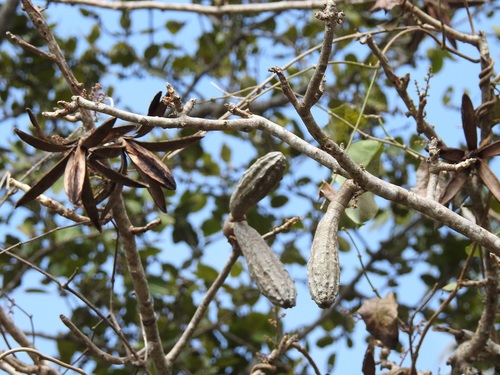
Cedrela is a genus of flowering trees in the mahogany family Meliaceae, placed within the order Sapindales. The genus comprises roughly 16 accepted species of evergreen or dry-season deciduous trees native to the tropical and subtropical New World, ranging from southern Mexico and the Caribbean south to northern Argentina. Trees in this genus bear large, pinnately compound leaves and produce lightweight, fragrant timber that is naturally resistant to wood-boring insects such as termites and to rot.
The most economically significant member, Cedrela odorata, is widely distributed through seasonally dry tropical forests and is deciduous during extended dry seasons. Its wood is commonly marketed as "Spanish cedar" — a misnomer, as the genus belongs to the mahogany family rather than true cedars (Cupressaceae) and has no Spanish geographic origin. The timber has been prized for centuries for crafting cigar boxes, classical guitar necks and linings, indoor paneling, veneer, and general construction. Other species, including C. angustifolia and C. montana, occupy higher-altitude, moister habitats and tend toward evergreen or briefly deciduous growth.
Due to overexploitation of its valuable timber, Cedrela odorata was listed under CITES Appendix III decades ago. In October 2022, all Neotropical Cedrela species were elevated to CITES Appendix II, requiring international trade permits and documentation. Several species have also been naturalized beyond their native range in parts of Africa, Southeast Asia, and Hawaii as ornamental and plantation trees.
Distribution
Cedrela species are native to the tropical and subtropical New World, spanning southern Mexico, the Caribbean, and Central America south to northern Argentina. Cedrela odorata, the most widespread species, thrives in seasonally dry tropical forests; C. angustifolia and C. montana occupy higher-altitude, moister Andean zones.
Ecology
Cedrela odorata is adapted to seasonally dry tropical and subtropical forests, shedding its leaves during dry seasons that may last several months. Higher-altitude species such as C. angustifolia and C. montana grow in moister montane conditions and are evergreen or only briefly deciduous.
Conservation
On 28 October 2022, all Neotropical Cedrela species were added to CITES Appendix II, requiring international trade controls. Cedrela odorata had previously been subject to CITES Appendix III protections due to timber over-harvesting pressure.
Cultural Uses
The timber of Cedrela odorata, sold as "Spanish cedar," is the traditional wood for cigar boxes and has long been used for classical guitar necks and interior linings, outdoor construction, paneling, and veneer. The fragrance and insect resistance of the wood made it especially valued for storage and instrument making. Other Cedrela species yield similar timber but are less exploited due to their relative scarcity.










