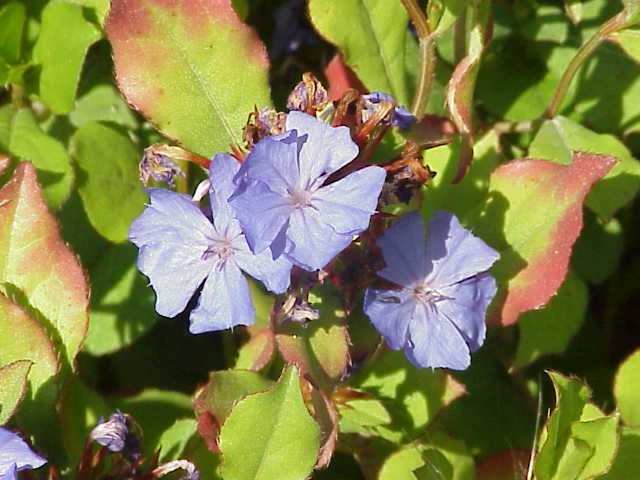
Ceratostigma is a genus of approximately eight species of flowering plants in the family Plumbaginaceae, order Caryophyllales, native to warm temperate and tropical regions of Africa and Asia. The genus is commonly known as "leadwort" or "plumbago," names it shares with the closely related genus Plumbago.
Plants in this genus are herbaceous perennials, subshrubs, or small shrubs, typically growing between 0.3 and 1 metre tall. The leaves are spirally arranged, simple, 1–9 cm in length, and usually feature a hairy margin. Depending on the species, plants may be evergreen or deciduous. The flowers are borne in compact inflorescences, each with a five-lobed corolla ranging in colour from pale to deep blue or red-purple. The fruit is a small, bristly capsule containing a single seed.
Several species are well regarded as ornamental garden plants, prized for their vivid late-summer flowers and often striking autumn leaf colour. Ceratostigma plumbaginoides and Ceratostigma willmottianum (including the cultivar 'Forest Blue') have received the Royal Horticultural Society's Award of Garden Merit. Ceratostigma griffithii, native to the Himalayas, is another widely grown ornamental species.
Etymology
The genus name Ceratostigma derives from Greek, combining keras (horn) and stigma (stigma), referring to the horn-like projections on the stigma of the flower. The common names "leadwort" and "plumbago" are shared with the related genus Plumbago and allude to the use of some plumbaginaceous plants in early lead-poisoning remedies.
Distribution
Ceratostigma is native to warm temperate and tropical regions of Africa and Asia, with species distributed from the Horn of Africa eastward through the Himalayas, China, and Southeast Asia. Ceratostigma abyssinicum occurs in northeastern Africa, while Himalayan and Chinese species such as C. griffithii and C. willmottianum represent the Asian centre of diversity.
Cultivation
Plants of this genus are widely cultivated as ornamental garden plants, valued primarily for their late-summer and autumn flowering when most other shrubs have finished blooming. Ceratostigma plumbaginoides is a spreading groundcover that colours well in autumn, while Ceratostigma willmottianum forms a larger shrub suitable as a border specimen. Both hold the Royal Horticultural Society's Award of Garden Merit (confirmed 2017). Most species prefer well-drained soil and a sunny to partially shaded position, and perform best in sheltered spots in cooler climates.










