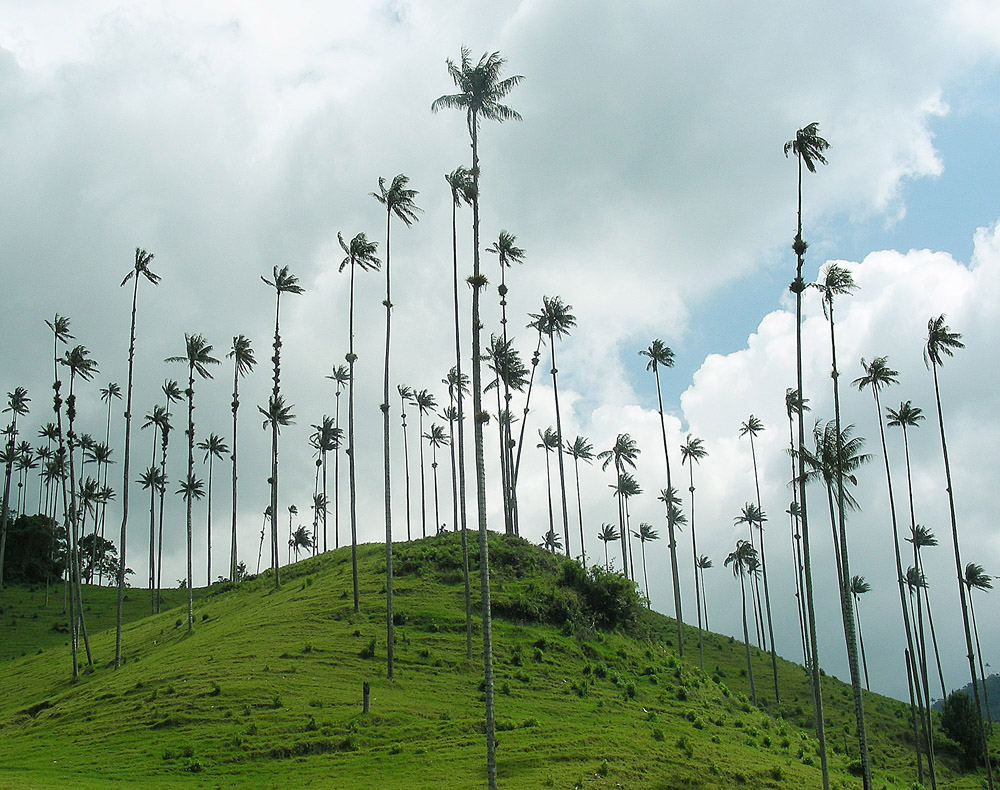
Ceroxylon, commonly known as Andean wax palms, is a genus of approximately 10–12 species of flowering plants in the palm family Arecaceae, order Arecales. The genus is native to the Andes mountain range of South America, distributed across Venezuela, Colombia, Ecuador, Peru, and Bolivia, making it the only palm genus adapted to high-altitude Andean environments.
These palms are among the most remarkable in the world. The tallest species, Ceroxylon quindiuense (the Quindío wax palm), reaches up to 61 m (200 ft) in height, making it both the world's tallest palm and the tallest monocotyledon on Earth. Members of the genus also hold the altitude record for the palm family, with some species growing above 3,000 m (10,000 ft) elevation in Andean cloud forests.
Ceroxylon palms are recognizable by their distinctive appearance: a single, smooth, often whitish cylindrical trunk covered in a waxy coating and ringed by prominent leafbase scars. The leaves are pinnate (feather-shaped). All species are dioecious, meaning each individual plant bears flowers of only one sex. Fruits are small and round — up to about 2.5 cm in diameter — and turn red or orange when ripe.
The genus is most closely related to Oraniopsis, a palm genus confined to northern Australia. Their shared ancestor is thought to have dispersed across the Antarctic land bridge during the Late Eocene epoch.
Several Ceroxylon species play critical ecological roles in their native Andean cloud forests. Ceroxylon quindiuense and C. alpinum are the primary nesting and foraging habitat for the yellow-eared parrot (Ognorhynchus icterotis), a Colombian parrot that was once nearly extinct and remains highly endangered. Many Ceroxylon species face ongoing threats from habitat destruction and over-harvesting.
Etymology
The name Ceroxylon is derived from two Ancient Greek words: κηρός (kērós, meaning "wax") and ξύλον (xúlon, meaning "wood"), a reference to the thick waxy coating that covers the trunks of these Andean palms.
Distribution
Ceroxylon is native to the Andes of South America, occurring in Venezuela, Colombia, Ecuador, Peru, and Bolivia. The species are almost exclusively montane, growing in Andean cloud forests, and include the highest-altitude palms in the family Arecaceae, with some found above 3,000 m (10,000 ft) in elevation.
Ecology
Ceroxylon quindiuense and C. alpinum are critical habitat trees for the yellow-eared parrot (Ognorhynchus icterotis), providing nesting cavities and food in the Andean cloud forests of Colombia. The loss of these palms through deforestation has been a primary driver of the parrot's near-extinction.
Conservation
Many Ceroxylon species are endangered as a result of habitat destruction in the Andes. The felling of palms for timber in Colombia and the widespread clearing of Andean cloud forest have significantly reduced populations. The conservation status of individual species varies, but the genus as a whole is considered vulnerable to continuing land-use change.
Cultural Uses
In Colombia, Ceroxylon palms have traditionally been harvested for their timber. The leaves of wax palms are also used in Palm Sunday religious ceremonies in Andean communities, a practice that has historically placed additional pressure on wild populations.
Cultivation
Several species — including C. quindiuense, C. alpinum, C. vogelianum, and C. parvifrons — are grown as ornamental trees outside their native range. They thrive in cool, humid, mild climates with minimal frosts, such as coastal California, Hawaii, New Zealand, South Africa, and coastal Western Europe.
Taxonomy Notes
Within the subfamily Ceroxyloideae of Arecaceae, Ceroxylon is most closely related to Oraniopsis, a monotypic genus restricted to Queensland, Australia. Molecular and biogeographic evidence suggests their common ancestor dispersed across the Antarctic land bridge during the Late Eocene, linking the South American and Australian components of this otherwise small subfamily.










