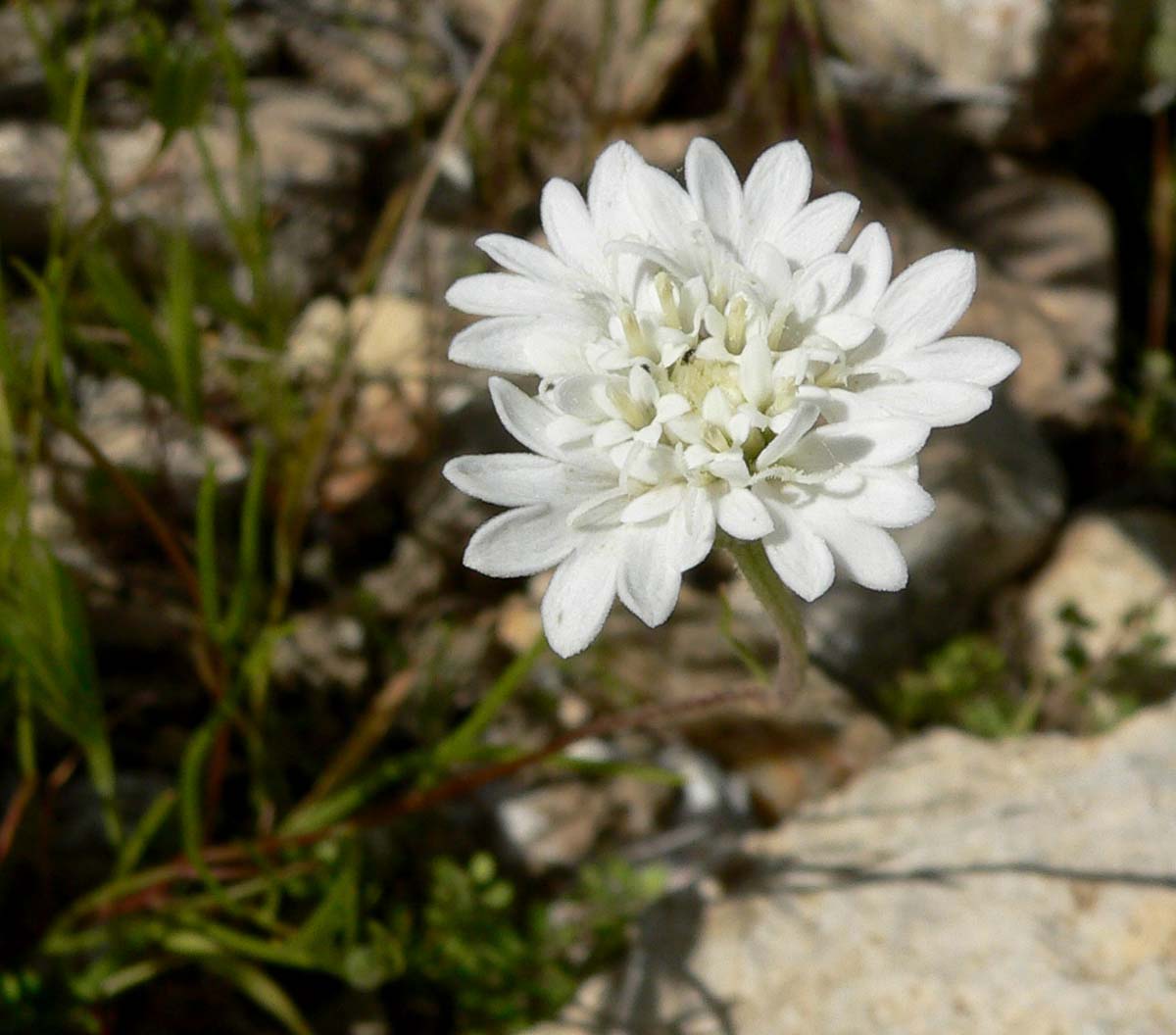
Chaenactis is a genus of flowering plants in the family Asteraceae, commonly known as pincushions and dustymaidens. Native to western North America, these wildflowers are especially characteristic of the desert southwest of the United States, though individual species extend across a broad arc from Baja California and Sonora in Mexico northward through California, Nevada, Arizona, Utah, New Mexico, Colorado, Wyoming, Idaho, Oregon, Washington, Montana, the Dakotas, and Nebraska, reaching into British Columbia and Alberta in Canada.
The genus was formally described by Augustin Pyramus de Candolle (DC.) and published in his Prodromus in 1836. It belongs to the tribe Chaenactideae within the family Asteraceae and is placed in the order Asterales. Approximately 24 accepted species are recognized by GBIF, and the genus has historically been treated under the synonyms Acicarphaea, Macrocarphus, and Acarphaea.
Plants in the genus are quite variable in appearance. They produce aster-like flower heads composed primarily of numerous disc florets. In some species, the outermost florets of the head are noticeably enlarged, giving a ray-like appearance even though the plants technically lack true ray florets. Flower colors range from white to yellow or pink depending on species. The vernacular name "pincushion" refers to the rounded, densely bristled appearance of the flowerheads.
Chaenactis douglasii, commonly called Douglas' dustymaiden, has the widest range of any species in the genus, occurring across much of the intermountain west. Chaenactis fremontii, Fremont's pincushion, is one of the most recognizable species of the desert southwest. Chaenactis glabriuscula was described by de Candolle himself and is a common annual of California's dry foothills and deserts.
Etymology
The genus name Chaenactis is derived from Greek: "chaeno" (to gape or open) and "aktis" (ray), a reference to the enlarged, gaping outer florets visible in many species. The common names "pincushion" and "dustymaiden" are both in widespread use across the genus range; "pincushion" refers to the bristly, rounded flowerheads, while "dustymaiden" describes the often gray-green, mealy foliage texture characteristic of several species.
Distribution
Chaenactis is native to western North America. The genus is most diverse and abundant in the desert southwest of the United States, with species recorded across California, Nevada, Arizona, Utah, New Mexico, Colorado, Wyoming, Idaho, Oregon, Washington, Montana, North Dakota, South Dakota, and Nebraska. The range extends into Canada (British Columbia and Alberta) and into northwestern Mexico (Baja California and Sonora). Chaenactis douglasii has the widest individual range within the genus, spanning much of the intermountain and Great Basin west. Several species, including C. fremontii and C. stevioides, are characteristic of the Mojave and Sonoran deserts. The high-elevation species C. alpigena (Southern Sierra pincushion) occupies alpine and subalpine habitats in the Sierra Nevada.
Taxonomy
Chaenactis was described by Augustin Pyramus de Candolle and published in the fifth volume of his Prodromus in 1836 (Prodr. 5: 659). The genus is placed in the tribe Chaenactideae of the family Asteraceae, order Asterales, class Magnoliopsida, phylum Tracheophyta. Three names have been treated as synonyms: Acicarphaea, Macrocarphus, and Acarphaea. GBIF (usageKey 3114807) records the genus as accepted and recognizes approximately 39 infrageneric taxa including synonyms and varieties, with around 24 as currently accepted species. Notable species authorities within the genus include Asa Gray (A.Gray), Hooker and Arnott (Hook. & Arn.), and de Candolle himself. A recently described species, Chaenactis kyhosii B.G.Baldwin, indicates the genus remains under active taxonomic study.










