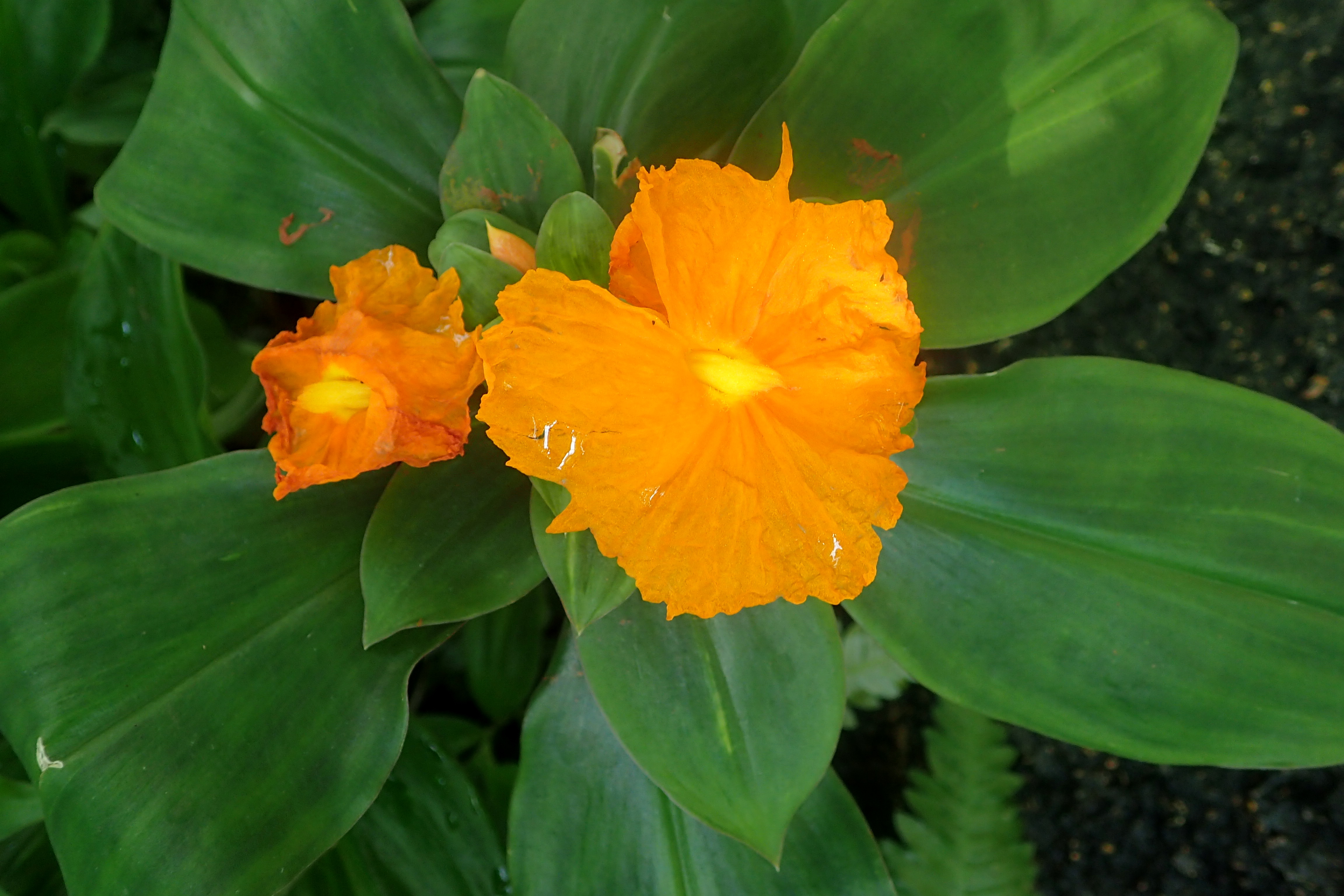
Chamaecostus is a small genus of tropical herbaceous plants in the family Costaceae — the spiral gingers — formally described as a genus in 2006. It is endemic to South America, with species distributed across Brazil, Colombia, Venezuela, Guyana, Suriname, French Guiana, and Bolivia.
Costaceae belongs to the order Zingiberales, which also includes bananas (Musaceae), bird-of-paradise flowers (Strelitziaceae), and edible ginger (Zingiberaceae). The family is distinguished from its relatives by the absence of aromatic oils and by possessing five fused staminodes that form a conspicuous, petaloid labellum — a structure that often serves to attract pollinators. The roughly 143 species across the seven genera of Costaceae are pantropical, and Chamaecostus accounts for approximately eight of them.
Plants in the genus are low-growing perennials arising from fleshy rhizomes with tuberous roots. The simple, entire leaves are spirally arranged around the stem — a hallmark of the family — with leaf bases forming a closed sheath bearing a small ligule. Flowers are borne in a terminal spike or cone-like head, each bloom subtended by a bract; the fruit is a berry or capsule. The best-known member, Chamaecostus cuspidatus (fiery costus or spiral flag), bears large, smooth, dark green leaves with light purple undersides and produces vivid orange flowers about 3.8 cm across during the warm months. Plants typically reach about 60 cm in height and form attractive arching clumps.
Several species are cultivated as ornamentals in tropical and subtropical gardens. Chamaecostus cuspidatus is also grown in India for its purported anti-diabetic properties and for use in Ayurvedic and Siddha traditional medicine.
Distribution
Chamaecostus is endemic to tropical South America. Its species range across Brazil (including the states of Bahia, Espírito Santo, and Pará), Colombia, Venezuela, Guyana, Suriname, French Guiana, and Bolivia.
Taxonomy Notes
Chamaecostus was segregated from the broader genus Costus and formally described as a separate genus in 2006. It is placed in the family Costaceae (order Zingiberales) and contains approximately 6–8 species. GBIF currently recognizes 4 accepted species-level descendants under this genus key.
Cultural Uses
Chamaecostus cuspidatus is known in India as the "insulin plant" and is used in Ayurvedic medicine, where dried leaves are prepared as a treatment for diabetes. In Siddha medicine it is called kostum and cultivated in Kashmir and the Himalayan foothills for its medicinal root.










