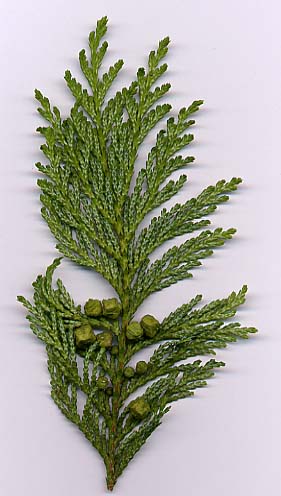
Chamaecyparis, commonly called false cypress or simply cypress, is a genus of evergreen conifers in the family Cupressaceae (order Pinales). The genus comprises around six living species native to two disjunct regions: eastern Asia (Japan and Taiwan) and the western and eastern margins of North America. Trees are medium to large in stature, typically reaching 20–70 metres tall, with aromatic, scented wood and foliage arranged in distinctive flat, horizontal sprays.
Leaves are dimorphic: needle-like juvenile leaves occur on young seedlings up to about a year old, while mature trees bear small scale-like adult leaves pressed closely against the branchlets. The seed cones are small and globose to slightly oval, composed of 8–14 scales arranged in opposite decussate pairs, each scale bearing two to four small winged seeds.
Taxonomically, the genus has undergone revision. The formerly included Nootka cypress (Chamaecyparis nootkatensis) was transferred on the basis of genetic and morphological evidence first to Xanthocyparis and subsequently to the monotypic genus Callitropsis. The related genus Fokienia is not always recognised as distinct; if synonymised, Fokienia hodginsii is treated as Chamaecyparis hodginsii. Several extinct species are also known from the fossil record, extending back to the Eocene of Arctic Canada.
Four species — C. lawsoniana (Lawson cypress), C. obtusa (Hinoki cypress), C. pisifera (Sawara cypress), and C. thyoides (Atlantic white cedar) — are widely cultivated as ornamental trees, with several hundred named cultivars selected for dwarf habit, coloured or variegated foliage, and thread-like shoots. In some areas cultivation is constrained by susceptibility to Phytophthora root rot, particularly P. lateralis in C. lawsoniana. The timber is prized in Japan, where it has been used for centuries in the construction of shrines and temples.
Etymology
The genus name Chamaecyparis is derived from two Greek words: khamai (χαμαί), meaning "on the earth" or "dwarf", and kuparissos (κυπάρισσος), meaning "cypress". The name alludes to the low or ground-hugging character sometimes attributed to smaller forms, or more broadly distinguishes this group from the true cypresses (Cupressus).
Distribution
Chamaecyparis has a disjunct native range spanning eastern Asia and North America. Asian species occur in Japan (C. obtusa, C. pisifera) and Taiwan (C. formosensis, C. taiwanensis). North American species are found on opposite coasts: C. lawsoniana along the Pacific Coast ranges of California, Oregon, and Washington, and C. thyoides (Atlantic white cedar) from Mississippi north to Maine along the eastern seaboard.
Ecology
Chamaecyparis species typically grow in moist, humid montane or coastal environments. Larvae of several Lepidoptera, including the juniper pug moth and pine beauty moth, use Chamaecyparis species as food plants. In cultivation, C. lawsoniana is notably susceptible to Phytophthora lateralis, a water mould root rot that has devastated natural stands and limits cultivation in some regions.
Cultivation
Four species are of major horticultural importance: C. lawsoniana, C. obtusa, C. pisifera, and C. thyoides. Collectively they have given rise to several hundred cultivars selected for traits including dwarf or compact growth, permanent juvenile (needle-like) foliage, and blue, yellow, silvery, or variegated leaf colour. Thread-like pendulous branchlet forms are also widely grown. C. lawsoniana cultivars in particular dominate the conifer trade in temperate horticulture. Disease pressure from Phytophthora root rots can limit outdoor planting in wetter climates.
Cultural Uses
The aromatic, durable wood of Chamaecyparis species has been prized for centuries. In Japan, the timber of C. obtusa (Hinoki cypress) is among the most esteemed building materials, used historically and today for Shinto shrines, Buddhist temples, and high-quality interiors. C. lawsoniana timber was historically important in North America for boat-building and cabinetry. The scented foliage and wood are also used in traditional crafts and incense.
Taxonomy Notes
Chamaecyparis belongs to the subfamily Cupressoideae within Cupressaceae. The genus has historically had fluid boundaries: Chamaecyparis nootkatensis (Nootka cypress) was removed to Xanthocyparis and later Callitropsis after molecular and morphological evidence showed it is more closely related to Hesperocyparis than to the core Chamaecyparis clade. Fokienia is sometimes merged into Chamaecyparis (making Fokienia hodginsii = Chamaecyparis hodginsii), though it is more commonly maintained as a separate genus. Fossil species are known from Eocene and Oligocene deposits of North America. GBIF currently recognises 4 accepted taxa within the genus.










