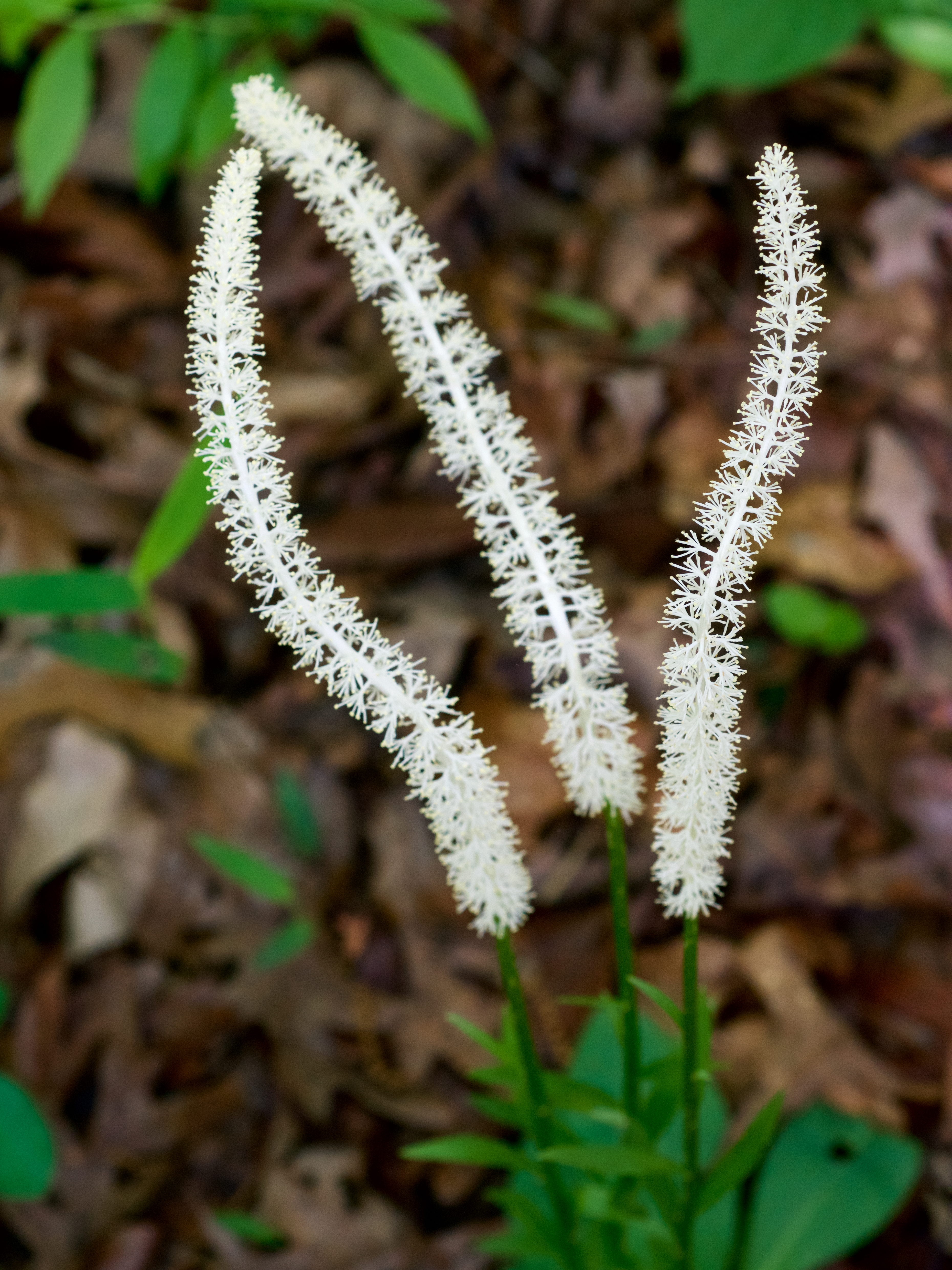
Chamaelirium is a small genus of perennial herbs in the family Melanthiaceae (order Liliales). Historically treated as monotypic, it was long considered to contain only Chamaelirium luteum (blazing-star, devil's bit, false unicorn, or fairy wand), native to eastern North America. Recent taxonomic revisions (2017–2018) have expanded the genus to include two Asian species: C. actinomorphum and C. viridiflorum.
Plants produce a basal rosette of spoon-shaped leaves 8–15 cm long. A single unbranched flowering stalk rises from the rosette, bearing a spike-like raceme of small flowers. The genus is dioecious — individual plants are either male or female — and populations are typically male-biased. Female plants are larger, with stalks reaching up to 1.2 m, but produce far fewer flowers than males. The type species, C. luteum, grows in wet meadows and deciduous woodlands east of the Mississippi River, with a historical presence in southern Ontario. Rhizomes of C. luteum have a long history of medicinal use, particularly as a uterine tonic and fertility aid, and contain steroidal saponins including chamaelirin and diosgenin. Wild collection pressure has placed the species at risk, and cultivation methods are still being developed.
Etymology
The genus name comes from Greek chamai ("on the ground") + leirion ("lily"), referring to the low-growing, lily-like habit. The specific epithet of the type species, luteum, is Latin for "yellow," describing the flower color of male plants.
Distribution
The genus has a disjunct distribution. The type species Chamaelirium luteum is native to temperate eastern North America, ranging east of the Mississippi River and historically into southern Ontario, Canada. The more recently added species C. actinomorphum and C. viridiflorum are native to East Asia.
Ecology
Chamaelirium luteum grows in wet meadows and deciduous woodlands. The species is dioecious, with male-biased sex ratios in natural populations — attributed to higher mortality in female plants and less frequent flowering in females. It is considered rare at the fringes of its range.
Cultivation
Chamaelirium luteum is at risk of extinction due to wild collection, and cultivation techniques are still being developed to meet market demand. It requires moist, well-drained, acidic soil (pH 4.5–6) with high humus content. Plants need shade — either from a shade structure in open fields or under tall hardwoods in forest cultivation. Propagation is by seed (sown in late fall or early winter, requiring cold stratification) or by root division (rhizomes cut into 6.4 mm discs, callused overnight, then potted). Young plants need moist, shaded conditions and should be left undisturbed for at least one growing season. Protect from slugs, snails, and deer.
Conservation
Chamaelirium luteum is at risk of extinction due to ongoing wild collection for the herbal medicine market. Cultivation techniques remain under development and are not yet sufficient to displace wild harvesting.
Cultural Uses
Chamaelirium luteum has been used medicinally by Indigenous peoples of eastern North America, traditionally as a remedy to prevent miscarriage and enhance fertility. In modern herbal medicine it is used for menstrual disorders, pregnancy complaints, fertility issues, and ovarian cysts, and as a diuretic. The rhizomes, harvested after six years of growth, contain steroidal saponins (chamaelirin and diosgenin) that act as an emmenagogue, diuretic, and emetic. It is also grown as an ornamental.
Taxonomy Notes
Chamaelirium was historically considered a monotypic genus containing only the eastern North American C. luteum. However, taxonomic work published in 2017 and 2018 transferred two East Asian species into the genus: C. actinomorphum (formerly placed elsewhere, reclassified by N.Tanaka & Aver., Taiwania 62: 161, 2017) and C. viridiflorum (newly described by Lei Wang, Z.C.Liu & W.B.Liao, Phytotaxa 357: 127, 2018). This expands the genus from one to three accepted species with a disjunct eastern North America–East Asia distribution.
Propagation
Propagation is by seed or root division. Seeds require cold stratification and are best sown in late fall or early winter in high-humus breeding beds. Root division involves cutting rhizomes into 6.4 mm (¼ inch) discs, allowing them to callus overnight, then planting in pots with moist, shaded conditions until emergence. Young plants from either method should be left undisturbed for at least one growing season before transplanting.










