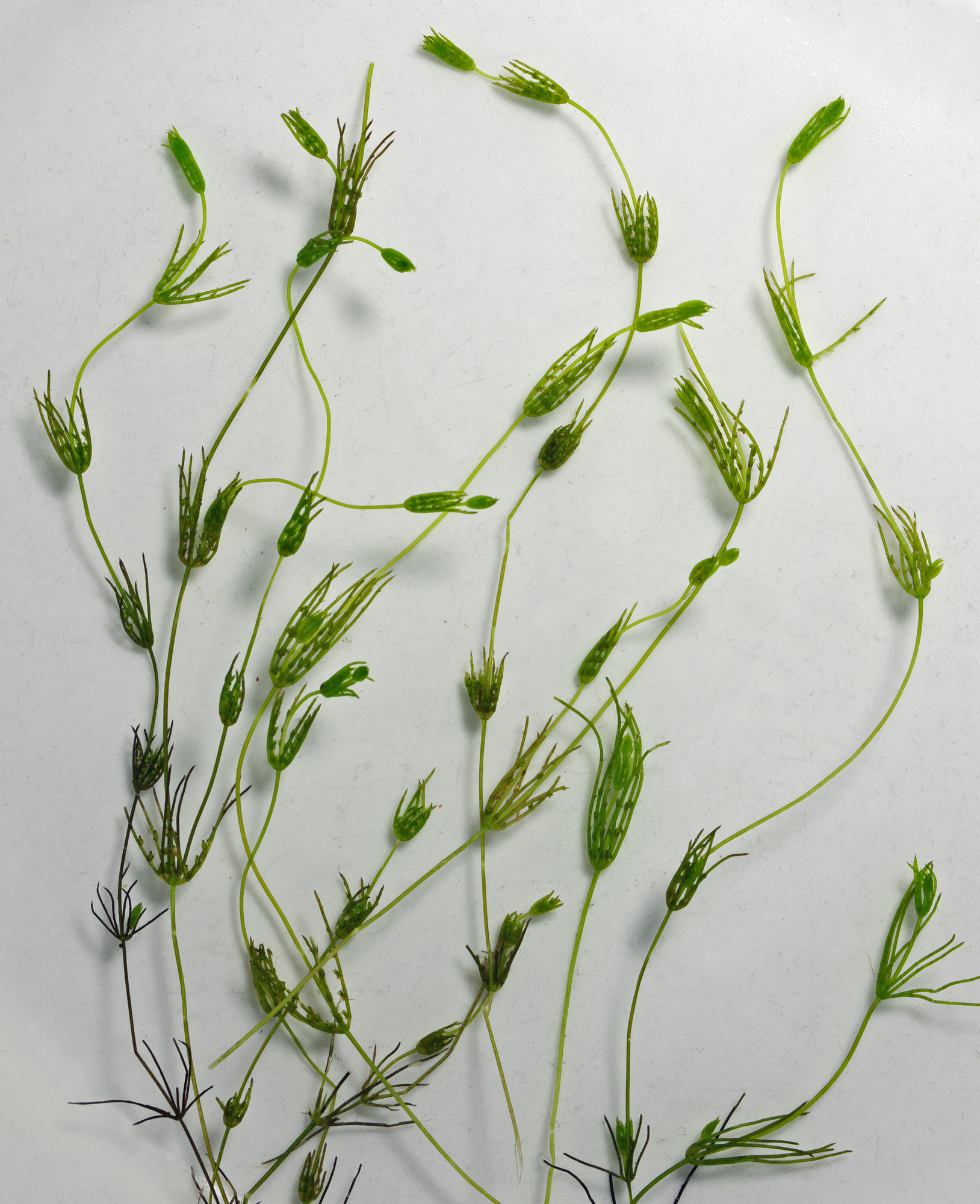
Chara is a genus of charophyte green algae belonging to the family Characeae, order Charales, within the division Charophyta. Despite being algae, Chara species are remarkably plant-like in appearance, possessing differentiated stem-like axes and whorled, leaf-like branchlets arranged at nodes — a convergent morphology that once led botanists to classify them among plants. Because their surfaces become encrusted with calcium carbonate (CaCO3) deposits, they are widely known as stoneworts.
The plant body is a gametophyte consisting of a main axis divided into nodes and internodes. From the nodes arise dimorphic branches: long branches of unlimited growth and shorter lateral branches of limited growth. The plant anchors itself to substrate via multicellular rhizoids with oblique septa, and bears needle-shaped stipulodes at the base of the secondary laterals. Cyanobacteria commonly colonize the outer surfaces of Chara as epiphytes, where they are thought to fix atmospheric nitrogen — a service of significance to the nutrient economy of the surrounding aquatic habitat.
Chara species inhabit freshwater environments worldwide, with a particular affinity for hard, lime-rich waters typical of limestone districts. They grow submerged, attached to muddy or gravelly bottoms, and are characteristic of clean, less oxygenated water bodies. The genus has a near-cosmopolitan distribution, recorded from 69° N in northern Norway to approximately 49° S in the Kerguelen Islands. More than 160 species are recognized. In Europe, stonewort communities constitute the EU Natura 2000 habitat type H3140 (hard oligo-mesotrophic waters with benthic Chara vegetation), and are the focus of targeted conservation efforts in countries including the Netherlands, Denmark, and the United Kingdom.
Etymology
The genus name Chara derives from Latin or Greek, though the precise origin is not detailed in available botanical literature reviewed here. The common name "stonewort" refers directly to the characteristic calcium carbonate encrustation that gives these algae a stony texture and appearance.
Distribution
Chara has a cosmopolitan distribution, ranging from 69° N in northern Norway to approximately 49° S in the Kerguelen Islands. About 51 species occur in India, and over 20 species grow in the Netherlands alone, where they occupy EU Natura 2000 hard-water habitat H3140. Many species are present across Europe and the British Isles, though populations in Denmark and elsewhere have declined due to nutrient pollution from phosphates and nitrogen.
Ecology
Chara species are indicator organisms of clean, hard, lime-rich freshwater, growing submerged in lakes, ponds, and slow streams attached to muddy or gravelly substrates. They are characteristically absent from waters with high mosquito larval activity and sensitive to eutrophication — enrichment by phosphates or nitrogen causes rapid habitat degradation. Cyanobacterial epiphytes on Chara surfaces may contribute biologically fixed nitrogen to surrounding aquatic food webs.
Taxonomy Notes
Chara belongs to the class Charophyceae, which represents the algal lineage most closely related to land plants (embryophytes). The family Characeae and order Charales are entirely aquatic, yet share cytological and biochemical traits — including phragmoplast cell division and similar flavonoid chemistry — with terrestrial plants. GBIF places Chara in phylum Charophyta, kingdom Plantae. Over 160 species are currently recognized within the genus.










