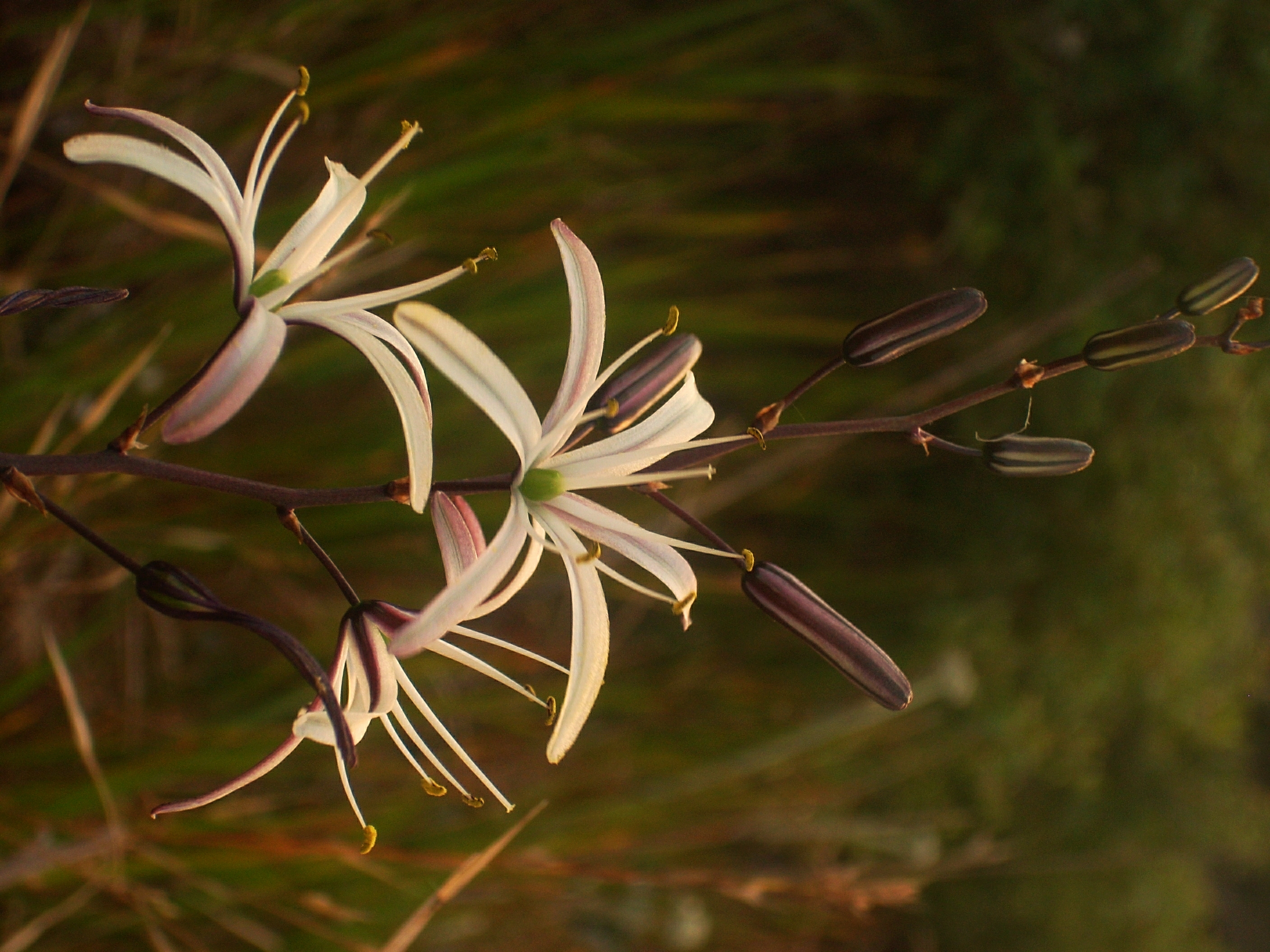
Chlorogalum is a small genus of perennial bulbous plants in the family Asparagaceae (subfamily Agavoideae, order Asparagales), native to western North America. The genus is commonly known as soap plant, soaproot, or amole — names that reflect the long-standing use of the plants' bulbs as a source of soap.
All species in the genus grow from elongated bulbs that may be white or brown, often wrapped in a distinctive fibrous coat. Flowers are borne on tall central stems and display six spreading, petal-like tepals alongside six prominent stamens, giving each bloom an open, star-like appearance. Flowering is typically nocturnal in most species.
Five species are currently recognized within Chlorogalum, all confined to California and, in some cases, adjacent Oregon. Of these, Chlorogalum pomeridianum (Wavy-leafed Soap Plant) is by far the most widespread, its range essentially encompassing those of all other members of the genus. The remaining species — including C. angustifolium, C. grandiflorum, C. purpureum, and C. parviflorum — have markedly more restricted distributions with little overlap.
The taxonomic placement of Chlorogalum has shifted considerably over time. Before the 1980s the genus was routinely treated within the Lily family, Liliaceae; it was subsequently moved through Agavaceae and Hyacinthaceae before molecular studies placed it firmly in Asparagaceae under the APG III system. Phylogenetic work published in 1999 showed that Chlorogalum's closest relatives include Agave and Anthericum. Later research further revealed that the genus is not strictly monophyletic: species with diurnal flowers and a chromosome count of 2n = 60 have been segregated into the separate genus Hooveria.
Chlorogalum has been important to many indigenous peoples of California, who used the saponin-rich bulbs as soap, food, medicine, and fish poison.
Etymology
The common names soap plant, soaproot, and amole all refer to the saponins present in the bulbs of Chlorogalum species, which lather when mixed with water and were used as a soap substitute by Native Americans and early European settlers in California. The name "amole" is a Spanish-derived term applied broadly to several soap-yielding New World plants.
Distribution
Chlorogalum is endemic to western North America, with the majority of species restricted to California. Some species, particularly C. pomeridianum, extend into southern Oregon. All five recognized species have limited, largely non-overlapping ranges, though C. pomeridianum is widespread enough to encompass the territories of its congeners.
Ecology
Chlorogalum species are geophytes that grow from bulbs, a growth form well suited to the summer-dry conditions of California's Mediterranean-climate habitats including chaparral, oak woodland, and grasslands. Most species flower nocturnally, suggesting pollination by moths or other nocturnal insects. The fibrous bulb coat and deep storage organ allow plants to survive seasonal drought and fire.
Cultural Uses
Chlorogalum bulbs have been used by numerous California Native American peoples for centuries. The Miwok and Karuk peoples used the saponin-laden bulbs of C. pomeridianum and C. angustifolium respectively as detergent for washing hair and skin, and C. pomeridianum was considered effective against dandruff. Bulb fibers were bound into small brushes, and extracts served as glue or sealant. Roasted bulbs were a winter food for the Miwok and Chumash, and the plant appears in the 1847 diary of Donner Party survivor Patrick Breen as a food offered by a Native American during the group's ordeal. Medicinally, bulb preparations were applied as antiseptic poultices and rheumatism rubs, and taken internally as a diuretic and laxative. The Lassik, Luiseño, and Mattole tribes used pulverized roots to stun fish in streams — a technique also applied to various yucca species.
Taxonomy Notes
Chlorogalum's family placement has changed repeatedly: it was treated in Liliaceae until the 1980s, then in Agavaceae, Hyacinthaceae, and briefly its own family Chorogalaceae, before molecular systematics established it in Asparagaceae subfamily Agavoideae under APG III. A 1999 phylogenetic study identified Agave and Anthericum as the genus's closest relatives. Subsequent molecular work showed the genus to be non-monophyletic: members with diurnal flowering and a chromosome number of 2n = 60 were transferred to the resurrected genus Hooveria, which includes the former Chlorogalum parviflorum and C. purpureum.

