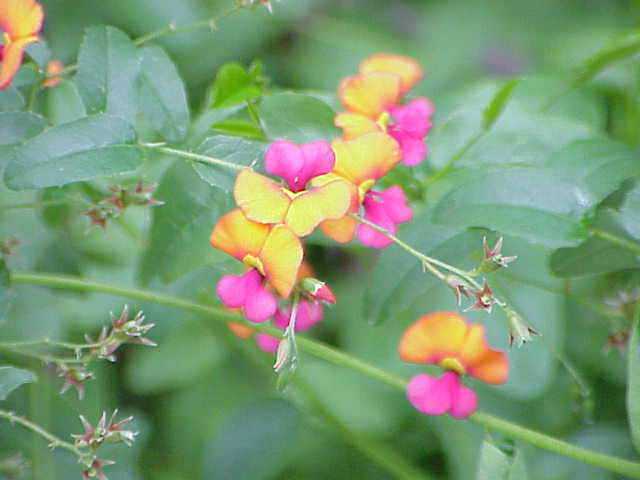
Chorizema, commonly known as flame peas, is a genus of flowering plants in the family Fabaceae (order Fabales), endemic to Australia. The genus comprises mostly shrubs and subshrubs, with some climbing species, and is particularly concentrated in the south-west of Western Australia — one of the world's recognised biodiversity hotspots.
Plants in the genus typically bear simple leaves arranged in opposite pairs. The flowers are borne in racemes, each on a short pedicel, and display the characteristic pea-flower (papilionoid) structure: the standard petal is roughly round or kidney-shaped, the wings are oblong and considerably longer than the keel, and the upper pair of sepal lobes are partly joined and broader than the lower. The stamens are free from one another — the characteristic that gave the genus its name. The fruit is an oval pod containing between 4 and 32 seeds.
The genus was first formally described in 1800 by the French botanist Jacques Labillardière in his account of the search for the lost La Pérouse expedition. The type species, Chorizema ilicifolium, is widely cultivated as an ornamental for its vivid orange and pink bicoloured flowers. Chorizema cordatum (heart-leaf flame pea) is another well-known species, frequently grown in gardens for its striking flower display.
Etymology
The genus name Chorizema derives from Greek, meaning "divided thread," a reference to the stamens being free (not fused into a tube) from one another. The name was coined by the French botanist Jacques Labillardière when he formally described the genus in 1800.
Distribution
Flame peas are largely endemic to the south-west of Western Australia. One outlier, C. parviflorum, extends into New South Wales and Queensland. The south-western Australian distribution places most species within the Southwest Australian Floristic Region, a globally recognised biodiversity hotspot.
Ecology
As members of the legume family (Fabaceae), Chorizema species are likely capable of nitrogen fixation through root-nodule symbiosis with soil bacteria, a trait common to the family. They grow in a range of habitats in south-west Western Australia, including heath, mallee scrub, and open woodland, typically on well-drained sandy or gravelly soils — conditions characteristic of the kwongan flora of that region.
Cultivation
Several species, particularly Chorizema ilicifolium and Chorizema cordatum, are cultivated as ornamental shrubs for their showy bicoloured flowers in shades of orange, pink, and red. They are suited to warm, dry climates and prefer well-drained, slightly acidic sandy soils with full sun or light shade. In cooler climates they are often grown under glass. Established plants are drought-tolerant and require little fertilisation given their nitrogen-fixing capacity.
Taxonomy Notes
The genus Chorizema was established by Jacques Labillardière in 1800, making it one of the earlier Australian plant genera to be formally described by European botanists. The type species is Chorizema ilicifolium. The genus belongs to the tribe Bossiaeeae within the subfamily Faboideae of Fabaceae. Approximately 16 species are currently recognised, accepted by the Australian Plant Census, nearly all confined to Western Australia.










