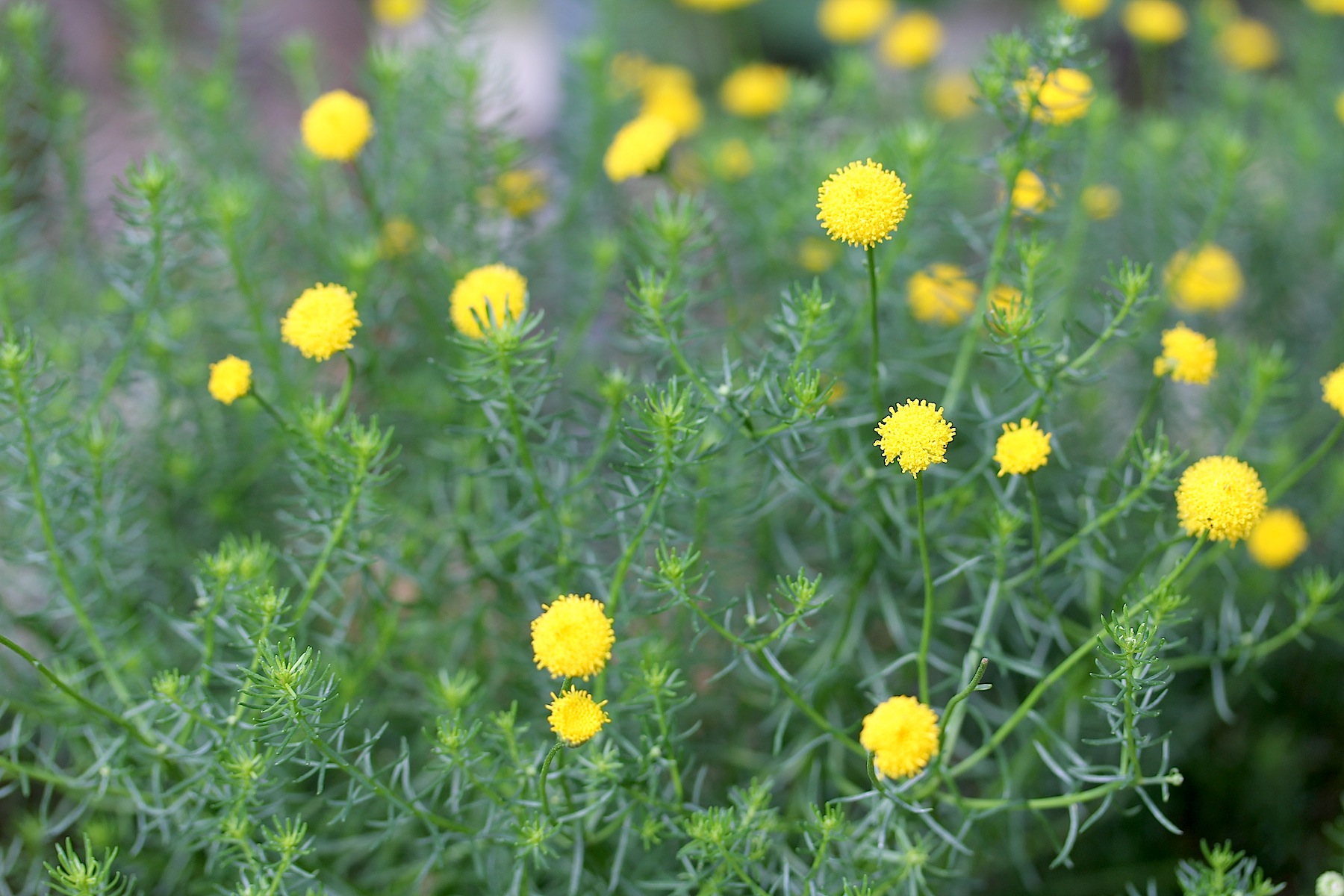
Chrysocoma is a small genus of flowering shrubs in the daisy family (Asteraceae), placed in the order Asterales. The genus is native to sub-Saharan Africa — centred on southern Africa — with the range extending to Australia. Plants are compact, multi-stemmed shrubs typically reaching 30–60 cm in height, with slender stems clothed in dense, narrow to needle-like (acicular) leaves that are often stiff-hairy along the margins. The flower heads are discoid (lacking ray or ligulate flowers), bright yellow, and borne solitarily at the tips of branches, surrounded by several rows of narrow bracts. Flowering occurs from spring through midsummer (September to January in the Southern Hemisphere). The most widely distributed species, Chrysocoma ciliata, occurs across most of South Africa, Lesotho, Mozambique, and Namibia, growing on rocky slopes and rocky plains, often alongside fynbos vegetation in the Western and Eastern Cape provinces. Another notable member, Chrysocoma coma-aurea, is characteristic of the Karoo and adjacent regions. The genus name derives from Greek, meaning "golden hair," in reference to the yellow flower heads.
Etymology
The name Chrysocoma derives from the Greek words chrysos (χρυσός), meaning "gold," and kome (κόμη), meaning "hair" — a reference to the tufts of bright yellow flower heads that crown the branch tips of these shrubs.
Distribution
Chrysocoma is native to Africa, with the greatest diversity in southern Africa, and extends to Australia. The species C. ciliata is distributed throughout most of South Africa (absent from Limpopo province), as well as Lesotho, Mozambique, and Namibia, and is particularly characteristic of rocky slopes and fynbos-associated habitats in the Western Cape and Eastern Cape.
Ecology
Species of Chrysocoma occupy rocky slopes and rocky plains in semi-arid and fynbos-margin habitats of southern Africa. Chrysocoma ciliata frequently grows alongside fynbos vegetation in the Cape provinces, tolerating thin, well-drained soils. The discoid yellow flower heads attract insect pollinators during the September–January flowering season.

