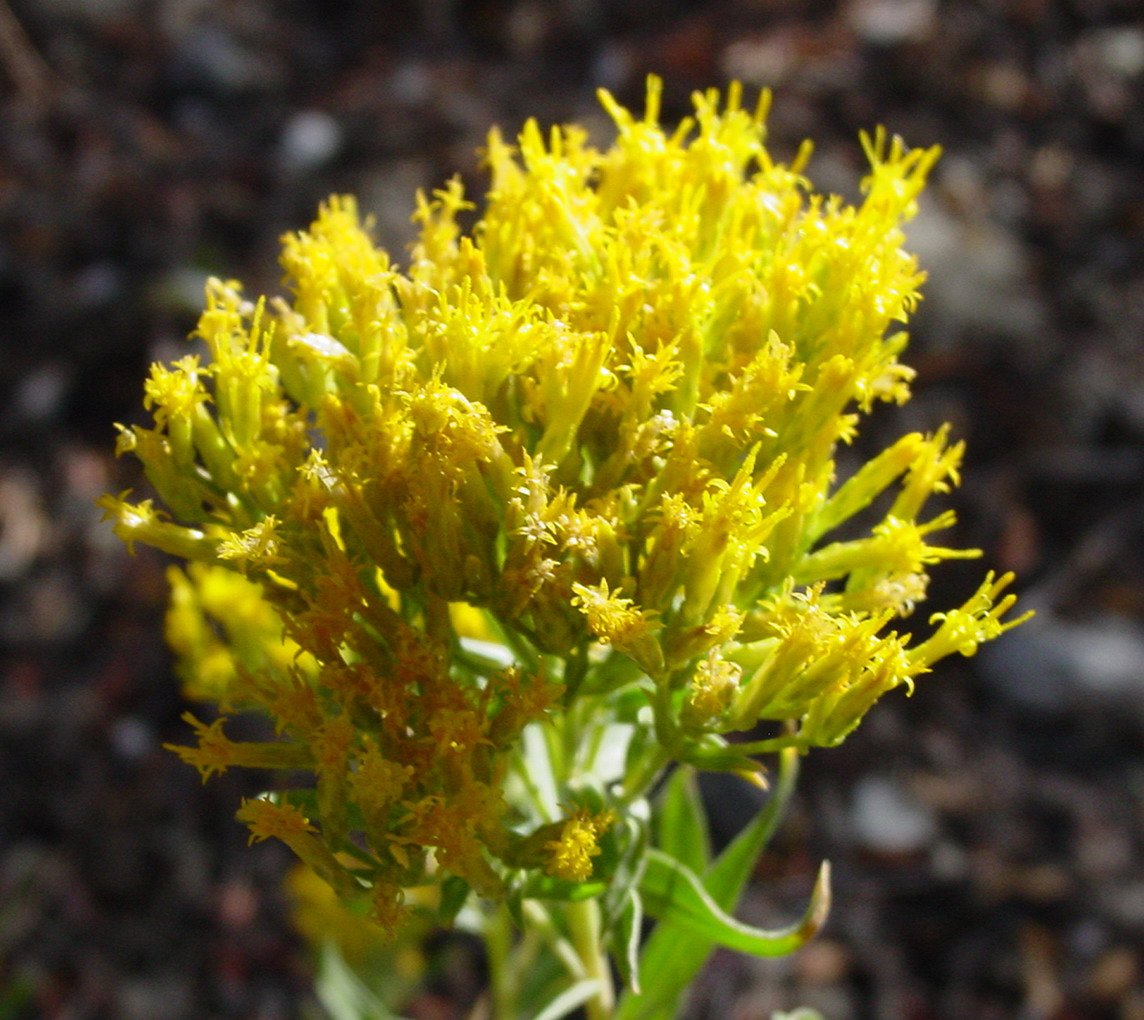
Chrysothamnus, commonly known as rabbitbrush, rabbitbush, or chamisa, is a genus of flowering shrubs in the family Asteraceae (order Asterales), native to the arid regions of the western United States, Canada, and northern Mexico. The genus comprises around a dozen species, all adapted to dry, open habitats including desert scrub, sagebrush steppe, and rocky slopes.
Plants typically grow as shrubs or subshrubs up to 120 cm (about 47 in) tall, with woody stem bases and flexible, often resinous or aromatic stems. The leaves are alternate, sessile or short-petioled, with entire margins, and are often narrow and linear. The flowerheads are composed entirely of disc florets — usually five to six bright yellow tubular flowers per head, though some heads bear up to 40 — and entirely lack ray florets. Flowers appear in late summer, producing conspicuous clusters of golden-yellow bloom that are a characteristic sight across western North American landscapes.
Chrysothamnus species serve as important ecological resources. The larvae of several Lepidoptera species feed on these shrubs, including Coleophora linosyridella, Coleophora viscidiflorella (both associated with C. viscidiflorus), and Schinia walsinghami. The plants are also known to provide habitat and forage for pollinators during the late-season blooming period when few other flowering plants are active.
The most widespread species is Chrysothamnus viscidiflorus (yellow rabbitbrush), which ranges from British Columbia south through much of the western United States. Other species have more restricted ranges within the Great Basin, Mojave Desert, and surrounding mountain regions.
Etymology
The name Chrysothamnus derives from the Greek chrysos (χρυσός, "gold") and thamnos (θάμνος, "shrub" or "bush"), referring to the golden-yellow disc flowers that characterize the genus. The common names rabbitbrush and chamisa refer to its association with semi-arid shrublands where rabbits are common.
Distribution
Chrysothamnus is native to the arid and semi-arid western interior of North America, ranging from British Columbia (Canada) south through the western United States — including the Great Basin, Colorado Plateau, Mojave Desert fringe, and Rocky Mountain foothills — into northern Mexico. Individual species show more restricted ranges: C. viscidiflorus spans the broadest territory, while C. humilis is largely confined to California, Nevada, Oregon, Washington, and Idaho, and C. depressus to California, Nevada, Arizona, Utah, Colorado, and New Mexico.
Ecology
Chrysothamnus species are characteristic shrubs of open, arid habitats including sagebrush steppe, desert scrub, dry washes, and rocky slopes throughout western North America. They bloom in late summer when most other plants in their range have finished flowering, making them valuable late-season nectar sources for pollinators. Multiple Lepidoptera species depend on Chrysothamnus as larval host plants, including specialist moths such as Schinia walsinghami and Coleophora species associated with C. viscidiflorus.










