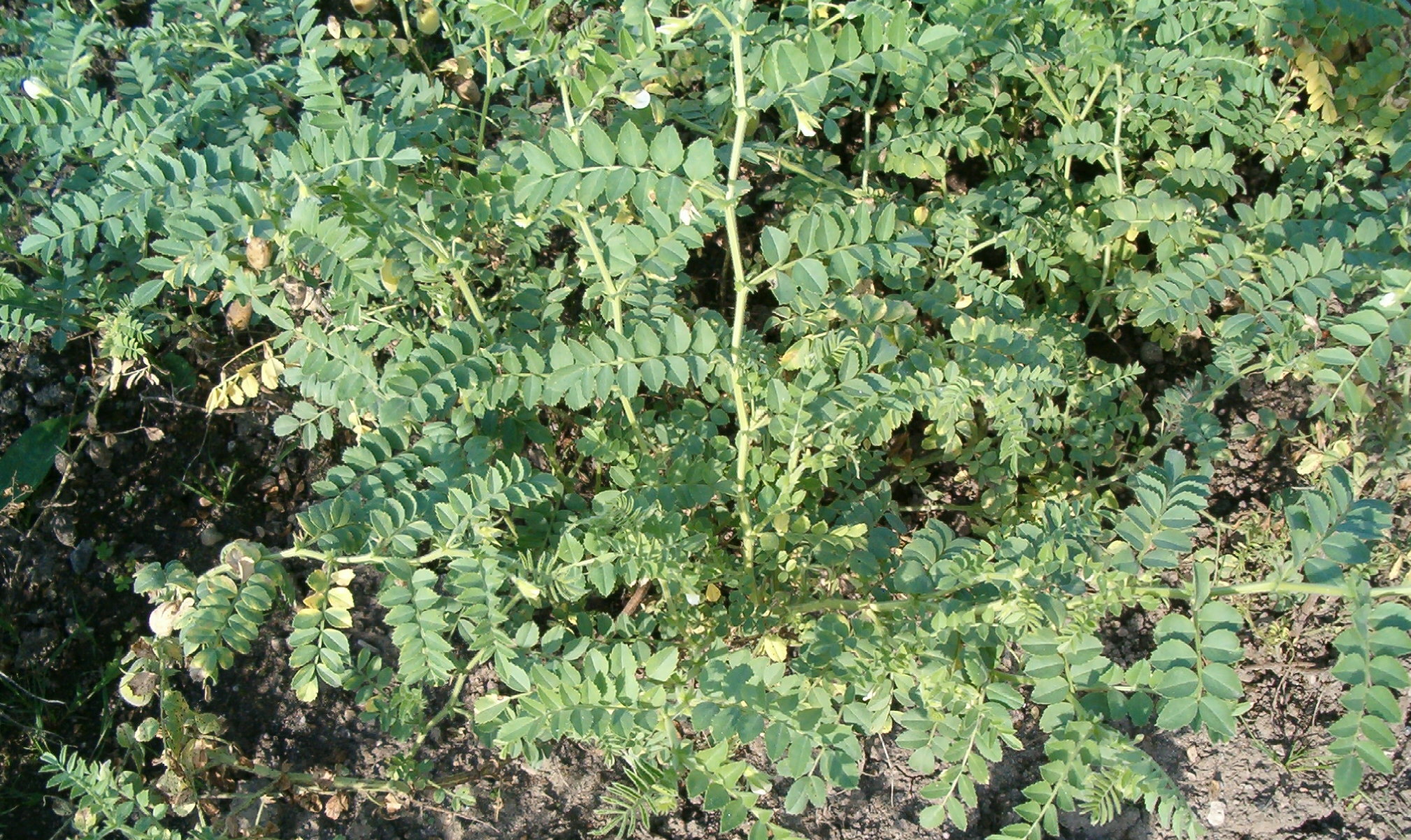
Cicer is a genus of flowering plants in the legume family Fabaceae, and the sole member of the tribe Cicereae. It belongs to the order Fabales and is placed within the informally recognised inverted repeat-lacking clade (IRLC) of legumes. The genus comprises around 45 accepted species, ranging from annual herbs to perennial shrubs, many armed with spiny stipules or rachis tips.
The genus is native to the Middle East and Asia, with species distributed from the Canary Islands and the Mediterranean basin eastward through Turkey, the Caucasus, Central Asia, and into the Indian subcontinent. Most wild species grow in dry, rocky, or montane habitats.
By far the most economically important member is Cicer arietinum, the chickpea (also called garbanzo bean), which is one of the oldest cultivated legumes on Earth and a globally significant source of plant protein. The wild progenitor of the cultivated chickpea is Cicer reticulatum, a species whose pods largely remain intact at maturity — a trait considered pre-adaptive to domestication. A related interfertile species, Cicer echinospermum, also serves as a source of genetic variation for chickpea breeding programmes.
Chickpea improvement has historically been constrained by narrow genetic diversity within the cultivated genepool, limiting resistance to diseases such as Ascochyta blight and Fusarium wilt, and tolerance to abiotic stresses including terminal drought and extreme temperatures. Wild Cicer relatives are therefore of significant conservation and agronomic interest as reservoirs of beneficial alleles.
Etymology
The name Cicer is the classical Latin word for the chickpea. It is the root of the Roman cognomen Cicero, famously borne by the orator Marcus Tullius Cicero, whose family name is traditionally said to derive from an ancestor who grew or traded chickpeas, or bore a wart resembling one.
Distribution
Cicer is native to the Middle East and Asia, with its centre of diversity in the eastern Mediterranean, the Caucasus, and Central Asia. Cicer canariense extends the genus's range to the Canary Islands. Wild species typically occur in dry, stony, or montane habitats across Turkey, Iran, Afghanistan, and the Indian subcontinent.
Cultivation
The only commercially cultivated species is Cicer arietinum (chickpea), grown widely across South Asia, the Mediterranean, and sub-Saharan Africa for its edible seeds, which are rich in protein, fibre, and micronutrients. Breeding programmes rely heavily on wild relatives — particularly C. reticulatum and C. echinospermum — to introduce resistance to Ascochyta blight, Fusarium wilt, and drought tolerance, as genetic diversity within cultivated material is narrow. Domesticated chickpea is vernalization insensitive and can flower throughout the year, distinguishing it from wild progenitors that require cold exposure before flowering.
Cultural Uses
The chickpea (Cicer arietinum) has been cultivated for at least 7,500 years and is fundamental to cuisines across South Asia, the Middle East, and the Mediterranean, forming the basis of dishes such as hummus, dal, and chhole. It is one of the world's most important grain legumes and a critical protein source in vegetarian and vegan diets globally.










