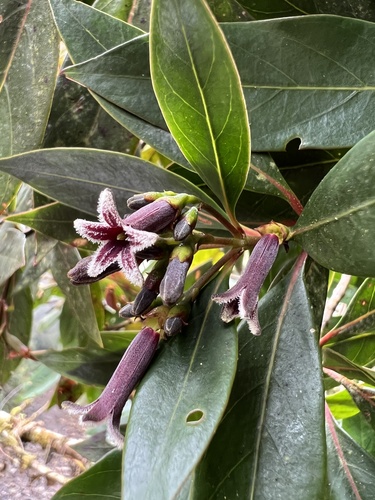
Cinchona is a genus of at least 23 species of evergreen trees and shrubs in the family Rubiaceae (order Gentianales), native to the tropical Andean forests of western South America. Plants grow 5 to 15 metres tall and bear opposite, rounded to lanceolate leaves 10–40 cm long. The flowers are white, pink, or red and are produced in terminal panicles; a defining character of the genus is that the corolla lobes are marginally hairy. The fruit is a small capsule containing numerous seeds, and some species display heterostyly.
Cinchona is renowned as the source of quinine and related alkaloids — quinine, quinidine, cinchonine, and cinchonidine — extracted from the bark. For centuries, bark preparations were the only effective treatment against malaria, earning the genus the common name "fever trees." This made Cinchona one of the most economically and politically significant plants of the colonial era, driving major botanical expeditions, smuggling operations, and the establishment of plantations in India, Sri Lanka, and Java by European colonial powers. The alkaloids quinine and cinchonine were first isolated by Pierre Joseph Pelletier and Joseph Bienaimé Caventou in 1820.
Although nearly 300 species were historically described, a comprehensive 1998 revision recognized only 23 distinct species. The type species is Cinchona officinalis, described by Linnaeus, which is found in a small region of Ecuador and has limited medicinal value. The most important cultivated species were C. pubescens (formerly C. succirubra, red bark) and C. calisaya, the latter yielding exceptionally high quinine content through the variety known as C. ledgeriana. Cinchona pubescens has become invasive on the Galápagos Islands.
The artificial synthesis of quinine in 1944, combined with the emergence of drug-resistant malaria strains and alternative therapies, ended large-scale commercial cultivation. However, Cinchona alkaloids remain relevant in treating Plasmodium falciparum malaria that has developed resistance to synthetic drugs.
Etymology
Carl Linnaeus named the genus in 1742 after the Countess of Chinchón, vicereine of Peru, who reportedly recovered from malaria by using the bark in 1638 and promoted its use in Europe. Linnaeus adopted the Italian spelling Cinchona rather than the Spanish Chinchona, leading some authorities including Clements Markham to advocate for the corrected spelling. The local Quechua names yarachucchu and ccarachucchu predate European classification, as do traditional uses known as "Jesuit's bark" and "Jesuit's powder."
Distribution
All species are native to tropical Andean forests of western South America. A few species have naturalized in Central America, Jamaica, French Polynesia, Sulawesi, Saint Helena, and São Tomé and Príncipe. During the 19th century, colonial powers established large cultivated plantations in the Nilgiris and Darjeeling regions of India, in Sri Lanka, and in Java (Indonesia). Cinchona pubescens has spread invasively on the Galápagos Islands.
Ecology
Cinchona species serve as larval food plants for several lepidopteran species, including the engrailed, the commander, and members of the moth genus Endoclita (E. damor, E. purpurescens, and E. sericeus). Natural populations of Cinchona in South America have geographically distinct distributions across the Andean range. C. pubescens is an ecological concern on the Galápagos Islands, where it grows uncontrolled and risks outcompeting native plant species.
History
Cinchona bark entered European awareness in the early 17th century as a treatment for malaria. The astronomer Charles Marie de la Condamine provided the first careful scientific description of the tree after visiting Quito in 1735. Quinine and cinchonine were isolated in 1820 by Pelletier and Caventou. To maintain their source, Peru and neighbouring countries banned the export of seeds and saplings in the early 19th century, prompting colonial expeditions — including Clements Markham's 1860 mission for Britain and the Dutch expedition under Justus Hasskarl — to smuggle plants out for cultivation in Asia. The high-yielding variety sourced by Charles Ledger and Manuel Incra Mamani (who died as a result of Bolivian authorities' response) gave the Dutch a dominant position in world quinine production through their Indonesian plantations. During World War II, Japanese control of Java cut Allied access to quinine, prompting the US-led Cinchona Missions (1942–1944) to source wild trees in South America.
Cultivation
Since its first confirmed medicinal record in the early 17th century, Cinchona bark has been cultivated for quinine and related alkaloids used to treat malaria. Large-scale plantation cultivation was established in India (Ootacamund, Darjeeling), Sri Lanka (Hakgala Botanical Garden), and Java from the 1850s–1860s, initially using C. pubescens and later the higher-yielding C. calisaya. By 1883, about 64,000 acres (260 km²) were under cultivation in Sri Lanka alone. The Dutch dominated world quinine production through their Indonesian plantations from the late 19th century, leading to a Cinchona Agreement in 1913 to stabilize prices. Cinchona remains the only economically practical source of quinine, which is still recommended for treatment of falciparum malaria.
Conservation
Over-harvesting of wild Cinchona bark historically led to destruction of large forest expanses and contributed to population decline in natural stands. The introduction of synthetic quinine in 1944 and alternative antimalarials reduced commercial pressure. However, C. pubescens is listed as an invasive species on the Galápagos, where it threatens native vegetation. Bioprospecting for Cinchona alkaloids raises ongoing questions about conservation benefit-sharing with biodiverse Andean nations and indigenous communities.










