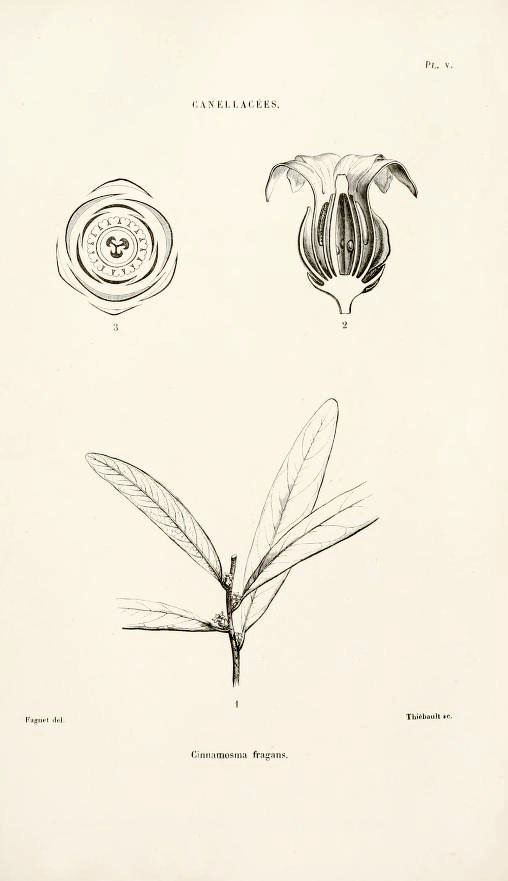
Cinnamosma is a genus of flowering plants in the family Canellaceae, order Canellales. It was described as a genus in 1867 by the French botanist Henri Ernest Baillon, with the original publication in Adansonia (volume 7, pages 212–220). The genus comprises three accepted species — Cinnamosma fragrans, Cinnamosma macrocarpa, and Cinnamosma madagascariensis — all of which are endemic to Madagascar. Members of Canellaceae are typically aromatic evergreen trees or shrubs, and Cinnamosma species are known for their fragrant properties, with C. fragrans being the type species and the most widely documented member of the genus.
Distribution
Cinnamosma is endemic to Madagascar. All three species — C. fragrans, C. macrocarpa, and C. madagascariensis — are restricted to the island, making the genus a component of Madagascar's distinctive and highly endemic flora.
Taxonomy
The genus Cinnamosma was described by Henri Ernest Baillon in 1867 in Adansonia (volume 7, pages 212–220). It belongs to the family Canellaceae within the order Canellales. The type species is Cinnamosma fragrans Baill. The other two accepted species are C. macrocarpa H.Perrier and C. madagascariensis Danguy.










