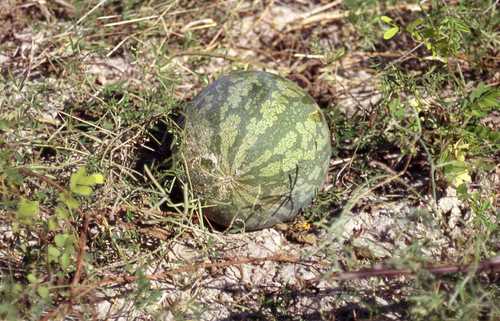
Citrullus is a genus of seven species of annual or perennial desert vines in the gourd family, Cucurbitaceae. Native to arid and semi-arid regions of Africa, the genus is best known for producing the watermelon (Citrullus lanatus), one of the world's most widely cultivated and consumed fruits.
Plants in the genus are prostrate or scrambling vines with stems reaching up to 3 metres in length. The leaves are typically three-lobed and densely hairy when young. With the exception of Citrullus ecirrhosus (the tendril-less melon), all species bear branching tendrils. Flowers are unisexual, white or yellow, and borne singly in the leaf axils; individual plants carry both male and female flowers (monoecious). The characteristic fruit is a pepo — a modified berry with a firm, often mottled rind and a fleshy interior — ranging from small wild forms of around 20 cm in diameter to cultivated watermelons exceeding 60 cm.
The seven recognized species include the economically dominant C. lanatus (watermelon), C. mucosospermus (egusi melon, prized for its oily seeds in West Africa), C. colocynthis (colocynth, historically used in medicine as a purgative), C. amarus (citron or bitter melon, naturalized across semi-arid regions on multiple continents), C. ecirrhosus (tendril-less melon of southern Africa), C. naudinianus, and C. rehmii.
Watermelon domestication traces to northeastern Africa, with wild seeds documented in Libya from around 3500 BC and cultivation in Sudan and Egypt established by 2000 BC. From there the crop spread through the ancient world — reaching India by the 7th century CE, China by the 10th century, and the Americas with European colonists in the 16th century. The taxonomy of the genus has been complicated by a nomenclatural error made in 1930, when L.H. Bailey incorrectly synonymized the bitter woolly melon (C. lanatus sensu Thunberg) with the sweet watermelon; this error was formally resolved and the name conserved at the International Botanical Congress in 2017.
Etymology
The genus name Citrullus is a Latin diminutive derived from citrus, referencing the citron fruit (Citrus medica), to which early melons bore a superficial resemblance. The same root gives the species epithet in the original binomial Cucurbita citrullus coined by Linnaeus in 1753.
Distribution
Citrullus is native to Africa, with its centre of diversity in arid and semi-arid regions from northeastern Africa (Sudan, Libya, Egypt) to southern and West Africa. Citrullus lanatus is now cultivated globally in tropical to temperate climates, while C. amarus has naturalized in semi-arid zones on several continents, and C. ecirrhosus is restricted to the arid regions of southern Africa.
History
The watermelon has one of the longest documented cultivation histories of any fruit crop. Wild seeds dated to approximately 3500 BC were found at the Uan Muhuggiag site in Libya, and cultivation in Egypt is attested by at least 2000 BC. The crop spread to India by the 7th century CE, to China by the 10th century, and was introduced to the Americas by Spanish settlers from 1576. Selective breeding over millennia transformed the originally bitter, yellowish-fleshed fruit into the sweet, red-fleshed varieties common today; seedless triploid hybrids were first developed in Japan in 1939.
Cultivation
Watermelons (C. lanatus) require temperatures above 25 °C and thrive in well-drained sandy loam soils with a pH of 5.7–7.2. Seeds are typically started under cover and transplanted outdoors. Bee pollination is essential, particularly for seedless varieties, which require interplanted pollinizer rows. Major pests include aphids, fruit flies, and root-knot nematodes; humid conditions predispose plants to powdery mildew and mosaic virus. Some varieties grown in East Asia are grafted onto resistant rootstocks to combat fusarium wilt.
Cultural Uses
Citrullus colocynthis (colocynth) has a long history of medicinal use as a purgative across North Africa, the Middle East, and South Asia. Citrullus mucosospermus (egusi melon) is cultivated primarily for its protein- and oil-rich seeds, which are a staple ingredient in West African cuisine. Watermelons have historically served as an important source of water for people and animals in arid regions of southern and East Africa, and the fruit was stored for consumption during dry seasons.
Taxonomy Notes
The taxonomy of Citrullus was complicated for decades by L.H. Bailey's 1930 misidentification, which conflated the bitter woolly melon (Citrullus lanatus sensu Thunberg, described from a Cape Town specimen collected in 1773) with the domesticated sweet watermelon (Citrullus vulgaris Schrad.). Molecular phylogenetic analysis confirmed these are not closely related; the closest living relative of the domesticated watermelon is C. mucosospermus from West Africa. The name Citrullus lanatus was formally conserved with a new type specimen at the International Botanical Congress in 2017.










