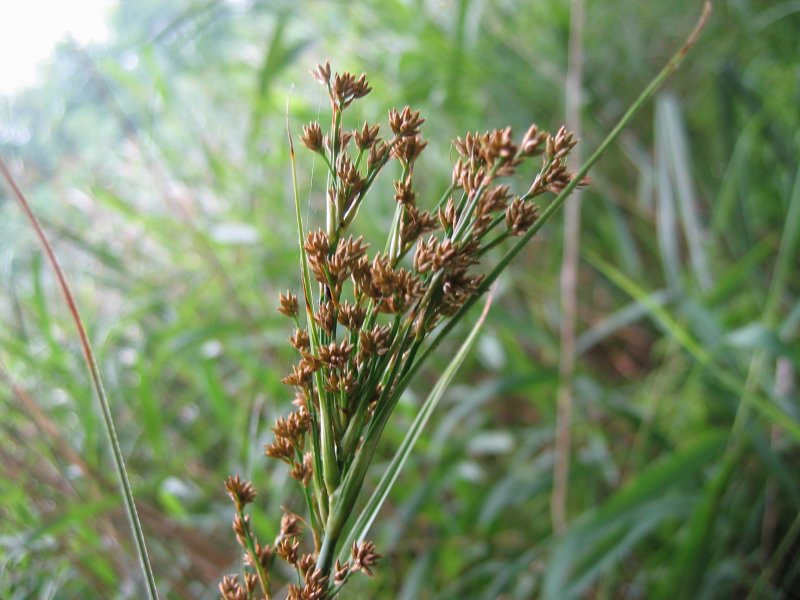
Cladium is a genus of large sedges in the family Cyperaceae (order Poales) with a nearly worldwide distribution across tropical and temperate regions. Plants in this genus are characterised by long, narrow, grass-like leaves with sharp, often serrated (sawtooth-like) margins, and erect flowering stems reaching 1–3 metres tall that bear a much-branched inflorescence. Like many wetland plants, Cladium develops deeply buried rhizomes capable of producing tall shoots with dense canopies, allowing it to dominate extensive areas of marsh and fen.
The number of species within the genus is disputed — different authors have recognised between 2 and 60 — but Kew Royal Botanic Gardens currently accepts three species, one of which comprises four subspecies. The best-known member is Cladium mariscus subsp. jamaicense, commonly called sawgrass, which is widespread in marshes and savannas throughout tropical and subtropical America. It is the defining plant of the Florida Everglades, the landscape famously described as a "River of Grass." Sawgrass thrives in extremely infertile, phosphorus-poor conditions, and its dense beds intermix with other vegetation types to produce the rich mosaic of habitats that underpins the Everglades' exceptional biodiversity. Agricultural phosphorus runoff has favoured dense cattail over sawgrass, with consequences for the wider ecosystem.
In Europe, Cladium mariscus (great fen-sedge) is a characteristic plant of calcareous fens, particularly in the British Isles, where it has historically been harvested for thatching — a practice that continues on the Baltic island of Gotland. Because it can form dense, light-excluding stands that reduce plant diversity, it is sometimes managed by mowing. Sawgrass has also been investigated as a potential cellulosic biofuel feedstock, possibly as an alternative to corn-derived ethanol.
Etymology
The name Cladium derives from the Greek klados (branch or twig), a reference to the much-branched inflorescence characteristic of the genus. The common name "sawgrass" reflects the sharply serrated leaf margins that can cut exposed skin.
Distribution
Cladium has a nearly worldwide distribution across tropical and temperate regions. Cladium mariscus subsp. mariscus spans Europe and northern Asia from Ireland and Morocco to Japan; subsp. jamaicense extends from Mexico to Argentina, the West Indies, and the southeastern United States, and has naturalised in tropical Africa and on oceanic islands including the Canary Islands, Hawaii, and Madagascar. Cladium mariscoides (twig-rush) occurs in eastern North America from Labrador to Florida and Texas, while Cladium costatum is known only from Venezuela and Guyana.
Ecology
Cladium species are obligate wetland plants, occurring in marshes, savannas, fens, wet meadows, and pond shores. Cladium mariscus subsp. jamaicense is adapted to extremely infertile, phosphorus-poor sites and forms the dominant vegetation across vast areas of the Florida Everglades, where its dense beds provide nesting habitat for American alligators and support a high diversity of plant and animal life — at least 80 species in the Everglades are threatened or endangered. In European calcareous fens, C. mariscus can become dominant and suppress other plant species, prompting management by periodic mowing. Cladium mariscoides has more specific habitat requirements and is consequently rare at the northern edge of its range.
Cultural Uses
Cladium mariscus has been harvested for thatching for centuries; on Gotland, a limestone island in the Baltic Sea, the tradition persists today. Sawgrass (C. mariscus subsp. jamaicense) has been investigated as a source of cellulose for bioethanol production, with potential as an alternative to corn-based ethanol feedstocks.
Taxonomy Notes
The number of species accepted in Cladium is disputed. Different authorities have recognised between 2 and 60 species as distinct; Kew Royal Botanic Gardens currently accepts three — C. costatum, C. mariscoides, and C. mariscus — the latter encompassing four subspecies (californicum, intermedium, jamaicense, and mariscus). GBIF records two accepted descendants under this circumscription.










