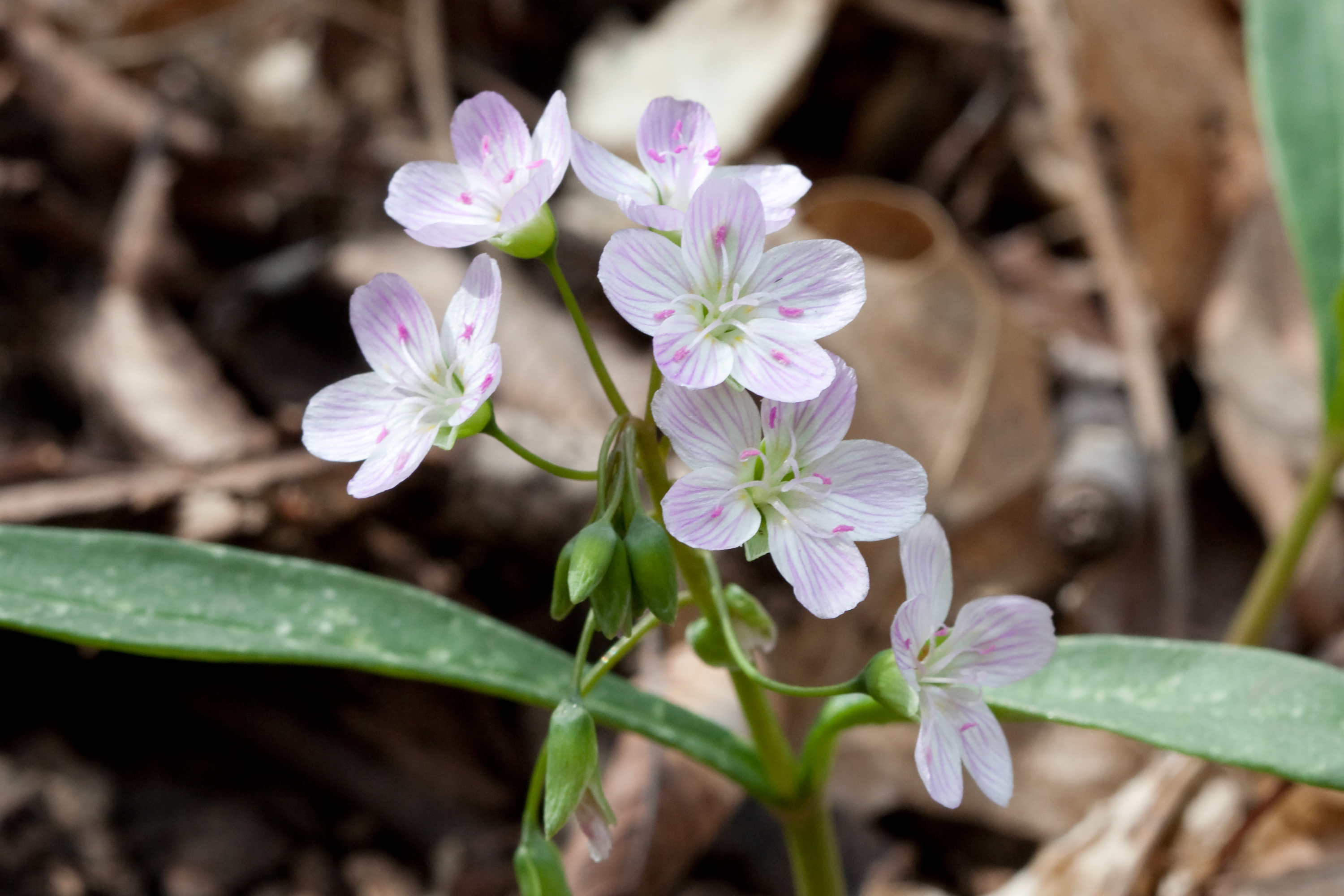
Claytonia L. is a genus of roughly 93 species of small, fleshy flowering plants in the family Montiaceae (order Caryophyllales). Established by Linnaeus in his Species Plantarum of 1753, the genus was long placed within the purslane family Portulacaceae, but molecular studies led to its reclassification into the segregate family Montiaceae under the APG IV system in 2009. Some species were formerly treated under the closely related genus Montia.
Plants in this genus are characteristically low-growing — typically only a few centimetres tall — with somewhat succulent leaves and small flowers arranged in heads of about 2.5 cm across. Members of the genus are commonly called spring beauties or springbeauties in English, reflecting their early-season bloom. The most widely recognised species is Claytonia perfoliata, known as miner's lettuce, which has been valued both as a wild edible and as a cultivated salad green.
The genus ranges across North America (the centre of its diversity), Central America, and into Asia — extending as far as Kazakhstan, Mongolia, and eastern Russia. Plants favour cool, moist habitats and are often found in mountainous or disturbed terrain. Several species, particularly C. perfoliata, have naturalised beyond their native range in temperate Europe.
Etymology
The genus Claytonia was named in honour of John Clayton (1686–1773), a colonial American botanist who collected plant specimens extensively in Virginia and other parts of North America and sent them to European correspondents including Jan Frederik Gronovius. Linnaeus formally established the genus in 1753, enshrining Clayton's contribution to early New World botany.
Distribution
Claytonia is primarily a genus of the Americas, with its greatest diversity in North America. Species occur throughout most of the northern United States and extend into Central America as far as Guatemala. The Old World portion of the range reaches west-central Asia — Kazakhstan, Mongolia, and eastern Russia. Claytonia perfoliata has expanded well beyond its native Mountain West range through naturalisation and is documented in Switzerland and other parts of temperate Europe.
Ecology
Species of Claytonia typically occupy cool, moist, and often disturbed habitats. C. perfoliata is particularly associated with moist soils in the Mountain West of North America and colonises disturbed ground readily. Several species in the genus are adapted to peaty, acid, low-nutrient soils and require good drainage despite their preference for moisture. The genus spans a broad elevational range, with some species — such as C. arctica — adapted to Arctic conditions, where they show extreme cold tolerance. Flowers appear from early spring through early summer depending on species and latitude.
Cultivation
Claytonia species prefer a damp, peaty, lime-free soil and a position in full sun. They are intolerant of shade and do best in moist but well-drained, lightly to medium-textured (sandy or loamy) soils with a mildly to strongly acidic pH. Plants are typically low-growing perennials reaching about 0.2 m in height, with a flowering season from May to July. Their high cold tolerance makes them suitable for cool temperate and sub-arctic garden settings.
Propagation
Two main methods are used. Seed is surface-sown on peat-based compost in spring at approximately 10°C and usually germinates within two to four weeks; seedlings are pricked out once large enough to handle. Alternatively, offsets can be divided in spring or autumn and replanted immediately.
Cultural Uses
Claytonia species have a long history of use as food plants. The leaves are rich in vitamins and can be consumed raw or lightly cooked, and the flowers make an attractive, edible garnish in salads. The fleshy tuberous roots are also edible, either raw or cooked in a manner comparable to small potatoes; indigenous peoples of North America traditionally prepared them with oil. Claytonia perfoliata — miner's lettuce — became particularly well known during the California Gold Rush, when miners ate it to prevent scurvy.
Taxonomy
Claytonia L. was described by Linnaeus in Species Plantarum (1753, p. 204) and given the taxonomic status of an accepted genus. For most of the nineteenth and twentieth centuries it was placed in Portulacaceae, the purslane family. Phylogenetic studies prompted the recognition of a separate family, Montiaceae, and the APG IV system formalised this change around 2009. Several Claytonia species were historically treated under the allied genus Montia, and the boundary between these two genera has been revised multiple times. GBIF currently accepts 93 descendant taxa under the genus.










