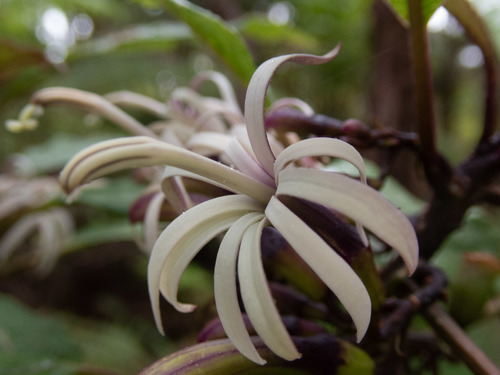
Clermontia is a genus of flowering plants in the bellflower family (Campanulaceae, subfamily Lobelioideae), endemic to the Hawaiian Islands. It is one of six genera that make up the Hawaiian lobelioids — the largest plant radiation on any island archipelago, with over 125 species across the group. Clermontia itself contains 22 species, making it the most common of the Hawaiian lobelioid genera.
Plants in this genus are branched shrubs or small trees, reaching up to 7 metres (23 feet) tall, and bear fleshy fruits — a trait that distinguishes them from the capsular-fruited Lobelia and Trematolobelia. Their flowers are often large and spectacular, and the genus is divided into two sections based on calyx morphology: section Clermontia, in which the calyx lobes match the corolla in colour and size (giving the appearance of twice the normal number of petals), and section Clermontioideae, in which the calyx lobes are short and green.
Unlike the closely related Cyanea, which typically grow in dense forest, Clermontia species are frequently found in more open areas and forest edges, making them somewhat more resilient to habitat fragmentation. They serve as critically important host plants for many species of endemic Hawaiian Drosophilidae (fruit flies), whose larvae develop in the decaying bark, leaves, flowers, and fruit. Several species, particularly on the Big Island of Hawaiʻi, grow as epiphytes on larger trees.
The genus was named by the French botanist Charles Gaudichaud-Beaupré in honour of Aimé, duc de Clermont-Tonnerre. Many Clermontia species are endangered, and some are believed extinct in parts of their former range. They carry the Hawaiian common name ʻōhā wai.
Etymology
The genus Clermontia was named by French botanist Charles Gaudichaud-Beaupré in honour of Aimé, duc de Clermont-Tonnerre (1779–1865), a French nobleman and statesman.
Distribution
Clermontia is endemic to the Hawaiian Islands, with species occurring across Kauaʻi, Oʻahu, Molokaʻi, Lānaʻi, Maui, and the Big Island of Hawaiʻi. Individual species often have restricted ranges confined to single islands or specific mountain districts.
Ecology
Clermontia species commonly grow in more open areas and forest edges, in contrast to the dense-forest Cyanea. This habitat preference gives them greater resilience to forest fragmentation. The genus is a vital host for endemic Hawaiian Drosophilidae (fruit flies), particularly Drosophila silvestris; fly larvae breed in the decaying bark, leaves, flowers, and fruit. Several species on the Big Island are epiphytic, growing on larger trees or fallen logs. Like all Hawaiian lobelioids, they are vulnerable to feral ungulates (pigs, rats) that chew the soft, latex-containing bark and disturb seedlings through digging.
Conservation
Many Clermontia species are classified as endangered. Some, such as C. grandiflora (formerly on Molokaʻi, Lānaʻi, and Maui) and C. multiflora (formerly on Oʻahu and west Maui), are believed extinct in parts or all of their historical range. Habitat loss, forest fragmentation, and damage from feral ungulates are the primary threats.
Taxonomy
Clermontia belongs to the Hawaiian lobelioids (Campanulaceae: Lobelioideae), a radiation of over 125 species across six endemic genera. The genus comprises 22 accepted species in two sections: section Clermontia (calyx lobes petal-like) and section Clermontioideae (calyx lobes short and green). A 2021 molecular phylogenetic study found that Clermontia forms a separate clade with some species of Cyanea, which is not monophyletic, indicating that the generic boundaries within Hawaiian lobelioids remain unsettled. The broader relationships between the Hawaiian genera and their continental relatives are still being resolved.










