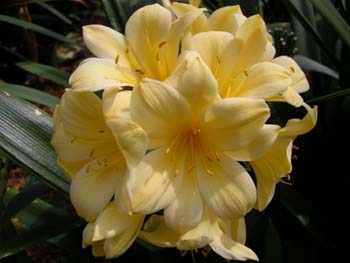
Clivia is a genus of monocot flowering plants in the family Amaryllidaceae (subfamily Amaryllidoideae), order Asparagales. The genus comprises six accepted species of herbaceous or evergreen perennial plants native exclusively to southern Africa — South Africa and Eswatini — where they grow primarily as forest undergrowth adapted to low light conditions.
Plants in the genus are characterized by long, strap-shaped, evergreen leaves that arise from thick branching roots or rhizomes rather than bulbs — a distinctive trait shared with the closely related genus Cryptostephanus and unusual within the subfamily. Individual flowers are composed of six tepals (three sepals and three petals, all similar in appearance) fused at the base into a tube; the tube may be short and cup-like or elongated and pendant depending on species. Flower color ranges from yellow through orange to deep red. Flowers are arranged in umbels borne on a long peduncle above the foliage, with each umbel subtended by several bracts. The ovary is inferior, consisting of three locules, and the fruit is a fleshy berry containing large seeds often exceeding 1 cm in diameter.
The genus was published by John Lindley in 1828, with Clivia nobilis as the type species. Six species are currently recognized: C. miniata, C. nobilis, C. gardenii, C. caulescens, C. mirabilis, and C. robusta. Of these, C. miniata is by far the most widely cultivated and has given rise to numerous cultivars with flower colors ranging from deep red-orange to pale yellow. Some species, including C. miniata, contain the alkaloid lycorine and are toxic to pets and small children if ingested.
Etymology
The genus name Clivia honors Charlotte Percy (née Clive), Duchess of Northumberland (1787–1866), who served for a time as governess to the future Queen Victoria of the United Kingdom. The name was given by botanist John Lindley when he formally published the genus in 1828.
Distribution
Clivia species are native exclusively to South Africa and Eswatini. They are primarily plants of forest understory and coastal bush, adapted to shaded, sheltered conditions. The exception is C. mirabilis, found in the arid Western Cape, which grows in higher-light rocky habitats — the only species tolerant of direct sun.
Cultivation
Clivia miniata is the most widely cultivated species and is grown worldwide as a houseplant and garden plant in frost-free climates. It tolerates low light, making it well suited to indoor culture. Cultivars range from the standard orange-red forms to yellows and near-whites. Yellow-flowered plants fall into two genetically distinct groups that breed true; crossing plants from different yellow groups produces orange-flowered offspring. Most species flower after four to five years from seed; C. nobilis requires seven to eight years.
Taxonomy Notes
The genus belongs to tribe Haemantheae within subfamily Amaryllidoideae of the family Amaryllidaceae. It is distinguished from nearly all other members of the subfamily by the absence of bulbs, with storage and anchoring functions fulfilled by fleshy rhizomes and roots instead. Six species are currently accepted; the genus was treated as having only four species until C. mirabilis was described in 2000 and C. robusta in 2004. GBIF records eight descendant taxa, reflecting recognition of additional infraspecific entities or hybrids such as C. × cyrtanthiflora.










