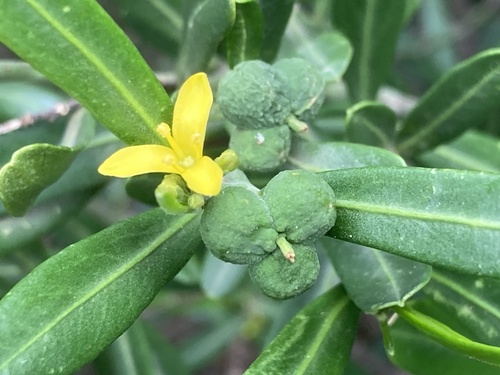
Cneorum is a small genus of flowering plants in the family Rutaceae (the rue or citrus family), order Sapindales, containing only two accepted species. The genus was formerly placed in its own family, Cneoraceae, but molecular studies have established it firmly within Rutaceae. Both species are native to the Mediterranean region of Europe and the Canary Islands.
The best-known member, Cneorum tricoccon (spurge olive), is a compact evergreen shrub typically reaching about 0.6 metres in height. It is in leaf year-round and bears small yellowish flowers from June to July, with seeds ripening from August to September. The flowers are hermaphroditic. The plant favours rocky, calcareous slopes and light, well-drained sandy soils in full sun across the western Mediterranean; it does not tolerate shade. Its common name alludes to a superficial resemblance to the olive, though the fruit has no food value. The plant contains tannins and has been used historically as a fuel source; limited medicinal uses — purgative and rubefacient — have been recorded in traditional practice.
The second species, Cneorum pulverulentum, is native to the Canary Islands and differs from C. tricoccon in being more restricted in distribution.
Etymology
The genus name Cneorum derives from the ancient Greek kneoron, a name used by classical authors for a small olive-like shrub of the Mediterranean region. The common name "spurge olive" reflects a resemblance to both spurge (Euphorbia) and olive (Olea) plants, though Cneorum is unrelated to either.
Distribution
Cneorum tricoccon is native to rocky, calcareous slopes of the western Mediterranean, ranging across southern Europe including Spain, southern France, and the western Balkans. Cneorum pulverulentum is endemic to the Canary Islands. Together the genus spans the Mediterranean Basin and Macaronesia.
Ecology
Both species favour well-drained, rocky or sandy calcareous soils in open, sunny positions. Cneorum tricoccon is typically found on dry to moderately moist rocky slopes and cannot tolerate shade. It is adapted to the warm, dry Mediterranean climate (USDA hardiness zones 8–11).
Taxonomy Notes
Cneorum was long placed in its own monotypic family Cneoraceae. Modern molecular phylogenetics has transferred the genus to Rutaceae, within the order Sapindales. PFAF still lists the older family name Cneoraceae, which conflicts with the current placement in Rutaceae accepted by GBIF and Wikipedia.










