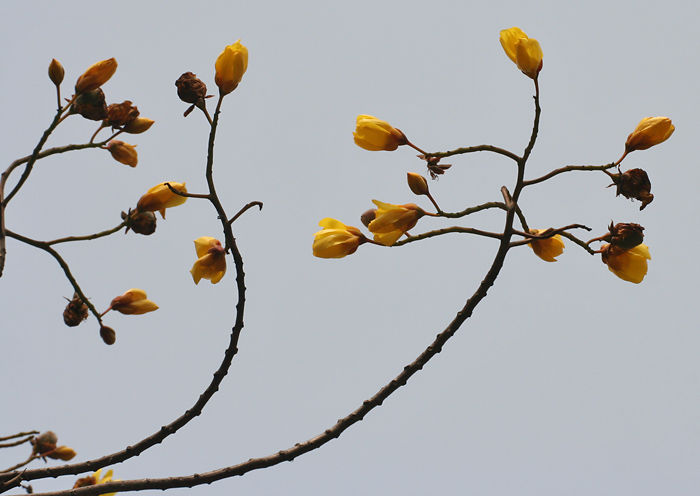
Cochlospermum is a genus of flowering trees and shrubs in the family Bixaceae, order Malvales, though some older classifications place it in its own family, Cochlospermaceae. The genus comprises roughly 15–20 species distributed across the tropics, with centers of diversity in Latin America, sub-Saharan Africa, the Indian subcontinent, and northern Australia.
Members of the genus are typically deciduous trees or large shrubs, often bearing large, showy yellow flowers — a characteristic that has made several species valued as ornamentals in tropical gardens. The flowers tend to appear before or alongside the new leaves at the start of the wet season, creating a striking display. Leaves are palmately lobed, reminiscent of those of Vitis (grapevine) in some species, which is reflected in names such as C. vitifolium.
Several species have economic and ethnobotanical significance. Cochlospermum tinctorium, native to tropical Africa from Sierra Leone to Uganda, has long been used as a source of yellow dye for leather and fabric. Cochlospermum religiosum, native to India, Sri Lanka, the Western Himalayas, and Myanmar, is widely planted near temples and has traditional medicinal uses. Cochlospermum regium and C. tinctorium are also used in traditional medicine across their respective ranges in South America and West Africa.
Etymology
The genus name Cochlospermum is derived from the Greek kochlos (spiral shell) and sperma (seed), referring to the distinctively coiled or spiral seeds found within the fruit capsules.
Distribution
Cochlospermum is native to tropical and subtropical regions worldwide, with species occurring across Latin America (Mexico south to Bolivia and Brazil), sub-Saharan and West Africa (Sierra Leone to Uganda and Angola), the Indian subcontinent and Myanmar, and northern Australia (Northern Territory, Queensland, and Western Australia).
Cultural Uses
Cochlospermum tinctorium, native to tropical West Africa, has traditionally been used as a yellow dye for leather goods and fabrics. Cochlospermum religiosum is widely planted near Hindu temples in India and is used in traditional Ayurvedic medicine. Multiple African species are used in local traditional medicine.










