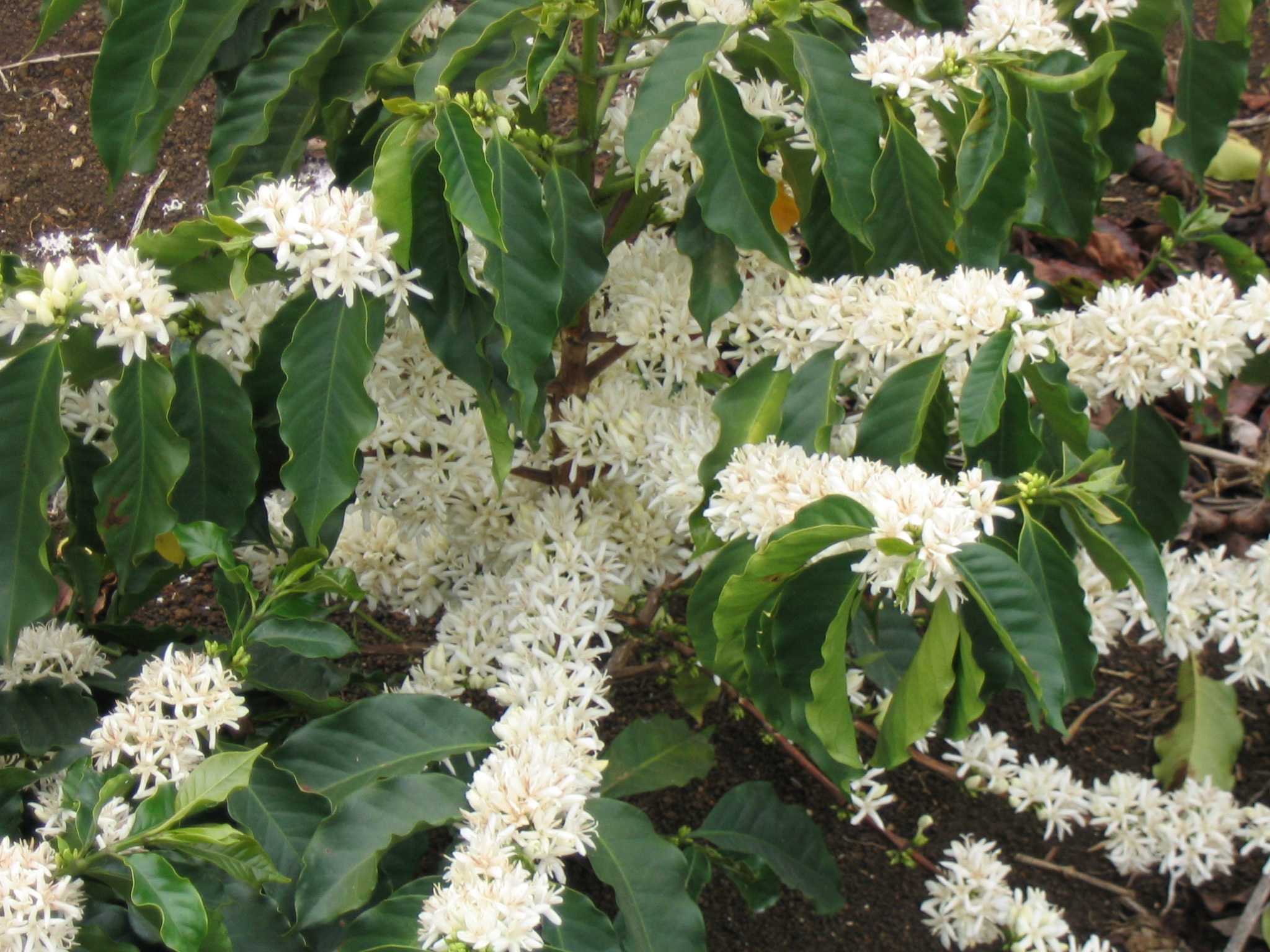
Coffea is a genus of more than 130 species of flowering shrubs and small trees in the family Rubiaceae (order Gentianales), native to tropical and southern Africa, tropical Asia, and — following a 2011 taxonomic revision — Australasia. The genus is best known as the source of coffee: the seeds of several species, commonly called coffee beans, are harvested, roasted, and ground to produce one of the world's most widely consumed beverages.
In cultivation, Coffea plants typically grow to 3–3.5 metres in tropical conditions, bearing glossy leaves and highly fragrant white flowers. The fruits, known as coffee cherries, are epigynous berries or indehiscent drupes that ripen over approximately nine months to a characteristic red or purple colour. Each cherry normally contains two seeds; a small proportion (5–10%) yield a single rounded seed called a peaberry. The genus was first formally described by Carl Linnaeus in 1753, with Coffea arabica as the type species. New species continue to be discovered: seven were named from the mountains of northern Madagascar in 2008–2009, and a caffeine-free species, Coffea charrieriana, was identified in Cameroon in 2008. In 2011, the twenty species of the former genus Psilanthus were transferred into Coffea on morphological and genetic grounds, expanding the genus from 104 to 124 accepted species; as of 2026, Plants of the World Online accepts 133 species.
Commercial coffee production relies overwhelmingly on two species: Coffea arabica (Arabica), which accounts for 60–80% of global production and is valued for its sweeter flavour, and Coffea canephora (Robusta), which contributes 20–40% and carries a higher caffeine content. C. arabica originated in the highlands of Ethiopia and the Boma Plateau of Sudan as a natural hybrid between C. canephora and C. eugenioides. Both commercially dominant species are considered vulnerable to climate-change-driven shifts in their suitable growing zones. Caffeine, the characteristic alkaloid of the genus, functions ecologically as a plant defence against herbivores and pests, while simultaneously attracting honeybee pollinators through olfactory conditioning. Caffeine has evolved independently in multiple Coffea lineages and, separately, in the unrelated genera Theobroma (cacao) and Camellia (tea), illustrating convergent evolution of this adaptive trait.
Etymology
The genus name Coffea is a Latinised rendering of the Arabic word qahwa, meaning coffee, which passed through Turkish kahve before entering European botanical nomenclature. The genus and its type species Coffea arabica were formally established by Carl Linnaeus in 1753.
Distribution
Coffea is native to tropical and southern Africa and tropical Asia, with its centre of diversity in Africa. Following the absorption of genus Psilanthus in 2011, the native range was extended to include Australasia. Coffea arabica, the dominant cultivated species, originated in the highlands of Ethiopia and the Boma Plateau of Sudan. The genus is now widely cultivated throughout the tropical belt, with major production in Central and South America, the Caribbean, and Africa.
Ecology
Caffeine in coffee plants serves as a chemical defence against insect herbivores and other pests. It also creates olfactory memory in honeybees, drawing them back to the flowers and facilitating pollination. Caffeine has evolved independently in multiple Coffea lineages — likely driven by high pest pressure in the humid forests of West-Central Africa — and has arisen separately in the unrelated genera Theobroma (cacao) and Camellia (tea), a striking example of convergent evolution. Not all Coffea species produce caffeine; the earliest diverging species had little or no caffeine content. Key insect pests of cultivated coffee include the coffee borer beetle (Hypothenemus hampei) and the coffee leafminer (Leucoptera caffeina).
Cultivation
Coffea is grown from seed in tropical regions, preferring high elevations and warm temperatures but unable to tolerate frost. In the field, plants typically reach 3–3.5 m and begin bearing fruit after three to five years; a single tree can remain productive for 50–100 years. The white flowers are highly scented, and the fruits (coffee cherries) take approximately nine months to ripen. The two commercially dominant species — C. arabica and C. canephora — are selected for flavour profile and caffeine content respectively and are grown across the tropical belt from Latin America to Southeast Asia.
Cultural Uses
Coffee ranks among the world's most valuable and widely traded agricultural commodities and is a critical export for numerous countries in Africa, Central and South America, and the Caribbean. Beyond roasted coffee beans, the fruits and leaves of Coffea species are used to prepare coffee cherry tea (cascara) and coffee-leaf tea, and coffee cherry extract is an ingredient in some soft drinks and packaged teas. The caffeine-free species Coffea charrieriana, discovered in 2008, has attracted research interest for its potential to contribute naturally decaffeinated traits to cultivated coffee through hybridisation.
History
The genus Coffea and type species Coffea arabica were first described by Carl Linnaeus in 1753. Botanical exploration has continued to yield new species into the twenty-first century: seven species were named from northern Madagascar in 2008–2009 by researchers at the Royal Botanic Gardens, Kew, and two from Cameroon in 2008, including the caffeine-free Coffea charrieriana. In 2011, Coffea absorbed the twenty species of the former genus Psilanthus, whose morphological and genetic similarities had long blurred the boundary between the two genera. The coffee genome was published in 2014, revealing more than 25,000 genes and demonstrating that caffeine biosynthesis in coffee evolved via a distinct genetic pathway from that in tea and cacao. A comprehensive phylogeny of the genus was published in 2017, suggesting Africa or Asia as the ancestral origin and identifying several independent radiations across Africa, Asia, and the Western Indian Ocean Islands.










