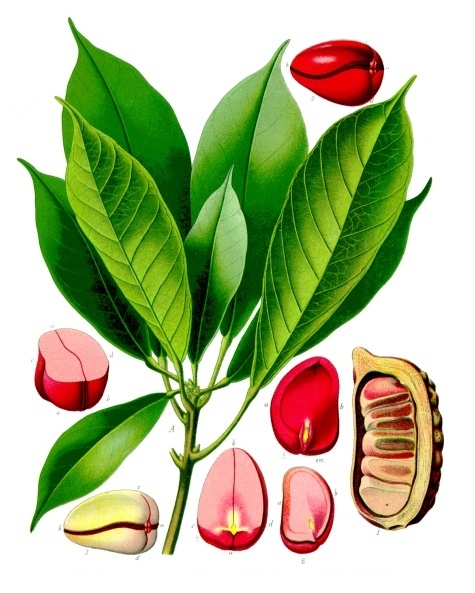
Cola is a genus of evergreen trees in the family Malvaceae (subfamily Sterculioideae, formerly placed in the separate family Sterculiaceae), native to the tropical forests of Africa. The genus encompasses approximately 140 accepted species, distributed primarily across the evergreen lowland and montane forests of continental tropical Africa.
Trees of this genus typically grow up to 20 metres (about 65 feet) tall, bearing glossy, ovoid leaves up to 30 centimetres long and distinctive star-shaped fruits. The genus is best known for the kola nut — the caffeine-rich seed harvested from the pods of two principal species, Cola nitida and Cola acuminata — which has been used for centuries as a stimulant across West and Central Africa and gave the soft drink "cola" both its name and, in early formulations, its characteristic caffeine content.
Cola was historically thought to be closely related to Theobroma (cocoa), the two genera sharing similar morphology and a tropical forest habitat. Molecular phylogenetics has since placed Theobroma in the subfamily Byttnerioideae, while Cola remains in Sterculioideae. The fossil record extends the genus back to the late Oligocene of Ethiopia (~27 million years ago), evidenced by Cola amharaensis, a well-preserved leaf compression from the Guang River flora. Outside mainland Africa, some Cola species are cultivated for their nuts in Brazil, Jamaica, and other parts of the humid tropics.
Etymology
The genus name Cola derives from kola, the West African vernacular name for the nut-bearing trees and their seeds. The same word passed into English as "kola nut" and ultimately gave the soft drink category its common name "cola."
Distribution
Cola comprises approximately 140 species found in the evergreen lowland and montane forests of tropical Africa. A small number of species, principally Cola nitida and Cola acuminata, are cultivated outside the continent in the humid tropics of the Americas — notably in Brazil and Jamaica — for commercial kola-nut production.
Cultural Uses
The seeds (kola nuts) of Cola nitida and Cola acuminata have long been chewed across West and Central Africa as stimulants owing to their caffeine content. They feature prominently in social ceremonies and hospitality traditions in many cultures. Historically, kola nuts were a key ingredient in early cola beverages, including the original Coca-Cola formulation, and the genus name became the global common name for the soft-drink category.
History
Fossil evidence places the genus in Africa as far back as the late Oligocene (~27 million years ago), based on Cola amharaensis, a fossil leaf from the Guang River flora of Ethiopia. The kola nut entered global commerce during the colonial era and was central to early soft-drink formulations in the late 19th century.
Taxonomy Notes
Cola was formerly placed in the family Sterculiaceae, but molecular studies have resulted in its inclusion in Malvaceae, subfamily Sterculioideae, under the APG classification system. The genus was historically considered closely related to Theobroma (cocoa), but the two are now assigned to different subfamilies within Malvaceae.










