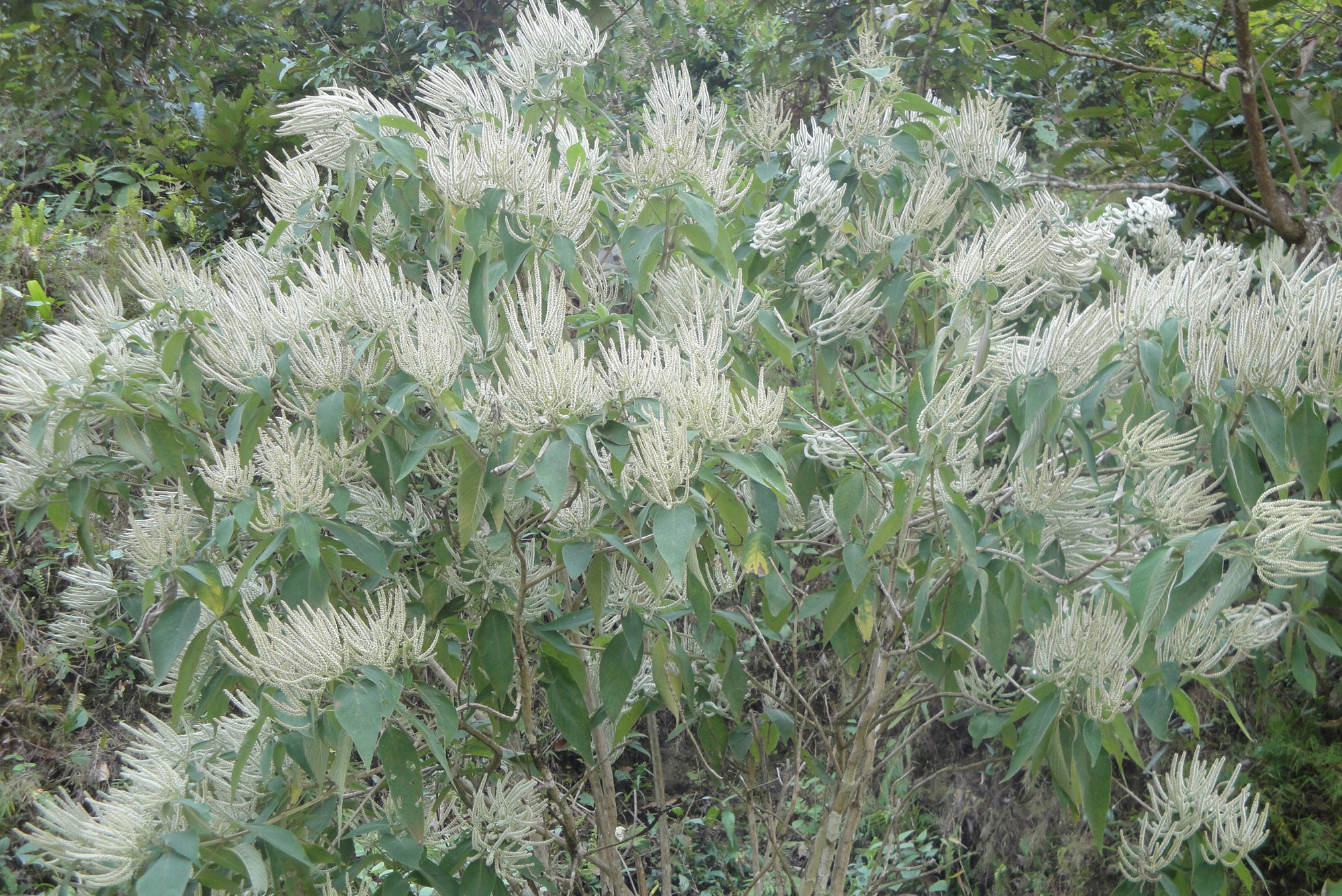
Colebrookea is a monotypic genus in the mint family (Lamiaceae, order Lamiales), first described by James Edward Smith in 1806 — originally published under the name Buchanania before being reclassified as Colebrookea. It contains a single accepted species, Colebrookea oppositifolia, native to the Himalayan foothills and adjacent South and Southeast Asia, with records from India, Pakistan, Nepal, Bhutan, Bangladesh, Myanmar, Thailand, and China (including Yunnan).
The genus is composed of tall, robust shrubs (occasionally herbs) with greyish, yellow-brown bark and a dense, felted (lanate-tomentose), non-glandular indumentum covering the stems. Leaves are opposite or borne in whorls of three, undivided, large, oblong-elliptic, and crenate to dentate along the margin. The inflorescence is a terminal panicle made up of numerous long, slender, spike-like branches, with densely congested, many-flowered verticillasters subtended by bracts that are fused at the base into an involucre-like structure.
Flowers are small, white, and sessile, and the species is gynodioecious, meaning individual plants bear either bisexual flowers or purely pistillate (female) ones, with stamens included in the female flowers and exserted in the bisexual ones. The calyx is campanulate with a very short tube and five slender teeth that elongate dramatically as the fruit matures, becoming capillary, spine-like, and plumose (feathery) — a feature reflected in the genus's Chinese name, 羽萼木属 ("feathered-calyx-tree"). The corolla is bilabiate, with an emarginate upper lip and a three-lobed lower lip whose middle lobe is longest. Each flower typically has four stamens and a style that splits evenly into two slender, spreading lobes near the tip; the fruit is a small, ovoid nutlet, hairy at the apex.
Regional floras describe Colebrookea as taxonomically isolated, with "no clear generic allies" within Lamiaceae, and note that its tall habit, panicles of slender spikes, and long, feathery fruiting calyx teeth make it very distinctive in the field.
Distribution
Colebrookea oppositifolia, the genus's only species, is native to the Himalayan foothills and neighboring parts of South and Southeast Asia. Wikipedia lists India, Pakistan, Nepal, Bhutan, Assam, Bangladesh, Myanmar, Thailand, and Yunnan; the Flora of China treatment corroborates China, India, Myanmar, Nepal, and Thailand, while the Flora of Pakistan confirms its presence in Pakistan.
Taxonomy Notes
The genus was first published in 1806 by James Edward Smith, originally under the name Buchanania, before being renamed Colebrookea (GBIF still lists Buchanania Sm. and Sussodia Buch.-Ham. ex D.Don as synonyms). Regional floras describe it as monotypic and without clear generic allies within Lamiaceae, distinguished by its tall, robust habit, panicles of slender flowering spikes, and the long, capillary-plumose calyx teeth that develop in fruit — the basis of its Chinese name, 羽萼木属 ("feathered-calyx-tree genus").










