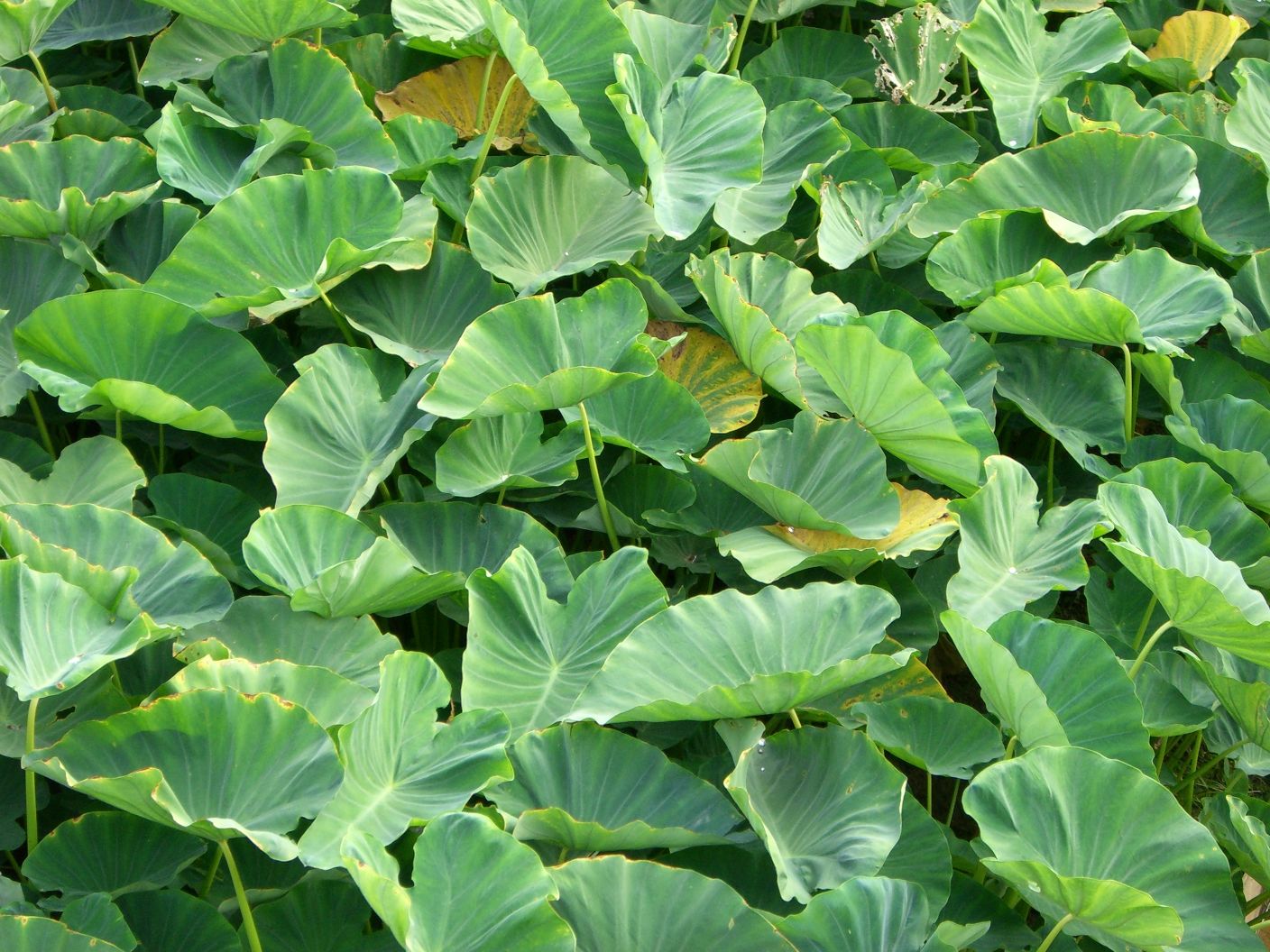
Colocasia is a genus of herbaceous perennial flowering plants in the family Araceae (order Alismatales), native to Southeast Asia and the Indian subcontinent. The genus is best known for Colocasia esculenta (taro), one of humanity's oldest cultivated starch crops, prized for its edible corms across tropical Asia, the Pacific, and beyond.
Plants in the genus grow from large corms at or just below the soil surface, producing impressively large leaves ranging from 20 to 150 cm in length. The leaves are sagittate (arrowhead- or shield-shaped), which gives rise to the common name "elephant ear" — a name shared with the related genera Xanthosoma and Caladium. Reproduction occurs primarily through rhizomes, tubers, and corms, though the plants also produce clusters of fragrant inflorescences in the leaf axils.
Like other aroids, Colocasia plants contain microscopic needle-like raphides of calcium oxalate monohydrate, which cause intense irritation to the lips, mouth, and throat if consumed raw. The corms and leaves must be thoroughly cooked, soaked, or fermented — sometimes with an acidic agent such as lime or tamarind — before they are safe to eat.
The genus is distributed natively from the Indian subcontinent through Southeast Asia, and has been naturalized across a much wider range including Africa, southern Europe, the Americas, and oceanic islands including Hawaii. C. esculenta has become invasive in wetland habitats along the Gulf Coast of the United States, where it threatens native wetland plant communities. Colocasia species also serve as larval food plants for certain Lepidoptera, including Palpifer murinus and P. sexnotatus.
Etymology
The generic name Colocasia derives from the ancient Greek word kolokasion. In the Koine Greek of the 1st-century CE botanist Pedanius Dioscorides, the term may have referred to the edible roots of both taro (C. esculenta) and the sacred lotus (Nelumbo nucifera).
Distribution
Colocasia is native to Southeast Asia and the Indian subcontinent, with individual species ranging from Yunnan and the eastern Himalayas through Indochina, Assam, Bangladesh, Myanmar, and the Nicobar Islands. Through millennia of cultivation, several species — especially C. esculenta — have been naturalized across tropical and subtropical regions worldwide, including Africa, southern Europe, South and Central America, the West Indies, Hawaii, and the southeastern United States.
Ecology
Colocasia species serve as larval food plants for several Lepidoptera, including Palpifer murinus and P. sexnotatus. Colocasia esculenta has become ecologically problematic as an invasive species in wetlands along the Gulf Coast of the United States, where it displaces native wetland vegetation.
Cultivation
Colocasia esculenta and other genus members are grown both for their edible corms — a traditional starch staple in many tropical regions — and as ornamental plants valued for their dramatic foliage. Plants can be grown in the ground or in large containers. In subtropical and tropical climates they remain in the ground year-round; in temperate regions they are typically planted out for summer and lifted in autumn, stored dry with ventilation to prevent fungal rot. Growth is optimal at 20–30 °C (68–86 °F), and plants suffer damage if temperatures drop below 10 °C (50 °F) for more than a few days. Corms are planted near the surface and show first growth within one to three weeks. Plants prefer compost-rich, moisture-retentive soil with some shade, though they tolerate average soils if kept sufficiently moist. Periodic fertilization every three to four weeks improves yields.
Cultural Uses
Taro (C. esculenta) is one of the world's oldest cultivated crops and remains a dietary staple across tropical Asia, the Pacific Islands, West Africa, the Caribbean, and parts of the Americas. The corm is consumed boiled, steamed, baked, or processed into flour, and the leaves are eaten as a vegetable in many cuisines. Because raw plant tissues contain irritating calcium oxalate crystals, traditional preparation methods — prolonged cooking, soaking, or fermentation — are essential before consumption.










