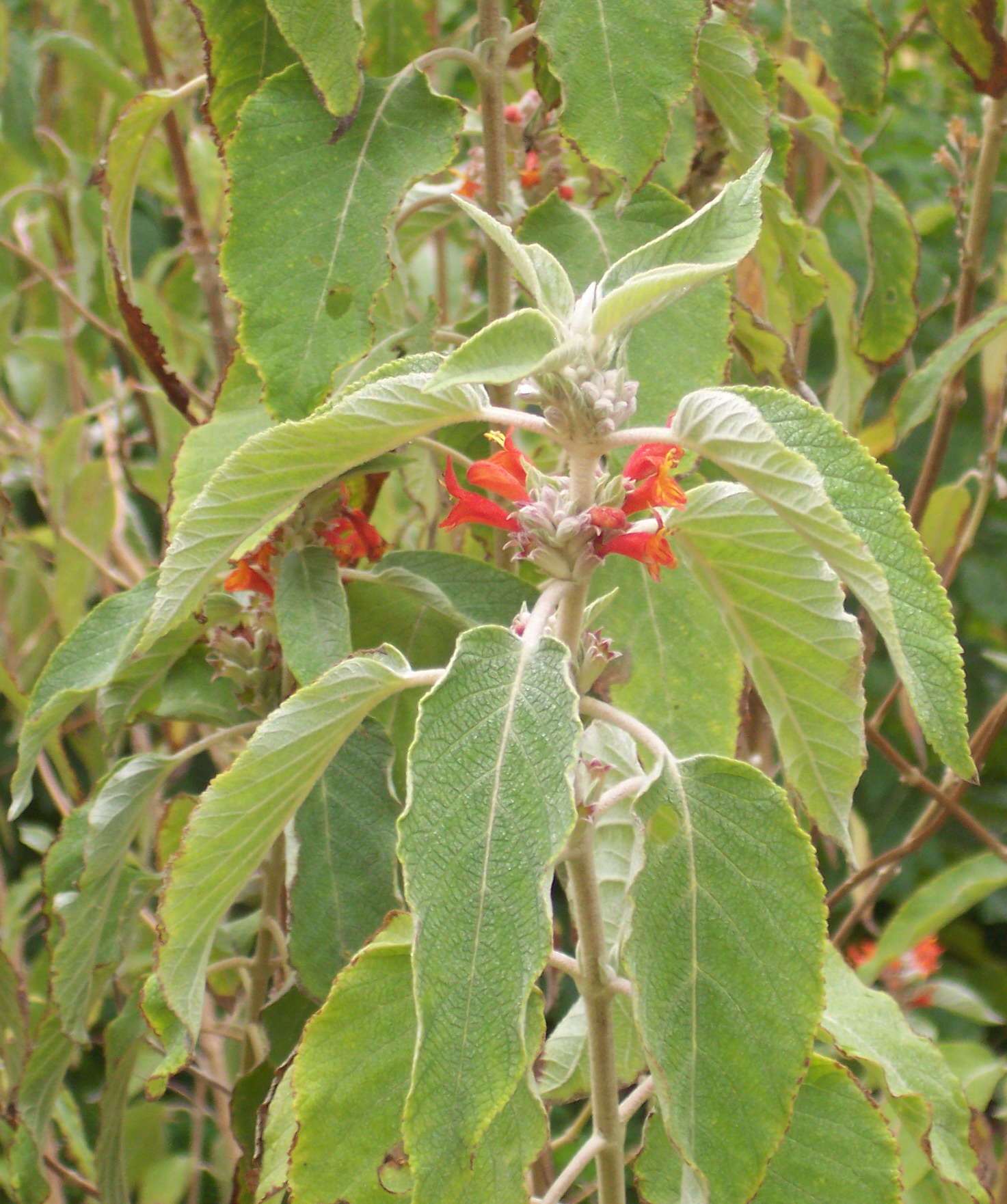
Colquhounia is a small genus of evergreen or semi-evergreen shrubs and subshrubs in the mint family, Lamiaceae, within the order Lamiales. The genus was first described in 1822 by Nathaniel Wallich and comprises about six recognized species.
Plants in this genus typically grow 1 to 3 metres tall, occasionally reaching 4 metres. Their square stems — a hallmark of the Lamiaceae — bear opposite pairs of aromatic, finely toothed leaves between 3 and 12 centimetres long. The tubular, two-lipped flowers are carried in terminal spikes, a floral form typical of many mint-family genera adapted for pollination by long-tongued visitors.
Colquhounia is native to the Himalaya and southwestern China, with its range extending south through Myanmar, Thailand, Laos, Cambodia, and Vietnam to Peninsular Malaysia. Individual species show more specific distributions within this broad range: Colquhounia coccinea spans Tibet, Yunnan, Bhutan, Assam, Arunachal Pradesh, Myanmar, Nepal, and Thailand, while Colquhounia vestita is found in Yunnan, Assam, Bhutan, Nepal, and the Himalayan foothills of northern and eastern India. This distribution places the genus within the biodiversity-rich montane and subtropical forests of the eastern Himalaya and Indo-Burma region.
Distribution
Colquhounia is native to the Himalaya and southwestern China, with its range extending south to Peninsular Malaysia. Within this range, Colquhounia coccinea is recorded from Tibet, Yunnan, Bhutan, Assam, Arunachal Pradesh, Myanmar, Nepal, and Thailand, while Colquhounia vestita occurs in Yunnan, Assam, Bhutan, Nepal, and the Himalayas of northern and eastern India.
Taxonomy Notes
Colquhounia was first described by Nathaniel Wallich in 1822 (published in Trans. Linn. Soc. London 13: 608), and is placed in the family Lamiaceae, order Lamiales. GBIF recognizes it as an accepted genus with about six species.










