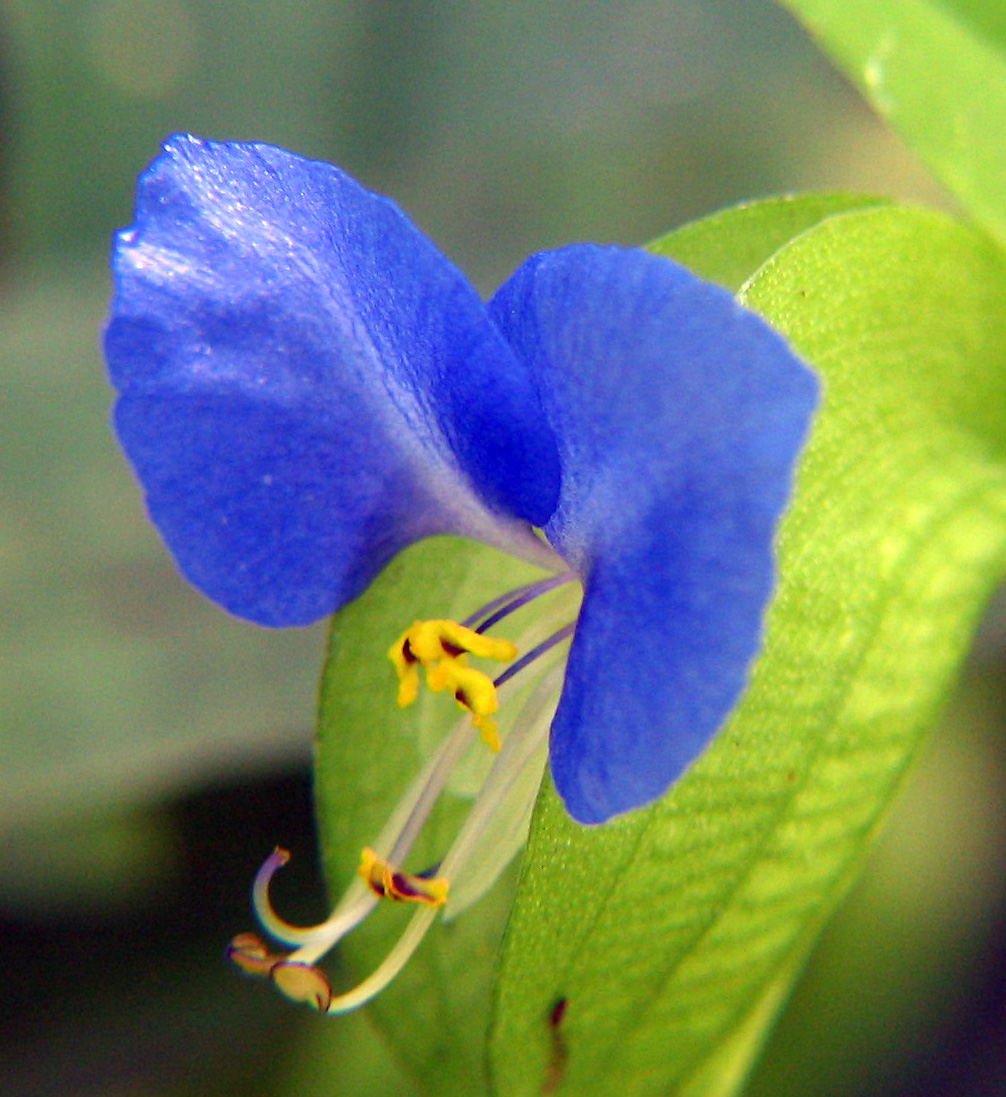
Commelina is a large, near-cosmopolitan genus of mostly tropical to warm-temperate herbs, and it sits at the heart of the family Commelinaceae — the dayflower family. Plants in the genus are perennial or annual, often weakly upright or sprawling, with simple, alternate leaves whose sheaths clasp succulent stems. What sets Commelina apart, more than any vegetative feature, is the curious architecture of its flowers.
Each flower is wrapped in a folded, leaf-like bract called a spathe, which usually persists at the base of the inflorescence and is often filled with a clear mucilaginous liquid. The flowers themselves are strongly zygomorphic — bilaterally symmetric rather than radial — with three unequal sepals and three petals in which the two upper petals are conspicuously larger and brightly coloured while the lower (proximal) petal is smaller and frequently differs in colour from the other two. The classic livery is sky blue, but across the genus petals also come in lilac, lavender, yellow, peach, apricot, and white. Inside the flower, six stamens are arranged in two unequal sets: three are fertile and three are sterile staminodes, the latter often elaborately ornamented and serving as visual lures for pollinators.
Each individual flower lasts only a single morning, opening at dawn and collapsing by mid-day — the source of the common name "dayflower" and the older folk name "widow's tears." A given plant compensates for this brevity by producing flowers in succession from the same spathe, so a colony in bloom can stay decorative for weeks.
Botanists currently recognise about 208 accepted species, although regional and older treatments often cite figures closer to 170. The genus has a long taxonomic history: Carl Linnaeus formally established it in Species Plantarum (1753), crediting Charles Plumier's earlier use of the name, and chose Commelina communis as the type species. Its native range is genuinely global within the tropics and warm-temperate zones, encompassing tropical Africa, South and Southeast Asia, much of the Americas including the southeastern United States, Australia, and Pacific islands. A handful of species — most notably C. communis and C. benghalensis — have spread far beyond their native ranges and are now naturalised across both hemispheres.
Several dayflowers play significant roles in human cultures, both as leaf vegetables and as traditional medicines in Africa and Asia. Others are valued ornamentals, while a few have become serious agricultural weeds, helped along by tough rhizomes, succulent stems that re-root easily, and, in C. benghalensis, the unusual habit of producing additional seed capsules underground.
Etymology
The genus name Commelina was bestowed by Carl Linnaeus in Species Plantarum (1753), building on an earlier use by the French botanist Charles Plumier — hence the full author citation "Plum. ex L." Linnaeus famously chose the name to honour the Dutch botanists Jan Commelijn (1629–1692) and his nephew Caspar Commelijn (1667/1668–1731). The widely repeated story — referenced in popular sources and in regional floras — is that the two upper, showy petals of Commelina communis represent the two distinguished Commelijns, while the smaller, often paler lower petal represents a third member of the family who died young before achieving anything of botanical note.
The vernacular name "dayflower" reflects the most distinctive habit of the genus: each individual flower lasts only a single morning, opening at dawn and collapsing by mid-day. The older English folk name "widow's tears" likely refers to the mucilaginous liquid that collects in the folded spathe enclosing the inflorescence.
Distribution
Commelina is almost cosmopolitan in distribution but is most diverse in the tropics and warm-temperate regions. POWO records native populations across tropical Africa, South and Southeast Asia, Central and South America, the southeastern United States, Australia, and the Pacific. Within North America, Commelina erecta and Commelina caroliniana are among the native species, while introduced members include C. communis and C. benghalensis.
The two most widely naturalised dayflowers extend the apparent range of the genus far beyond its tropical centre. The Asiatic dayflower (C. communis), native to East Asia, is now a common weed across much of Europe and eastern North America; Switzerland's national flora, for example, recognises it as the only Commelina present in the country. C. benghalensis, native to Bengal, ranges throughout warm-temperate, subtropical and tropical Africa and Asia and has naturalised across the Americas. POWO additionally records introductions of various Commelina species in places as climatically distinct as Albania, Algeria, Austria, the Baltic States, Bulgaria, California, and Ascension Island.
Ecology
Commelina species occupy a wide ecological range that mirrors their geographic spread, but most occur in moist, disturbed, or seasonally wet habitats. Across the African continent, dayflowers are found in forests, savanna, and grassland, characteristically thriving in sandy or sandy-rocky soils where they spread rapidly during the rains. Many species are short-lived perennials or annuals that complete their life cycle while soils remain moist.
The genus's pollination biology revolves around the unusual, asymmetrical flower. The mucilage-filled spathe protects developing buds, and the brightly coloured upper petals plus ornamented staminodes act as visual signals to insect visitors; in southern Africa, ants are noted as significant pollinators of C. africana. Several species are also self-compatible, and self-pollination has been documented in some Commelina species in temperate North America — a useful insurance policy for the genus given the very short life of an individual flower. Seed dispersal can be partly anthropogenic where the plants are gathered as vegetables, fodder, or medicine.
Cultural & Traditional Uses
Commelina has a long and varied human footprint, particularly across Africa and Asia. In southern Africa, Ndebele communities prepare root decoctions of C. africana to treat venereal diseases and menstrual complications, and Southern Sotho healers incorporate the plant's ash into charms used for the treatment of infertility, either applied topically or consumed as an infusion. The ash itself is used as a soil fertiliser, and the leaves of several species are cut for livestock feed.
C. benghalensis is among the most extensively used dayflowers worldwide. In Zulu medicine it is applied as a poultice for high blood pressure, while Sotho practitioners use it for infertility; broader African and Asian traditions employ it against burns, sore throats, eye conditions, dysentery, and skin rashes. The mild, succulent leaves are also eaten as a spinach-like vegetable in both Southeast Asia and Africa, and the plant is widely cut as fodder for cattle and other livestock.
Conservation & Weediness
The genus as a whole is not considered globally threatened, but a number of its members have moved in the opposite direction and become significant agricultural weeds. C. benghalensis is characterised by southern African botanists as "a common, troublesome, widespread weed that is difficult to eradicate" — its unusual habit of producing additional seed capsules on subterranean runners means that even diligent removal of above-ground growth leaves a reservoir of viable seed safely below the soil surface. C. communis is likewise treated as a common weed across much of its naturalised range in Europe and eastern North America. These weedy traits — rapid vegetative spread, rooting from succulent stem nodes, and prolific seed production — appear in several other species of the genus and complicate management in tropical and subtropical cropping systems.
Taxonomy Notes
Commelina was formally established by Carl Linnaeus in Species Plantarum (1753), crediting an earlier use by Charles Plumier; the standard author citation is therefore "Plum. ex L." It is the type genus and the largest genus of the family Commelinaceae, within the order Commelinales (monocots, class Liliopsida). The type species is Commelina communis.
POWO accepts 208 species in the genus and lists 21 heterotypic synonyms — including such names as Allosperma, Allotria, Ananthopus, Commelinopsis, and Dirtea — reflecting a long history of segregate genera that have ultimately been folded back into Commelina. Older regional treatments and some floras still cite a global figure closer to 170 species (for example the SEINet/Flora of North America summary and SANBI's southern African account), so any published species count should be read with the date of the source in mind. GBIF's species backbone lists 376 descendant taxa under the genus, which includes both accepted species and a long tail of synonyms and infraspecific names.
History
The genus is among the earliest plant names formally adopted by Linnaeus, who published it in Species Plantarum in 1753 — one of the foundational works of modern botanical nomenclature. Linnaeus drew the name from earlier usage by the French monk-botanist Charles Plumier, who in turn dedicated it to the Commelijn family of Dutch botanists active at Amsterdam's Hortus Botanicus in the 17th and early 18th centuries. The often-retold etymology, with the showy upper petals standing in for the two famous Commelijns and the small lower petal for an undistinguished third relative, has become one of the best-known anecdotes attached to a Linnaean name and is repeated in regional floras across the world today.










