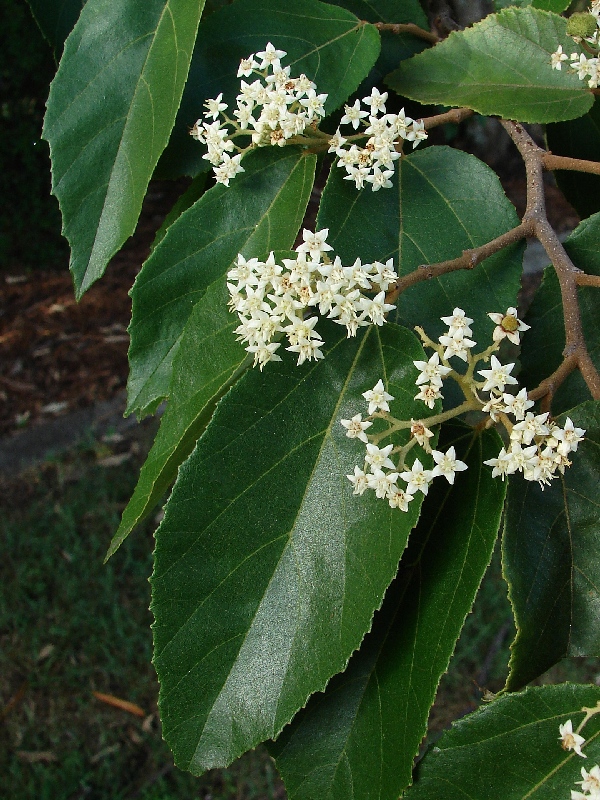
Commersonia is a genus of flowering plants in the mallow family Malvaceae, comprising around twenty-five accepted species of shrubs and trees. Members occur from Indochina to Australia, with individual species also native to Vanuatu, New Guinea, Madagascar and the Society Islands; the great majority of Australian species are confined to Western Australia, with others scattered across New South Wales, Victoria, Queensland, the Northern Territory and South Australia.
Plants in the genus have stems, leaves and flowers covered with star-shaped (stellate) hairs. The leaves are simple, often with irregularly toothed margins. Flowers are bisexual, with five sepals, five petals and five stamens, and the fruit is a capsule that splits into five valves.
Commersonia belongs to the order Malvales. It was formally described in 1775 by the naturalists Johann Reinhold Forster and his son Georg Forster in Characteres generum plantarum. The first species they described, Commersonia echinata, is now known as Commersonia bartramia. The genus name honours Philibert Commerson (1727–1773), a French naturalist who took part in the Bougainville expedition of 1766 and died on Mauritius.
The circumscription of Commersonia has changed substantially over time: a taxonomic revision published in 2011 added three newly described species and transferred fourteen species previously classified in the genus Rulingia into Commersonia, while at the same time moving a number of other species out into the newly created genus Androcalva. This history is reflected in the common names of several current Commersonia species, which still reference "rulingia" (for example hazel-leaved rulingia and round-leaved rulingia).
Well-known members include Commersonia bartramia (brown kurrajong), a tree ranging from Southeast Asia to eastern Australia, and Commersonia dasyphylla (kerrawang), a shrub of eastern Australia.
Etymology
The genus is named after Philibert Commerson (1727–1773), a French naturalist who took part in the Bougainville expedition of 1766 and died on Mauritius. Commersonia was described in 1775 by Johann Reinhold Forster and his son Georg Forster.
Distribution
Species of Commersonia occur from Indochina to Australia, with the majority of Australian species endemic to Western Australia and others found in New South Wales, Victoria, Queensland, the Northern Territory and South Australia. Other species extend to Vanuatu, New Guinea, Madagascar and the Society Islands.
Taxonomy Notes
Commersonia (family Malvaceae, order Malvales) was described in 1775 by J.R. Forster & G. Forster; the first species named, Commersonia echinata, is now treated as Commersonia bartramia. A 2011 revision reshaped the genus, adding three newly described species and moving fourteen species out of Rulingia into Commersonia, while transferring other species into the newly erected genus Androcalva.










