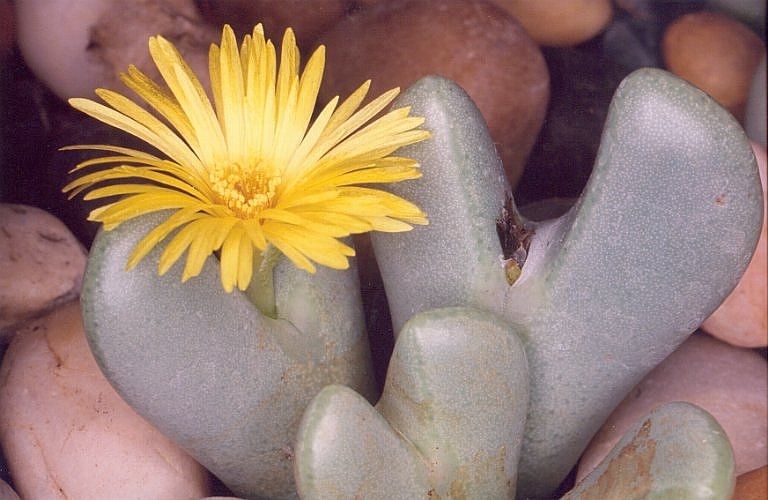
Conophytum is a genus of about 100–106 accepted species of miniature succulent plants in the family Aizoaceae (the fig-marigold family), native to the arid regions of southern Namibia and the western and southern Cape Provinces of South Africa. The plants are sometimes called button plants, knopies (Afrikaans for "buttons"), dumplings, or cone plants.
Each plant body consists of a pair of highly succulent leaves fused together into a compact, often globe-like or conical shape. Depending on the species, these bodies range from deeply bilobed to smoothly spherical or conical, and measure between about 6 mm and 5 cm across. Some species possess translucent epidermal windows that allow light to penetrate into the interior tissues. Because conditions in their native habitat are extremely harsh, Conophytum grow very slowly: a 50-year-old specimen may reach no larger than a walnut.
Like most members of the Aizoaceae, Conophytum follows a pronounced growth cycle tightly linked to rainfall patterns. During the dry season, the outer leaf pair desiccates and forms a papery sheath that protects the developing new growth inside. Plants enter full dormancy in spring (in the Northern Hemisphere, roughly late March through late July), during which watering should be withheld entirely. The active growing and flowering season runs from late summer through autumn — typically late July or August through mid-October in the Northern Hemisphere — with weekly watering. In winter, watering is reduced to approximately once every three weeks.
The genus was formally described by the botanist Nicholas Edward Brown in 1922, published in Gardeners' Chronicle. Five formerly separate genera — Berresfordia, Conophyton, Derenbergia, Herreanthus, and Ophthalmophyllum — have since been synonymized within Conophytum. The type species is Conophytum minutum, with the lectotype designated in 1951.
Etymology
The genus name Conophytum combines the Latin conus (cone) and the Greek phytum (plant), reflecting the conical or dome-shaped body of many species. Common vernacular names include knopies (Afrikaans for "buttons"), waterblasies (Afrikaans: "water blisters"), cone plants, dumplings, sphaeroids, conos, and button plants. The name Conophyton was tentatively suggested by Adrian Hardy Haworth in 1821 but was never formally published; Nicholas Edward Brown's 1922 name Conophytum stands as the valid publication.
Distribution
Conophytum is endemic to the winter-rainfall succulent Karoo region of the southwestern corner of southern Africa. The genus occurs naturally in southern Namibia and in the western and southern Cape Provinces of South Africa, where plants grow in rock crevices and on exposed quartz outcrops in extremely arid habitat. This restricted, highly specialized distribution makes the genus acutely vulnerable to any disturbance of its native habitat.
Taxonomy
The genus Conophytum was formally established by Nicholas Edward Brown in 1922 in Gardeners' Chronicle (series III, volume 71, page 198). Adrian Hardy Haworth had earlier suggested the parallel name Conophyton in 1821, but did not validly publish it; Brown's name therefore takes precedence. The lectotype, Conophytum minutum, was formally designated in 1951.
Conophytum is placed in the family Aizoaceae, order Caryophyllales, class Magnoliopsida. Five formerly recognized genera have been subsumed as synonyms: Berresfordia, Conophyton, Derenbergia, Herreanthus, and Ophthalmophyllum. GBIF records 258 descendant taxa within the genus; approximately 106 are treated as accepted species in current checklists.
Cultivation
Conophytum follows a strict seasonal growth cycle that must be respected in cultivation. The plants are well suited to container growing and demand excellent drainage. In the Northern Hemisphere, the dormancy period runs from approximately the end of March through late July; during this time watering should cease entirely, allowing old leaf pairs to dry into a protective papery sheath around the emerging new growth. As temperatures rise in late summer (late July or August), watering can resume on a weekly basis through to mid-October. From mid-October through winter, watering should be reduced to approximately once every three weeks. In spring, as temperatures climb again, weekly watering resumes until the next dormancy period.
Optimal growing temperatures fall between 15°C and 25°C (59°F–77°F). The plants are generally grown in a gritty, very free-draining substrate and appreciate full sun to bright indirect light. Heavy rainfall or overwatering during dormancy can cause abnormal "stacking," where two leaf pairs develop simultaneously rather than one replacing the other.
Conservation
Several Conophytum species are threatened with extinction, primarily due to habitat destruction from small-scale mining and, increasingly, poaching from wild populations for the international succulent trade. Demand from collectors — notably in East Asian markets — has driven significant illegal harvesting. In June 2021, South African police arrested twelve men at a farm in the Western Cape in possession of approximately 4,000 plants identified as Conophytum acutum, a figure that astonished researchers who had estimated only around 1,000 wild individuals of that species existed.
Conservation efforts include seed banking: Kirstenbosch National Botanical Garden collaborates with the Millennium Seed Bank to collect, categorize, and preserve seed material from vulnerable Conophytum populations as an insurance against extinction.

