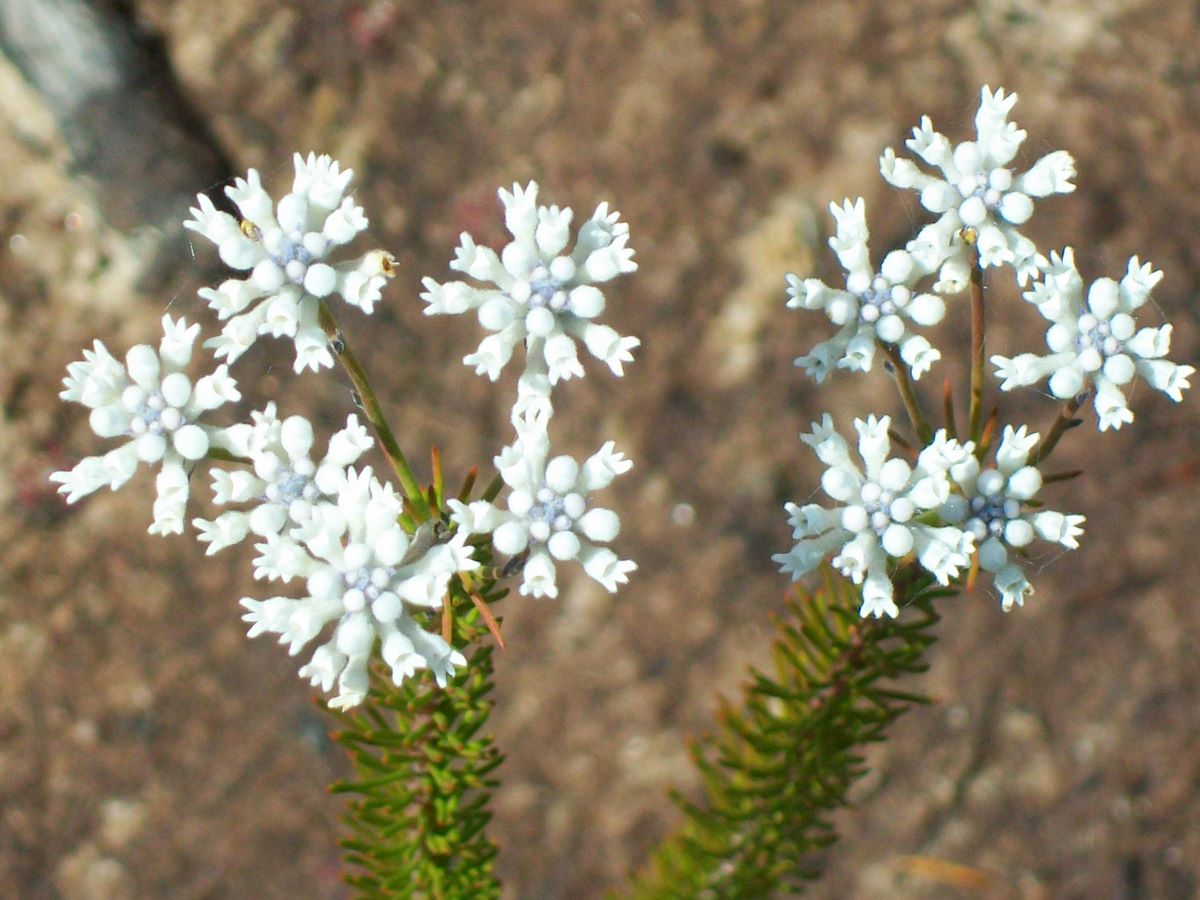
Conospermum is a genus of approximately 50 species of flowering shrubs and small trees in the family Proteaceae (order Proteales), endemic to Australia. Members of the genus are commonly known as smokebushes — a name earned by their wispy heads of blue or grey flowers that, from a distance, resemble drifting puffs of smoke.
Plants range from low shrubs of about 0.3 metres to small trees reaching 4 metres in height. The leaves are usually simple, linear to egg-shaped, with smooth (entire) margins. Flowers bear both male and female parts, are arranged in heads or spikes, and come in shades of white, pink, blue, grey, or cream. The fruit is a small nut, typically fringed with hairs at its base.
The genus is notable for an exceptional pollination mechanism. When an insect lands on an open flower, the compressed style suddenly flicks from one side of the flower to the other, simultaneously collecting pollen deposited by the visitor and coating the insect with adhesive. The anthers then burst, dusting the insect with fresh pollen. The mechanical force of this flick is sufficient to kill small ants and flies. Certain specialist bees in the genus Leioproctus (L. conospermi, L. pappus, and L. tomentosus) have co-evolved to feed exclusively on one or two Conospermum species, obtaining both nectar and pollen, and some appear to be camouflaged with white eyes, pale wings, and white-haired bodies. Research published in 2020 also documented ant pollination in C. undulatum, a rare pollination mode in plants — ants carried 68–86% viable pollen grains and measurably contributed to seed set.
Conospermum was first formally described by James Edward Smith in 1798, published in the Transactions of the Linnean Society of London. The type species, C. longifolium (long leaf smokebush), was not formally described until 1806. Most of the roughly 50 species are concentrated in the biodiversity hotspot of south-west Western Australia, with smaller numbers in New South Wales and one species reaching Tasmania. Several Western Australian species are commercially harvested for the cut flower trade.
Etymology
The genus name Conospermum derives from the Ancient Greek κῶνος (kônos), meaning "cone," and σπέρμα (spérma), meaning "seed," referring to the cone-like shape of the fruit. The common name smokebush alludes to the wispy grey or blue flower heads, which resemble puffs of smoke when viewed from a distance.
Distribution
Conospermum is endemic to Australia, occurring in all mainland states. The great majority of species are restricted to the south-west of Western Australia, a globally recognised biodiversity hotspot. Six species extend to New South Wales and one, C. taxifolium, occurs in Tasmania.
Ecology
Conospermum flowers are pollinated primarily by insects through a spring-loaded mechanism: when a visitor lands, the style snaps laterally, collecting incoming pollen and applying adhesive before the anthers release a pollen burst — a force strong enough to kill small ants and flies. Specialist bees of the genus Leioproctus have co-evolved as dedicated pollinators of one or two Conospermum species and show striking camouflage adaptations (white eyes, pale wings, white-haired bodies) matching the pale flower heads. Ant pollination — unusual in the plant kingdom — is also documented in C. undulatum, where ants carry a high proportion of viable pollen and contribute meaningfully to seed set.
Taxonomy Notes
The genus was established by James Edward Smith in 1798 (Trans. Linn. Soc. London), with C. longifolium as the type species. In 1975, Australian botanists Lawrie Johnson and Barbara Briggs placed Conospermum in the subtribe Conosperminae alongside Synaphea, a placement subsequently confirmed by molecular phylogenetic evidence showing the two genera are sister taxa. The genus belongs to the family Proteaceae, order Proteales.










