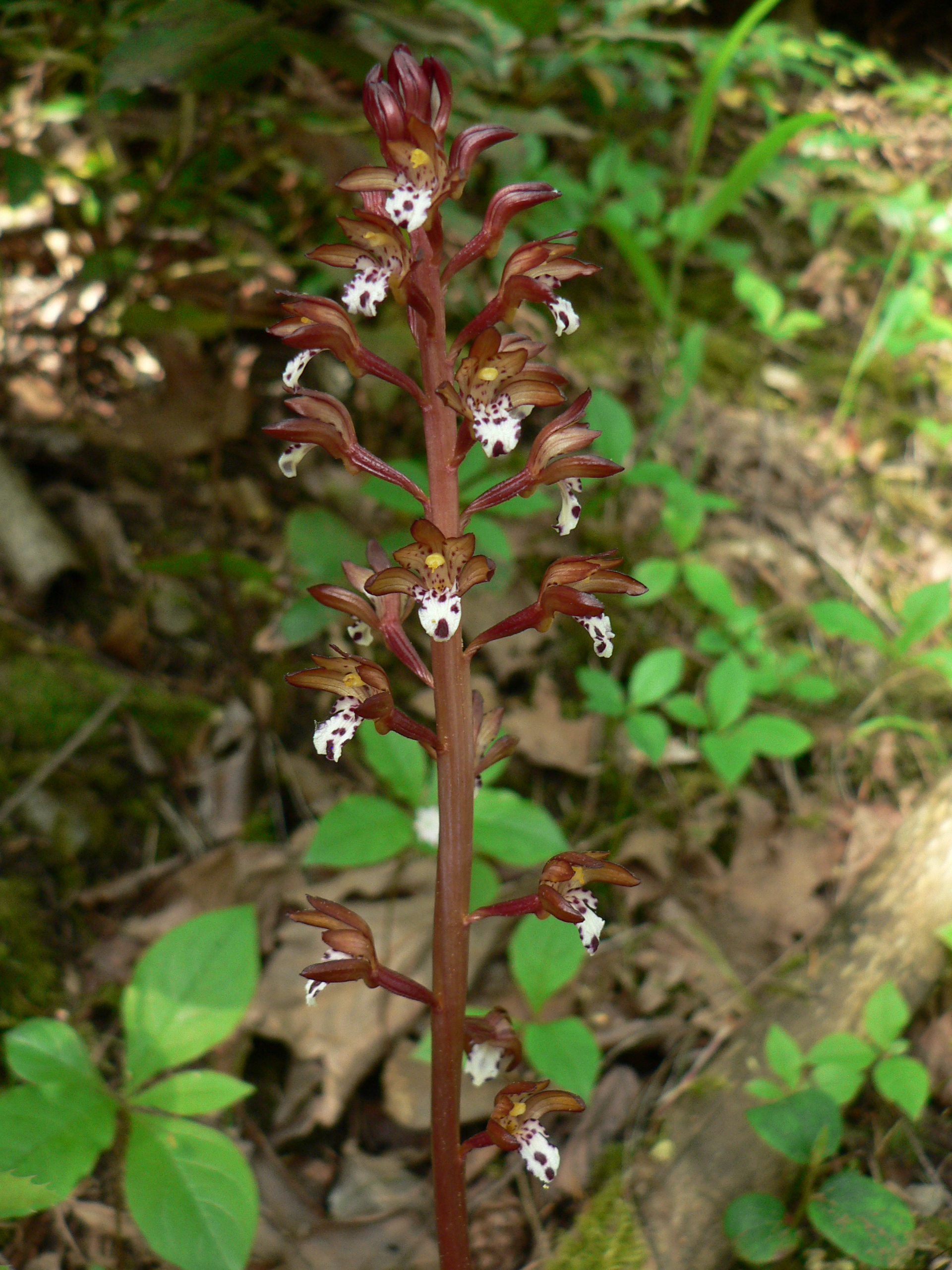
Corallorhiza, commonly known as coralroot orchids, is a genus of flowering plants in the family Orchidaceae (order Asparagales). The genus comprises roughly a dozen species, nearly all native to North America, from Canada through Mexico, Central America, and the West Indies. The single exception is Corallorhiza trifida, which has a circumboreal distribution spanning North America, Europe, and Asia.
Coralroot orchids are among the most extreme examples of mycoheterotrophy in the plant kingdom. Instead of true roots, they possess distinctive coral-shaped rhizomes that are colonised by mycorrhizal fungi; it is from these coral-like structures that the genus takes both its scientific name and its common name. Most species are completely leafless and produce little or no chlorophyll, abandoning photosynthesis entirely in favour of obtaining carbon and nutrients directly from the fungal network. Corallorhiza trifida is a partial exception — it retains some chlorophyll and can fix a limited amount of CO₂ — but even this species depends primarily on its fungal partners for carbon acquisition.
Because of their obligate dependence on specific mycorrhizal fungi, coralroot orchids have never been successfully cultivated; removing them from their native habitat severs the fungal associations they need to survive. The plants are typically inconspicuous, appearing above ground only during the flowering season as slender, often brownish or purplish stems bearing small orchid flowers. Notable species include C. maculata (spotted coralroot), one of the most widespread members of the genus across western and central North America; C. striata (striped coralroot), recognised by the bold purple-striped petals; C. odontorhiza (autumn coralroot), which flowers late in the season across eastern North America; and C. mertensiana (western coralroot), found along the Pacific coast.
Etymology
The name Corallorhiza is derived from the Greek korallion (coral) and rhiza (root), referring to the branched, coral-like appearance of the rhizomes that replace true roots in these orchids.
Distribution
Almost all species are confined to North America, ranging from Canada south through the United States, Mexico, Central America, and the West Indies. Corallorhiza trifida is the single wide-ranging outlier, with a circumboreal distribution that extends across northern Europe and Asia as well.
Ecology
Coralroot orchids are obligate mycoheterotrophs: their coral-shaped rhizomes host mycorrhizal fungi from which the plants draw carbon and nutrients, bypassing photosynthesis almost entirely. Most species produce no functional leaves and negligible chlorophyll. Corallorhiza trifida retains some photosynthetic capacity but still relies primarily on its fungal associations. This intimate dependency on specific soil fungi means that coralroot orchids can neither be transplanted successfully nor cultivated — they are strictly tied to intact native plant communities that sustain the required fungal networks.

