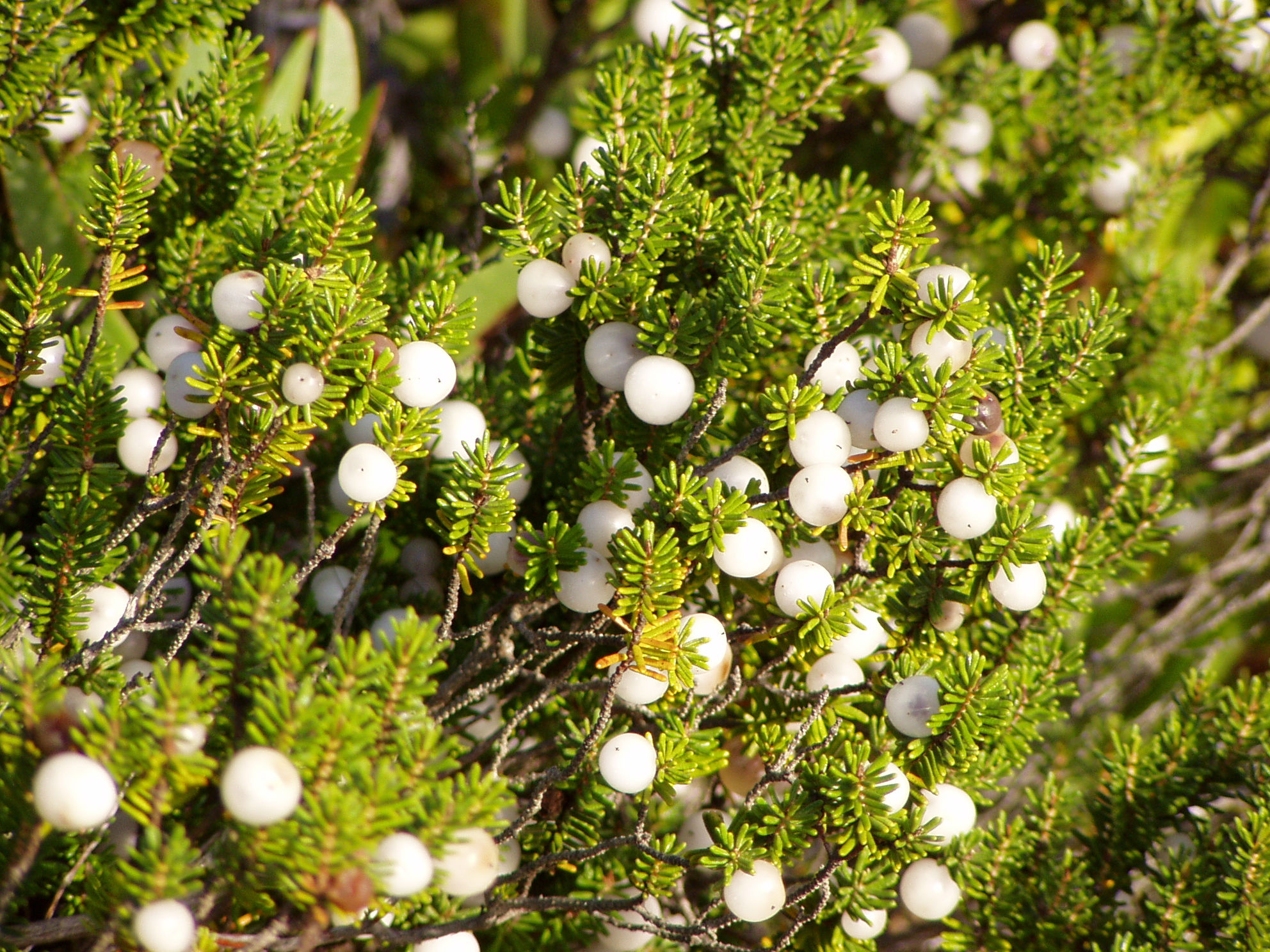
Corema is a small genus of just two species of flowering shrubs in the family Ericaceae (order Ericales), the heather family. The genus is notable for its restricted, disjunct distribution: one species occurs on the Iberian Peninsula and Atlantic islands, while the other is native to the northeastern coast of North America. Both species are dioecious — plants are either male or female — and form low, compact shrubs with needle-like leaves reminiscent of other ericaceous genera such as crowberries (Empetrum).
The better-known species, Corema album (L.) D. Don, is called Camarinha or Portuguese crowberry. It grows to roughly one metre in height; its branches carry a honey-like scent, and when ripe it produces small white drupes that are edible and have been consumed in coastal Portugal and Spain for centuries. The second species, Corema conradii (Torr.) Torr. ex Loudon, known as Broom crowberry or Conrad's broom crowberry, is native to sandy coastal barrens and pine barrens of the northeastern United States, from New Jersey northward to Nova Scotia.
Etymology
The genus name Corema derives from the Greek korema (κόρημα), meaning "broom" or "besom", in reference to the plant's broom-like, densely branched habit.
Distribution
Corema album is native to the Atlantic coast of the Iberian Peninsula (Portugal and Spain) and nearby Atlantic islands. Corema conradii occurs in coastal and inland sandy barrens of the northeastern United States and adjacent Canada. The two species represent a striking transatlantic disjunction within Ericaceae.
Ecology
Both species inhabit nutrient-poor, sandy, or rocky substrates — coastal dunes and scrubland in the case of C. album, and pine barrens and coastal heathlands for C. conradii. Their dioecious breeding system requires both male and female plants for fruit set. The white drupes of C. album are consumed by birds and mammals, aiding seed dispersal.










