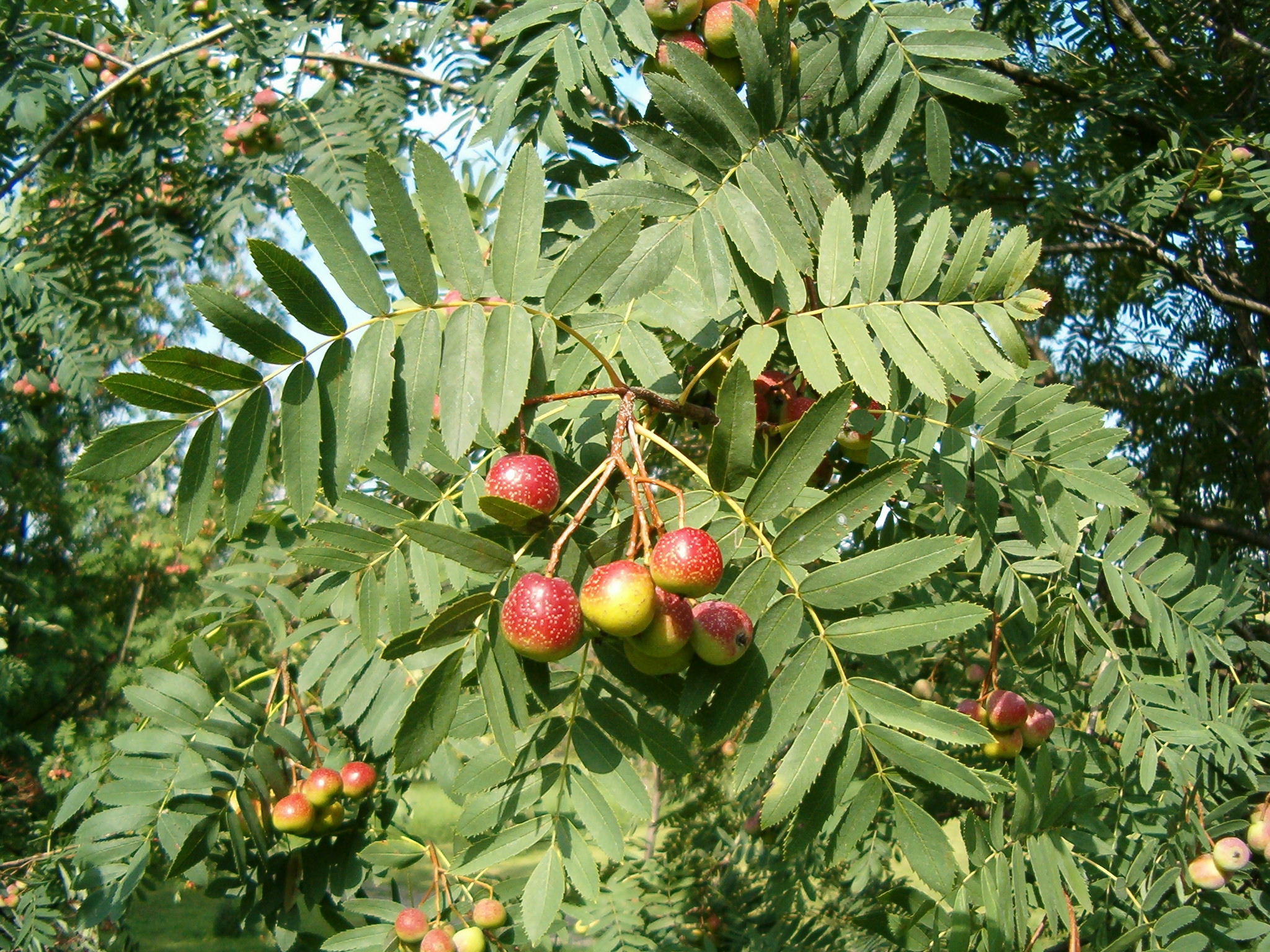
Cormus is a monotypic genus of flowering plant in the rose family (Rosaceae), order Rosales, containing a single species: Cormus domestica, commonly known as the service tree or sorb tree (not to be confused with the wild service tree, Torminalis glaberrima). GBIF's accepted taxonomic placement confirms the genus holds exactly one descendant species, and Wikipedia states directly that it is "the only species in the monotypic genus Cormus."
The service tree is a deciduous tree typically 15–20 m tall (occasionally to 30 m), with a trunk up to 1 m in diameter, though on exposed sites it can grow as a shrub only 2–3 m tall. Young bark is smooth and brown, becoming scaly and rough with age. The pinnate leaves, 15–25 cm long, carry 13–21 serrated leaflets. In late spring it produces white, five-petalled, insect-pollinated flowers held in broad corymbs, followed by a small, human-edible pome fruit — greenish-brown, often flushed red, and shaped like a miniature apple or pear depending on the form. This fused-carpel pome fruit is the character that distinguishes the genus from the compound-leaved subgenera of Sorbus, within which Cormus was formerly classified.
Its native range spans western, central and southern Europe, northwest Africa's Atlas Mountains, and southwest Asia as far east as the Caucasus. Across much of this range it is now uncommon to rare: it is listed as endangered in Switzerland and Austria and is uncommon in Spain. Genuinely wild populations persist as stunted shrubs on coastal cliffs in south Wales, southwest England (Gloucestershire and Cornwall), making it one of Britain's rarest native trees, found at only a handful of sites. Individual trees can be very long-lived, with ages of 300–400 years recorded in Britain and one veteran specimen in Moravia, Czech Republic, estimated at roughly 450 years old.
The tree has a long history of human use. Its fruit, astringent until "bletted" (overripened), has been fermented into a cider-like drink and made into jam, juice and brandy, traditions still celebrated with a dedicated festival and museum in the Moravian Slovakia region. The species appears in the Babylonian Talmud and is referenced in Plato's Symposium, and its dense, stable wood was historically prized for making woodworking hand planes.
Etymology
The English name "service tree" derives from Middle English "serves" (plural of "serve"), from Old English "syrfe", itself borrowed from the Latin "sorbus" — unrelated to the verb "serve". Other English names include sorb, sorb tree, and whitty pear, the last combining "whitty" (from its rowan-like pinnate leaves) with "pear" (from the fruit's shape).
Distribution
The genus's sole species is native to western, central and southern Europe, northwest Africa's Atlas Mountains, and southwest Asia east to the Caucasus.
Ecology
The species grows as a deciduous tree or, on exposed sites, a low shrub, and is long-lived — ages of 300–400 years are recorded in Britain, with one Moravian specimen estimated at around 450 years old. Genuinely wild individuals persist as stunted shrubs on coastal cliffs in south Wales and southwest England, among only a handful of known British sites.
Conservation
The species is listed as endangered in Switzerland and Austria and is uncommon in Spain; in Britain it survives at only a handful of wild sites.
Cultivation
The fruit, gritty and astringent when picked, sweetens once "bletted" (overripened) and is used to make a cider-like drink, jam, juice and brandy — traditions still active in the Moravian Slovakia region of the Czech Republic, home to a dedicated festival and community museum.
Cultural Uses
The tree is cited in the Babylonian Talmud (Ketubot 79a) and referenced in Plato's Symposium, where its pickled, halved fruit serves as a metaphor. Its dense, stable wood was historically favored for manufacturing wooden hand planes.
Taxonomy Notes
Cormus is treated as a monotypic genus (family Rosaceae, order Rosales per GBIF) with a single accepted species, Cormus domestica, distinguished from Sorbus by its fused carpels producing an apple- or pear-shaped pome; it has historically also been treated as a subgenus of Sorbus.










