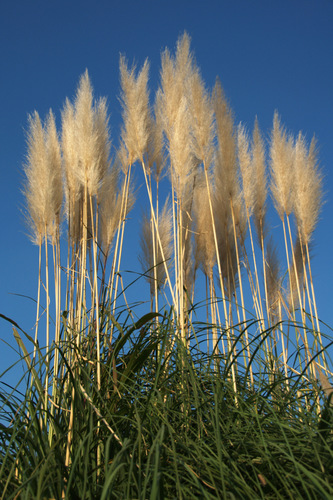
Cortaderia is a genus of approximately 20 species of perennial grasses in the family Poaceae (order Poales), native to South and Central America. The genus is perhaps best known for its ornamental representative, pampas grass (Cortaderia selloana), whose towering silky plumes have made it a widely planted — and in many regions invasive — garden specimen.
All species share a distinctive growth form: robust, upright culms rising from dense basal tussocks, topped by large, feathery inflorescent plumes that stand well above the foliage. Smaller species form rounded, hedgehog-like clumps less than 0.5 m tall, while larger species, including C. selloana and C. jubata, can build tussocks up to 4 m in height, sometimes nearly as wide as they are tall. Rhizomes and stolons are rare across the genus.
In their native range, Cortaderia species are a dominant component of C3 temperate grasslands stretching from Tierra del Fuego in the far south through Patagonia, the Pampas, and the Andes all the way north to Venezuela and Costa Rica. Some species are adapted to high elevations, occurring at up to 4,500 m in Andean paramo, where they form a major part of the vegetation. The genus also reaches the Atlantic coastal mountains of Brazil (Serra do Mar) in the east.
The name Cortaderia comes from the Argentine Spanish word cortadera, itself a reference to the sharply serrated leaf margins that can easily cut exposed skin — a practical warning for anyone working around mature plants. The common name “pampas grass,” though strictly applied to C. selloana, is widely used for the entire genus and even for some species formerly included in it.
For many years, several New Zealand species were treated as members of Cortaderia, but since 2011 these have been reclassified into the separate genus Austroderia, which is now considered endemic to New Zealand. Cortaderia in its current circumscription contains species exclusively from the Americas.
Two species — C. selloana and C. jubata — have become significant invasive plants outside their native range, establishing in parts of the Atlantic coast of Europe (from Portugal to France, especially northern Spain), California, Hawaii, Australia, New Zealand, and South Africa. Both produce abundant seed and can rapidly colonise disturbed ground, dunes, riverbanks, and sparse shrublands, outcompeting native vegetation and accumulating flammable leaf litter.
Etymology
The genus name Cortaderia derives from the Argentine Spanish word cortadera (“cutter”), referring to the sharp serrations along the leaf margins that can easily lacerate skin. The popular common name “pampas grass,” though strictly applicable only to C. selloana, is frequently extended to all species in the genus and even to some former members now placed in Austroderia.
Distribution
Cortaderia is native to South and Central America, ranging from the Patagonia region of southern Chile and Argentina north through the Andes and surrounding lowlands to Costa Rica. Species occur from sea level to approximately 4,500 m elevation in Andean paramo, and from the Atlantic coastal mountains of Brazil west to Ecuador. Cortaderia selloana and C. jubata have naturalised far beyond this native range, becoming invasive in parts of Europe, North America, Australasia, and southern Africa.
Ecology
The genus forms a major component of C3 temperate grasslands across South America, contributing significantly to paramo vegetation at high Andean elevations. Several species — particularly C. selloana and C. jubata — are highly competitive in disturbed habitats, colonising disused farmland, dunes, sparse shrublands, and riparian areas. The accumulation of slow-decomposing dead leaf litter in large tussocks increases fire risk in fire-prone regions.
Cultivation
Cortaderia selloana is the most widely cultivated species, prized in temperate gardens for its tall, showy plumes. Both C. selloana and C. jubata have escaped cultivation to become invasive weeds in California, Hawaii, Oregon, parts of Australia, New Zealand, South Africa, and the Atlantic arc of Europe. In regions where they are classified as noxious or invasive, planting may be restricted or prohibited.










