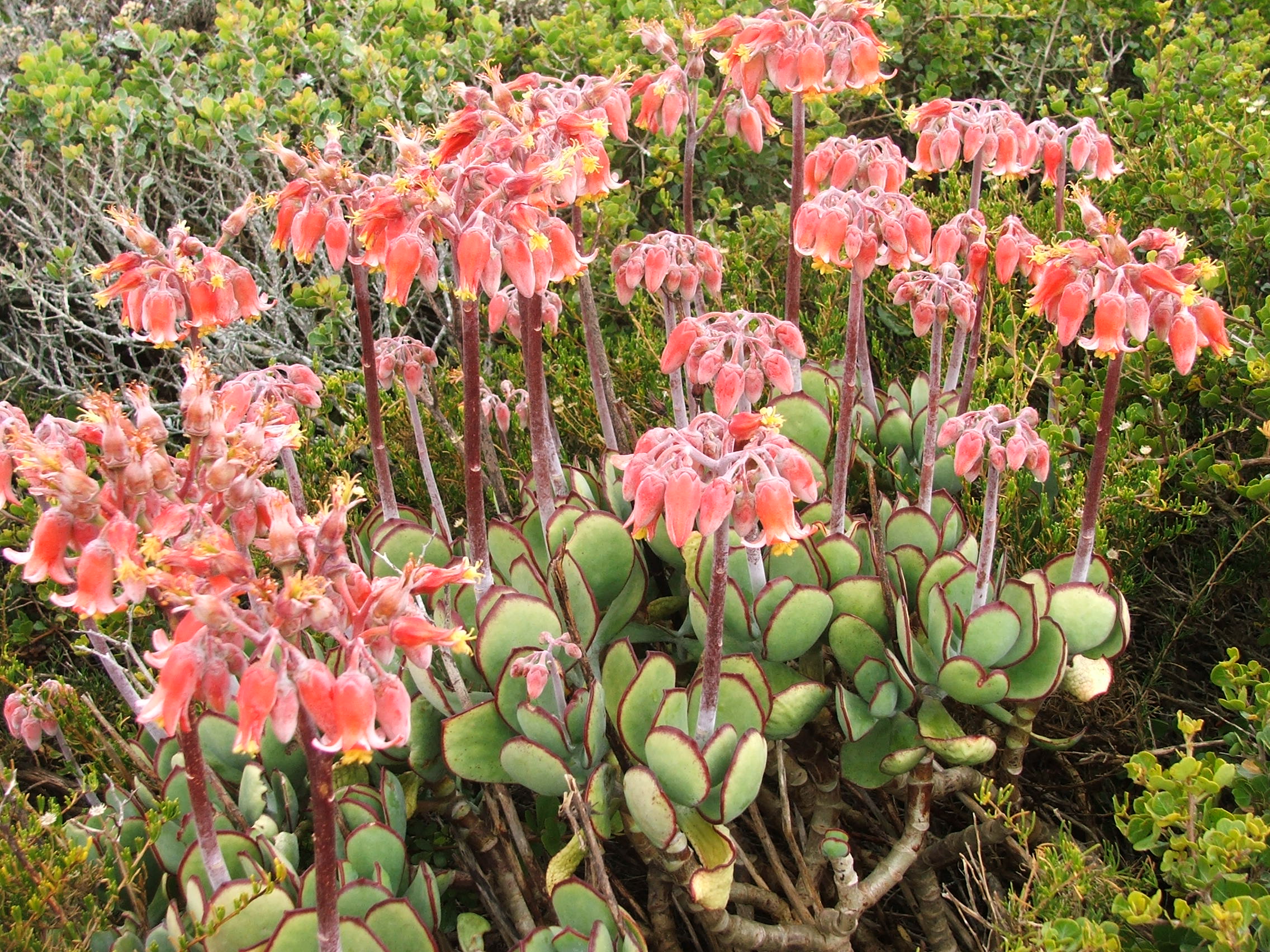
Cotyledon is a genus of roughly 35 species of succulent plants belonging to the family Crassulaceae (order Saxifragales), most closely related to Tylecodon, Kalanchoe, and Adromischus within a clade that is sister to the basal Crassula lineage. The genus is centred in Southern Africa, with ten species largely confined to South Africa, though the group extends across the drier parts of the continent as far north as the Arabian Peninsula. Plants grow on coastal flats, rocky hillsides, and cliff faces, where some species cling as cremnophytes.
Members of Cotyledon are shrublets with fleshily woody, brittle stems and persistent, opposite succulent leaves arranged in decussate pairs — each pair rotated 90 degrees relative to the pair above and below, a common pattern in Crassulaceae. Leaf shape is highly variable, even within a single species, ranging from paddle-shaped to almost cylindrical. The flowers are pendulous and tubular, borne in short cymes on stout, elongated peduncles; each has a five-lobed calyx and a five-lobed corolla forming a tube or urn longer than broad, with recurved triangular tips and ten stamens arising near the base.
The genus once encompassed around 150 species, but a major taxonomic revision beginning in the 1960s split much of that diversity into separate genera — Adromischus, Dudleya, Rosularia, and Tylecodon among them — leaving Cotyledon with fewer than approximately two dozen species, of which about four are characteristic of South African fynbos.
Most cotyledons are toxic and have caused livestock losses in goats, pigs, and poultry. Despite this, many species have a long history of use in traditional medicine across their range, employed for purposes from treating corns to serving as charm ingredients. In horticulture, the genus is valued as a drought-tolerant garden and indoor subject; plants require little irrigation outside of genuinely arid conditions but are sensitive to poor drainage and low light.
Etymology
The genus name Cotyledon is the same word used for the embryonic seed leaf in plants generally, derived from the Greek kotyledon (meaning "cup-shaped hollow"), and was applied to this succulent genus by early botanists on account of the rounded, cup-like form of some leaves.
Distribution
Cotyledon is found predominantly in Southern Africa, with ten species largely confined to South Africa occurring in both winter and summer rainfall regions. The genus extends across drier parts of Africa as far north as the Arabian Peninsula. Habitats include coastal flats, rocky hillsides, and cliff faces.
Taxonomy Notes
Before the 1960s, the genus Cotyledon included approximately 150 species. Subsequent revisions split the bulk of these into at least four other genera — Adromischus, Dudleya, Rosularia, and Tylecodon — reducing Cotyledon to roughly 24 or fewer species. Phylogenetically, Cotyledon together with Tylecodon, Kalanchoe, and Adromischus forms a clade sister to the basal Crassula clade within Crassulaceae. GBIF currently records 30 descendant taxa under the accepted genus.
Cultivation
Cotyledon species are valued as garden and indoor succulents that tolerate low water levels, thriving with little irrigation in most conditions outside true deserts. They require well-drained soil and good light; waterlogged or shady conditions are detrimental. Common pests include mealybugs (Pseudococcus) and related sap-sucking insects. Most species are toxic to livestock — including goats, pigs, and poultry — and should be planted accordingly. Inflorescences of the larger species are sometimes harvested for use in dried floral arrangements.










