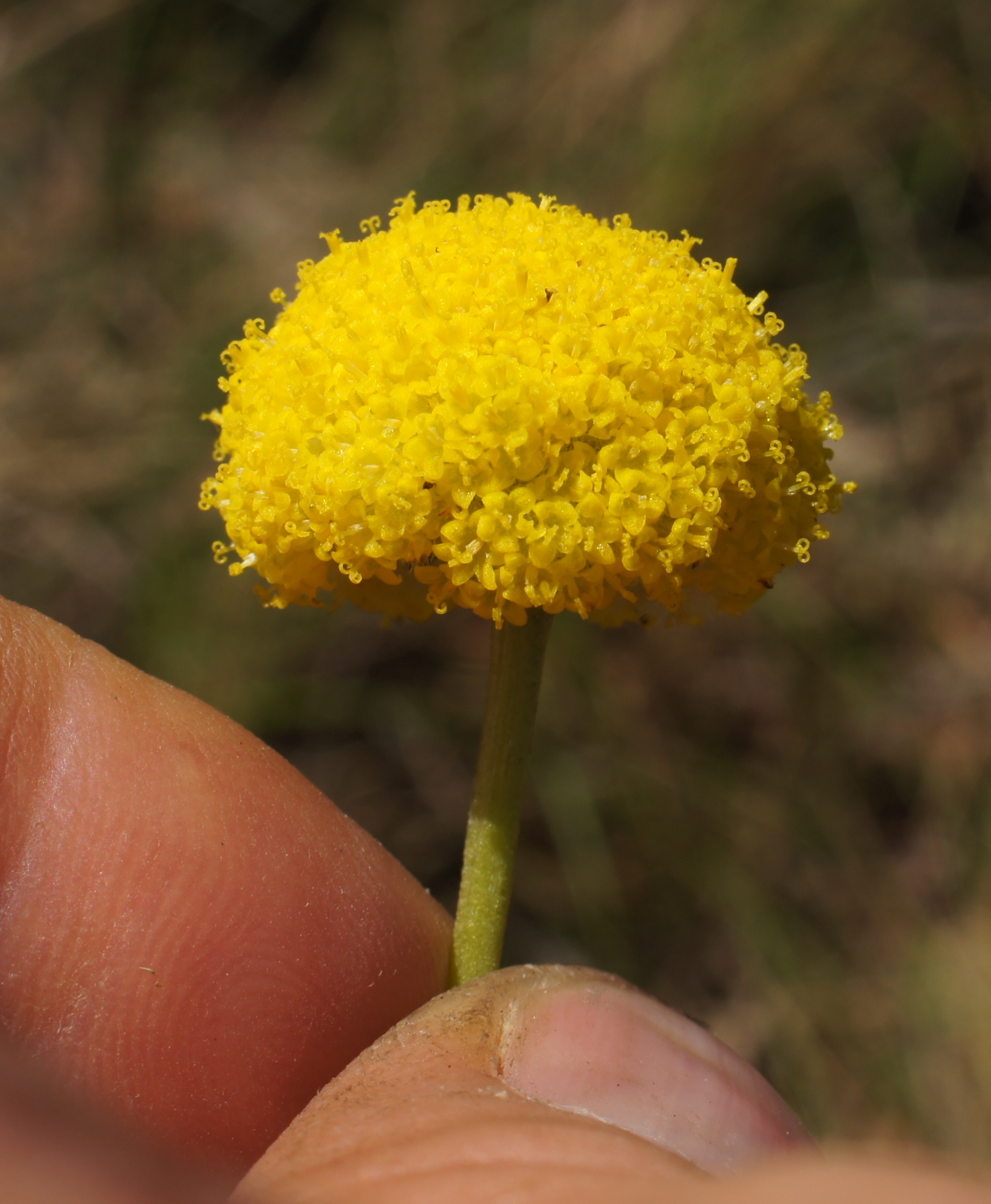
Craspedia is a genus of approximately 23 species of flowering herbs in the family Asteraceae (tribe Gnaphalieae), native to Australia and New Zealand. They are popularly known as billy buttons, billy balls, or woollyheads — names that reflect the distinctive spherical to hemispherical compound flower heads carried on tall, erect, unbranched scapes. Most species are perennial rosette-forming plants; one species, Craspedia haplorrhiza, is annual.
The leaves form a basal rosette and show considerable variation in colour, ranging from white to green, and are often covered in fine hairs. The capitula are composite heads made up of many tiny individual florets. A closely related genus, Pycnosorus, shares the common name billy buttons; the two genera are distinguished by the attachment of individual flower heads — directly attached in Pycnosorus, on short stalks in Craspedia. Molecular phylogeny suggests the two genera may in fact be monophyletic.
The genus was first described by the German botanist Johann Georg Adam Forster in 1786, with Craspedia uniflora as the sole original species. It is found in every Australian state except the Northern Territory, and throughout New Zealand from East Cape on the North Island south to Stewart Island, including Campbell Island and the Chatham Islands. Habitats range from coastal dunes and wetlands to alpine fellfields and the Southern Alps.
Craspedia is widely cultivated as an ornamental and floricultural plant, prized both as a fresh-cut flower and as a long-lasting dried flower in floral arrangements.
Etymology
The genus name Craspedia derives from the Greek kraspedon, meaning an edge, hem, or border. It refers to the woolly fringes of the leaves of the type species, Craspedia uniflora, as observed by the genus's author, J.G.A. Forster, in 1786.
Distribution
Craspedia is native to Australia and New Zealand. In Australia the genus occurs in every state except the Northern Territory. In New Zealand it ranges from East Cape on the North Island south to Stewart Island, and also occurs on Campbell Island and the Chatham Islands. Habitats span sea level to the Southern Alps, encompassing native grasslands, Eucalyptus shrublands, coastal sand dunes, wetlands, fellfields, and alpine scree.
Ecology
Species of Craspedia occupy open habitats from coastal to alpine zones and are considered plants of disturbed and open areas, sometimes ruderal. Australian species re-establish readily after fire and are most common in native grasslands and shrublands associated with Eucalyptus forests; alpine species are found in Tasmania. In New Zealand they are largely absent from closed Nothofagus forests but occur on coastal dunes, wetlands, and greywacke scree. The genus tolerates a wide range of soil types — sands, gravels, clays, and loams — but is intolerant of very infertile, acidic soils, which explains its absence from parts of western Tasmania dominated by buttongrass moorland.
Cultivation
Craspedia is hardy to USDA hardiness zones 9–11. Propagation by seed is preferred over rosette division, as seeds germinate rapidly on standard germination media and plants are generally self-fertile. Alpine species require consistent moisture and excellent drainage. All species perform best with cool roots; surrounding them with rock, gravel, or sand improves growing conditions. The cultivar 'Golf Beauty' is commercially available.
Taxonomy Notes
The genus Craspedia was established by J.G.A. Forster in 1786, originally containing only Craspedia uniflora. It is placed in the family Asteraceae (also listed under the synonym Compositae), tribe Gnaphalieae. Early authors included Pycnosorus within Craspedia; it was later segregated. Molecular phylogenetic evidence suggests Craspedia and Pycnosorus may be monophyletic rather than separate sister clades. GBIF recognises 31 descendant taxa.










