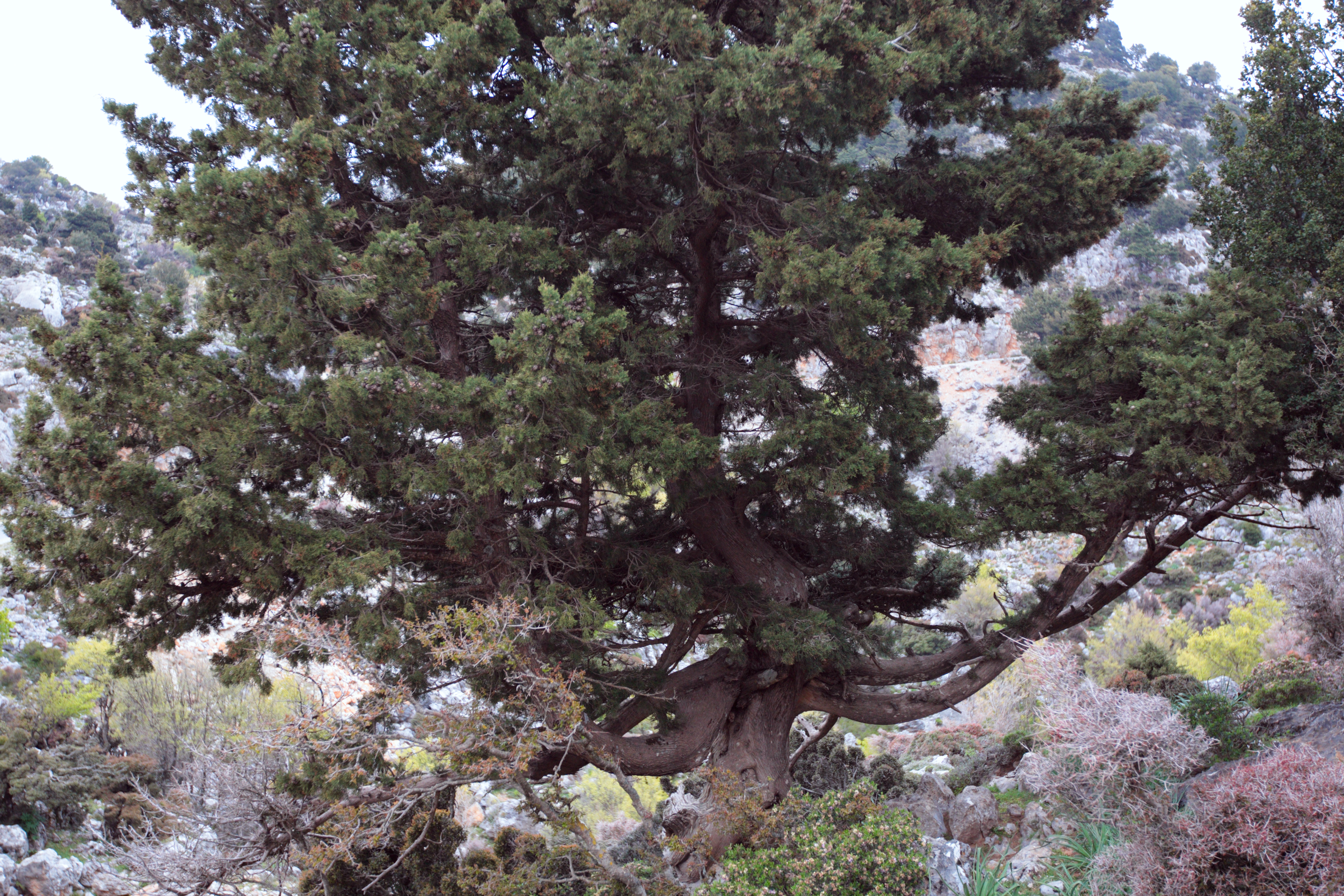
Cupressus is a genus of evergreen coniferous trees and shrubs in the cypress family, Cupressaceae. Members range from compact shrubs to forest giants of 5 to 40 metres, with the recently described Cupressus austrotibetica reportedly reaching 102 metres — making it the second-tallest tree species on the planet. The genus is easy to recognise from a distance: aromatic, scale-like leaves clothe slender ascending or pendulous branchlets, and small globose woody cones with shield-shaped scales mature over an unhurried 18 to 24 months before splitting open.
True cypresses are restricted to the warm temperate and subtropical Northern Hemisphere, with a broken native distribution that arcs from the Sahara and the Mediterranean basin across the Middle East and the Himalaya into south-western and central China and northern Vietnam. The Himalayan region is the centre of diversity, holding around ten of the sixteen species currently recognised by Kew's Plants of the World Online. Many of these grow on stony slopes, dry mountainsides, or the fringes of deserts, where their deep roots and drought-hardy foliage outcompete softer-needled conifers.
Cupressus has been in serious taxonomic motion this century. Molecular phylogenies published between 2006 and 2009 showed that the genus as traditionally circumscribed was paraphyletic, and the New World cypresses of California, the south-western United States, Mexico, and Central America have since been transferred to the segregate genera Hesperocyparis, Callitropsis, and Xanthocyparis. What remains in Cupressus sensu stricto is the Old World lineage, which is most closely related to the junipers — Cupressus and Juniperus split from a common ancestor about 56 million years ago.
The genus has been bound to human culture for thousands of years. Cupressus sempervirens, the slender Mediterranean cypress, is the type species and the tree of Cyparissus, mourning, Tuscan hillsides, and Van Gogh's The Starry Night. The Sarv-e-Abarkooh in Iran is one of the oldest living trees in the world. Several species — Mediterranean cypress, Monterey cypress (Cupressus macrocarpa), Arizona cypress, and the famously vigorous Leyland hybrid (×Cuprocyparis leylandii, formerly Cupressus × leylandii) — are mainstays of horticulture as specimen trees, screens, and tall hedges.
Etymology
The name Cupressus is the classical Latin name for the Mediterranean cypress and was applied to the genus by Linnaeus when he founded the modern circumscription in Species Plantarum (1753). The Latin word comes via Greek kyparissos, which is itself often traced further back through Hebrew gopher — the wood reportedly used for Noah's Ark in the Book of Genesis. Greek and Roman writers attached the tree to the myth of Cyparissus, the youth beloved of Apollo who, after accidentally killing his pet stag, asked the gods to let him grieve forever and was transformed into a cypress. That myth, recorded most famously by Ovid, is the root of the tree's long association with mourning across Mediterranean cultures.
Distribution
Cupressus sensu stricto is an Old World genus. Native populations form a long, broken belt that begins in the central and north-western Sahara, runs east through the eastern Mediterranean (Cyprus, Turkey, Lebanon, Syria, Iran), and continues across the Himalaya into Nepal, Pakistan, Tibet, central and southern China, and northern Vietnam. Kew's Plants of the World Online lists Algeria, Libya, Morocco, Cyprus, Iran, Lebanon-Syria, Turkey, Nepal, Pakistan, Tibet, the China provinces (North-Central, South-Central, Southeast), and Vietnam among the native territories, with the Himalayan region acting as the centre of species diversity. Several species — most notably the Mediterranean cypress and the Portuguese cypress (Cupressus lusitanica) — have been carried far beyond that native range and are now naturalised in much of Mediterranean Europe, parts of east Asia, and other warm-temperate regions; Switzerland's Info Flora checklist, for example, records both species as introduced ornamentals.
Ecology
True cypresses tend to occupy environments that punish softer conifers. They populate dry mountainsides, rocky slopes, and desert margins from the Sahara to inner Asia, and several species are adapted to fire and prolonged drought. GBIF flags the genus as exclusively terrestrial. Cupressus is wind-pollinated and a notably prolific allergen — the genus rates 10 on the OPALS allergy scale, with warm-climate populations shedding pollen for around seven months of the year, which is enough to drive seasonal allergic reactions in some Mediterranean and subtropical cities.
Cultivation
Most Cupressus species are easy-going landscape conifers given an open site. Plants For A Future characterises them as adaptable to most soils, with a preference for deep, moist loams, but they will also handle heavy clays, dry alkaline ground, atmospheric pollution, and strong inland winds. They tolerate moderate shade when young, though full sun produces the densest specimens, and most resent the salt spray of true maritime exposure. Hardiness varies by species: the genus is often pegged broadly at USDA zones 5–7, with warm-climate species like Monterey cypress, Arizona cypress, and Mediterranean cypress more comfortable at zones 7–10. Their narrow, evergreen crowns make them classic accent trees, formal sentinels, windbreaks, and (in the case of Leyland and Monterey cypresses) tall garden hedges.
Propagation
Cypresses are usually raised from seed, but the process is slow. Seeds typically need stratification — Plants For A Future recommends about one month of warm followed by one month of cold treatment — and even then germination can take up to 18 months, so growers sow in cold frames and leave the trays in place for two seasons. Cuttings work but are not guaranteed: half-ripe wood taken in late summer or early autumn, or short hardwood cuttings taken in late winter and early spring, will sometimes strike in sandy soil under cover. Named clones and hybrids (Leyland cypress in particular) are propagated almost exclusively from cuttings because seed-grown plants will not come true.
Conservation
Several Cupressus species are of significant conservation concern despite the genus's broad horticultural footprint. The Saharan cypress (Cupressus dupreziana) of the Tassili n'Ajjer in Algeria is one of the rarest conifers in the world — the most recent census located just 233 surviving individuals on the plateau. Other Old World cypresses, including Cupressus chengiana in western China, are also classed in threatened categories by the IUCN owing to small ranges, low recruitment, and habitat pressure. By contrast, widely cultivated species such as Cupressus sempervirens are not considered globally at risk because they are abundant in cultivation across many continents.
Cultural Uses
Cupressus has been part of Mediterranean and Asian material culture for millennia. Cupressus sempervirens is the dominant cemetery tree throughout the Muslim world and much of Christian Europe — Athenian households once garlanded their doors with its boughs during mourning, and cypress wood was burned to fumigate the air at cremations. The tree appears in Jewish tradition as a candidate for the gopher wood of Noah's Ark and the wood of Solomon's Temple, and in Persian Zoroastrian tradition as a relic planted by King Vishtaspa near the first fire temple. Van Gogh's late paintings, including Cypresses (1889) and The Starry Night, fixed the cypress in Western visual culture. Beyond symbolism, the genus produces one of the most durable softwood timbers in the world — Plants For A Future calls it among the finest for flooring, fencing, and boat-building — and its aromatic resin, leaves, and seeds have a long folk-medicinal and perfumery history, with the resin noted as a strong diuretic.
History
Cupressus was formally established by Linnaeus in Species Plantarum in 1753, but its species had already been written into Mediterranean culture for thousands of years. The Sarv-e-Abarkooh in Iran's Yazd Province, traditionally claimed to be roughly 4,000 years old, is one of Earth's oldest living trees and predates many of the civilisations that have venerated the cypress. The genus has spent the twenty-first century being re-drawn: molecular phylogenetics between 2006 and 2009 split off the New World cypresses into Hesperocyparis, Callitropsis, and Xanthocyparis, leaving Linnaeus's Cupressus as a purely Old World lineage that diverged from the junipers around 56 million years ago.
Taxonomy
Cupressus L. (Cupressaceae, subfamily Cupressoideae) was published in Linnaeus's Species Plantarum: 1002 (1753) and is treated as accepted by both POWO and the GBIF backbone. Plants of the World Online recognises sixteen accepted species in Cupressus sensu stricto, with Platycyparis and Tassilicyparis (both 2006) listed as heterotypic synonyms. The big twenty-first-century change is the removal of the New World cypresses: molecular studies published between 2006 and 2009 showed that traditional Cupressus was paraphyletic, and the western North American, Mexican, and Central American species were transferred to Hesperocyparis (around 17 species), the monotypic Callitropsis, and the monotypic Xanthocyparis. Cupressus is now confined to the Old World and is the sister genus to Juniperus, from which it diverged roughly 56 million years ago. Some authors continue to lump these lineages, which is why species counts of 16–25 still circulate in older or more conservative treatments.










