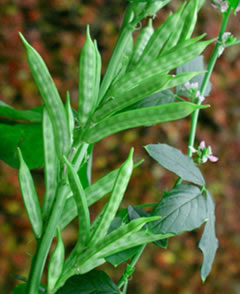
Cyamopsis is a small genus of legumes in the family Fabaceae (order Fabales), comprising four species. Its members are distributed across sub-Saharan Africa (particularly southwestern Africa and the Sudanian and Somali-Masai regions), Saudi Arabia, Pakistan, and India, typically growing in tropical seasonally-dry thorn scrub and grassland — often in floodplains, stream beds, and pans, and in open sandy or rocky ground. The genus name derives from Greek kýamos ("bean") and ópsis ("view" or "appearance"), meaning roughly "bean-like."
The genus's best-known and economically important member is Cyamopsis tetragonoloba, commonly called guar or cluster bean, the source of guar gum. Guar is an annual legume whose wild origin is unknown — it has never been found growing outside cultivation — and it is thought to have developed from the African species Cyamopsis senegalensis before being further domesticated in South Asia, where it has been cultivated for centuries. Like other legumes, guar lives in symbiosis with nitrogen-fixing bacteria and is drought-tolerant, making it valuable in crop-rotation systems in semi-arid regions such as Rajasthan, where farmers use it to replenish soil nitrogen ahead of subsequent plantings.
Guar seeds contain a large endosperm rich in a water-soluble galactose-mannose polysaccharide that produces a viscosifying, gelling effect when hydrated — guar gum. This gum has wide-ranging industrial and food applications and, more recently, surging demand from its use in hydraulic fracturing of oil and shale gas, as well as its role as a key ingredient in the toy Slime. Guar cultivation is centered overwhelmingly in India, particularly around Jodhpur, Rajasthan, which accounts for roughly 80% of world production, with smaller growing areas in the semiarid high plains of Texas, Australia, and parts of Africa.
The other three species in the genus — Cyamopsis dentata and Cyamopsis serrata (both native to southern Africa) alongside Cyamopsis senegalensis (native to dry tropical Africa and Saudi Arabia) — remain wild, undomesticated relatives without significant economic use, in contrast to their widely cultivated relative.
Etymology
The genus name Cyamopsis means "bean-like," from Greek kýamos ("bean") and ópsis ("view" or "appearance"). The common name "guar" (for the genus's cultivated species, C. tetragonoloba) comes from Hindi ग्वार (gvār); the plant is also known as cluster bean, gavar, gawar, or guvar bean.
Distribution
Species of Cyamopsis occur across sub-Saharan Africa (especially southwestern Africa and the Sudanian and Somali-Masai regions), Saudi Arabia, Pakistan, and India, typically in tropical seasonally-dry thorn scrub and grassland, floodplains, stream beds, pans, and open sandy or rocky habitats. The cultivated species, guar (C. tetragonoloba), is grown mainly in north-western India (particularly Rajasthan, which produces about 80% of the world's supply), with smaller growing areas in Texas (US), Australia, and Africa.
Ecology
Guar (C. tetragonoloba) is drought-tolerant, well-suited to semiarid conditions, and lives in symbiosis with nitrogen-fixing bacteria, which lets farmers use it in crop-rotation cycles to replenish soil nitrogen ahead of the next planting.
Cultivation
Guar is cultivated principally in north-western India (especially around Jodhpur, Rajasthan, and the Gujarat/Kutch regions, which together account for roughly 82% of India's guar-growing area), with smaller commercial plantings in the semiarid high plains of Texas in the US, Australia, and parts of Africa. Rising demand — notably from hydraulic fracturing — has driven expanded cultivation, including in drought-prone areas of the southwestern United States where it remains economically viable.
Cultural Uses
Guar seeds' endosperm yields guar gum, a water-soluble, viscosifying galactose-mannose polysaccharide used widely in food products, industrial applications, and the extractive industry — including hydraulic fracturing of oil and shale gas — and as a major ingredient of the toy Slime. Guar also serves human and animal nutrition, though its seed gum remains its most economically important use.
History
The wild origin of guar (Cyamopsis tetragonoloba) is unknown, as it has never been found growing outside cultivation; it is assumed to have developed from the wild African species Cyamopsis senegalensis. It was further domesticated in South Asia, where it has been cultivated for centuries.










