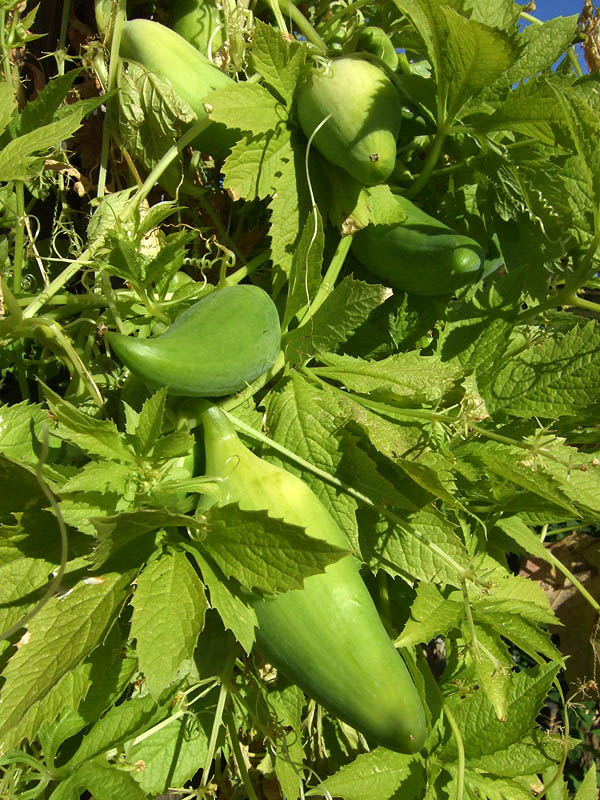
Cyclanthera is a genus of flowering plants in the family Cucurbitaceae (the gourd family), order Cucurbitales, described by the botanist Heinrich Adolf Schrader in 1831. The genus comprises roughly 60–70 species of climbing vines native primarily to the Americas, with the greatest diversity in the Neotropics.
Plants in the genus are annual or perennial climbers that use branched tendrils to scramble over supporting vegetation. A defining morphological feature of the genus is the extreme fusion of stamens in some species: the filaments and anthers coalesce into a ring (a cyclic structure) around the gynoecium with a single pollen-releasing locule — an unusual condition within Cucurbitaceae and the direct source of the genus name.
The most economically important member is Cyclanthera pedata (caigua or achocha), a domesticated Andean crop cultivated for its hollow, mild-flavoured fruits. Immature fruits are eaten raw like cucumbers; mature fruits are stuffed and cooked in the manner of marrow. The plant has also been used in Andean folk medicine to treat cardiovascular and gastrointestinal conditions. Other species in the genus are wild, including Cyclanthera dissecta, a weedy vine found across the southwestern United States, Mexico, and Central America, and Cyclanthera cordifolia, native to South America.
Etymology
The genus name Cyclanthera derives from the Greek kyklos (“ring, circle”) and anthera (“anther”), referring to the characteristic fusion of stamens into a ring around the gynoecium seen in several species — a morphological trait unique enough to name the entire genus.
Distribution
Cyclanthera is centred in the Neotropics, with species distributed across South America, Central America, Mexico, and parts of the southern United States. Cyclanthera pedata, the most widely known species, is believed to originate in the Andes of South America and is now cultivated throughout tropical and subtropical America. Cyclanthera dissecta extends into the southwestern United States. The genus reaches elevations up to 3,000 m in Andean habitats.
Cultural Uses
Cyclanthera pedata (caigua or achocha) has been cultivated as a food crop in the Andes for centuries. Immature fruits are eaten raw or cooked and have a mild, cucumber-like flavour; mature fruits are typically stuffed and baked. Young leaves and shoots are cooked as greens. In traditional Andean medicine, the fruit juice is used for hypertension, high blood cholesterol, arteriosclerosis, and diabetes, and powdered seeds are taken against intestinal parasites.
Ecology
Cyclanthera pedata grows at elevations up to 3,000 m in the Andes and tolerates subtropical conditions; it requires a warm growing season of at least four months. It is not known in a truly wild state and has become naturalised or weedy in some areas, including being recorded as a weed pest in Florida.










