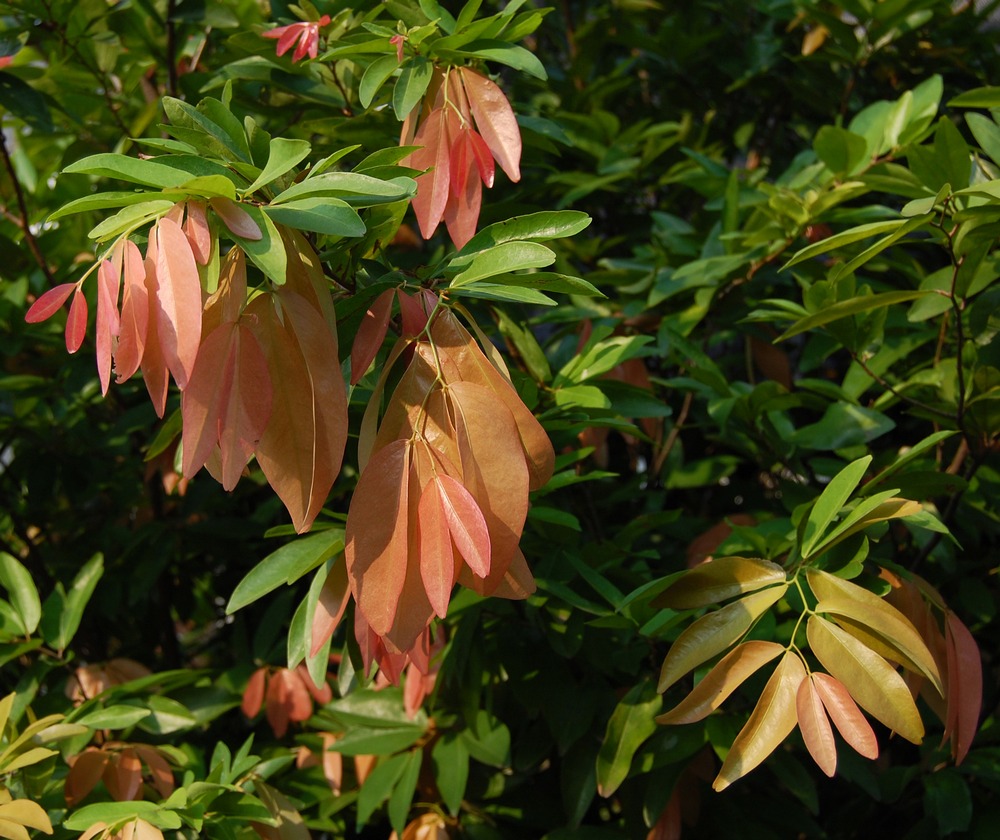
Cynometra is a genus of tropical forest trees in the legume family Fabaceae (subfamily Detarioideae), with a pantropical distribution spanning Africa, Asia, and the Neotropics. The genus was described from Malay botanical knowledge documented by the Dutch naturalist Georg Eberhard Rumphius and encompasses approximately 113 accepted species according to Plants of the World Online, following a major 2019 recircumscription.
Trees in Cynometra range from shrubs to towering canopy emergents. Cynometra cauliflora (namnam), native to Southeast Asia, is a small tree of 3–15 metres notable for cauliflory — bearing its large, fleshy seedpods directly on the trunk and lower branches rather than at branch tips. Cynometra alexandri (muhimbi, Ugandan Ironwood), by contrast, reaches up to 50 metres in the rain forests of DR Congo, Uganda, Rwanda, and Tanzania, and is prized for its extremely hard, termite-resistant heartwood used in heavy construction, marine work, and flooring.
Species of Cynometra are particularly significant ecological components of West African and Neotropical forests. C. alexandri is gregarious, often forming dense stands in lowland rain forest at elevations of 700–1,200 metres. The genus plays an important role in tropical timber economies as well as in local food culture — C. cauliflora has been cultivated in Southeast Asia for its edible fruit, which can be eaten raw, pickled, or made into condiments such as sambal.
The genus was extensively revised in 2019 by botanist Aleksandar Radosavjevic, who recircumscribed Cynometra to include all species previously placed in Maniltoa while removing African species with jointed pedicels and dehiscent fruits. Before this revision, the genus was considered polyphyletic.
Etymology
The name Cynometra is a Greek calque of puki anjing, the local Malay name for Cynometra cauliflora, as recorded by the Dutch naturalist Georg Eberhard Rumphius in his documentation of Southeast Asian flora.
Distribution
Cynometra has a pantropical distribution across Africa, Asia, and the Neotropics. Species are especially prominent as forest components in West Africa and the Neotropics, and C. alexandri dominates rain forest stands in DR Congo, Uganda, Rwanda, and Tanzania at 700–1,200 m. C. cauliflora is cultivated throughout the wet tropical lowlands of Southeast Asia, thriving particularly in monsoon climates with a distinct dry season.
Ecology
Several species, including Cynometra alexandri, are gregarious and form dense, monodominant stands in lowland tropical rain forest on firm ground. C. alexandri grows at elevations of 700–1,200 metres in central and east African rain forest, where it is a structurally dominant canopy tree with extensive plank buttresses.
Cultural Uses
Cynometra cauliflora (namnam) has been cultivated in Southeast Asia for its edible cauliflorous fruit, which is eaten fresh, cooked with sugar as a compote, pickled, or used to prepare sambal. Cynometra alexandri (muhimbi / Ugandan Ironwood) yields an extremely dense, durable heartwood traded for heavy construction, marine work, flooring, railroad crossties, and mining timbers; it is also used locally for fuel and charcoal.
Taxonomy Notes
Until 2019, Cynometra was considered polyphyletic and in need of revision. In that year, botanist Aleksandar Radosavjevic recircumscribed the genus by absorbing all species formerly in Maniltoa and excluding African species characterised by jointed pedicels and dehiscent fruits. The genus belongs to the subfamily Detarioideae of Fabaceae, and Plants of the World Online recognises 113 species as of February 2026.

