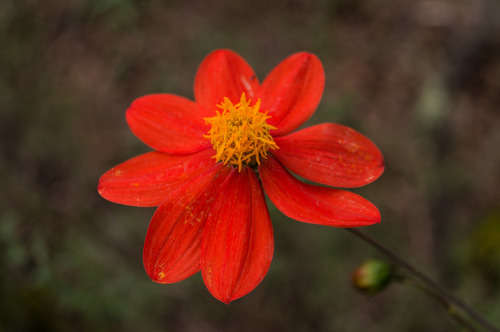
Dahlia (Cav.) is a genus of bushy, tuberous, herbaceous perennial plants in the family Asteraceae (order Asterales), comprising approximately 42–49 accepted species native to Mexico and Central America. They are relatives of the sunflower, daisy, chrysanthemum, and zinnia.
Plants grow from tuberous roots and produce leafy stems ranging from 30 centimetres to more than 2.4 metres tall. As members of Asteraceae, dahlias bear composite flower heads (capitula) made up of individual florets arranged around a central disc with surrounding petal-like ray florets — each floret is a complete flower in its own right. Flower diameter ranges from 5 cm to 30 cm, and flowers occur in almost every colour except blue; the absence of blue results from dahlias having only five hydroxyl groups on their anthocyanins, whereas a true blue requires six. The majority of species do not produce scented flowers.
The extraordinary diversity of cultivated dahlias arises from two unusual genetic properties: garden dahlias are octoploids (eight sets of homologous chromosomes), and they carry an unusually high density of transposons — genetic elements that move between chromosomal positions, generating further variation with each generation.
Dahlias were known to Aztec and other Mesoamerican peoples long before the Spanish conquest. The Aztecs called them “Cocoxochitl” or “Acocotle” (roughly “hollow stem flower” or “water pipe flower” in Nahuatl), and used the hollow stems of Dahlia imperialis as water pipes and the tubers medicinally to treat epilepsy. The genus was formally described in 1791 by Abbe Antonio José Cavanilles, Director of the Royal Gardens of Madrid, who named it in honour of Swedish botanist Anders Dahl. The tubers contain inulin — a fructose-based storage polysaccharide — rather than starch, which gave them dietary and medical significance: prior to the discovery of insulin in 1923, inulin extracted from dahlia tubers was administered to diabetics as “Atlantic starch.”
Etymology
The genus name Dahlia was bestowed in honour of Anders Dahl, a Swedish botanist and student of Linnaeus. Although many sources credit Linnaeus himself, he died in 1778 — over a decade before the plants reached Europe in 1789 — so the name is attributed to Abbe Antonio José Cavanilles, who described the genus in 1791. In the early nineteenth century, German botanist Carl Ludwig Willdenow renamed the genus Georgina after naturalist Johann Gottlieb Georgi; this name persisted in Germany for decades and survives today in Russian, where dahlias are still called георгина (georgina).
Distribution
Dahlia is found predominantly in Mexico, with some species ranging south through Central America to northern South America. The genus is characteristic of upland and montane habitats, growing at elevations between 1,500 and 3,700 m in pine–oak woodland zones. Most species have limited, scattered ranges across Mexico’s mountain ranges.
Ecology
The most common pollinators of dahlias are bees and small beetles. Dahlias produce no significant scent and instead attract pollinators through their brightly coloured ray florets. Native populations inhabit high-altitude pine–oak woodlands in Mexico and Central America and are not frost-tolerant in their native form.
Cultivation
Dahlia tubers are hardy to approximately USDA Zone 8 and are not adapted to sub-zero temperatures. In temperate climates, gardeners can grow dahlias by lifting tubers after the first frost and storing them in cool, frost-free conditions through winter. Planting tubers 10–15 cm deep provides additional cold protection. In active growth, dahlias perform best in well-watered, free-draining, sunny positions. Taller cultivars require staking, and regular deadheading encourages continuous flowering. Formal classification of cultivar types was established internationally in 1962–1966 and culminated in the Royal Horticultural Society’s 1969 International Register of Dahlia Names; the classification system distinguishes groups by disc visibility, floret folding (flat, involute, revolute), and fimbriation.
History
Dahlias were recorded in Mexico as early as 1525 by Spanish explorers, with the earliest detailed description by Francisco Hernández, physician to Philip II, who studied them in Mexico from 1570. The plants were used as food and medicine by indigenous peoples. Cuttings reached Europe in 1789, when specimens were sent to the Royal Gardens of Madrid. The genus was formally named Dahlia by Cavanilles in 1791; a competing name Georgina was introduced in 1805 but ultimately superseded. In 1846 the Caledonia Horticultural Society offered £2,000 to the first person to breed a blue dahlia — a prize that remains unclaimed. By the early twentieth century, distinct cultivar types were recognised, and classification was standardised internationally by 1969 under the Royal Horticultural Society.
Cultural Uses
The Aztecs used dahlias (Cocoxochitl) to treat epilepsy and employed the hollow stems of Dahlia imperialis as water pipes. Dahlia tubers are considered a native ingredient in Oaxacan cuisine; some cultivars are still grown for their large, sweet-potato-like tubers, and Dacopa — an intense mocha-flavoured extract from roasted tubers — is used to flavour beverages across Central America. Prior to the discovery of insulin in 1923, inulin derived from dahlia tubers (sold as “Atlantic starch” or “diabetic sugar”) was prescribed to diabetics and patients with tuberculosis in Europe and America. Dahlia has been the national flower of Mexico since 1963.










