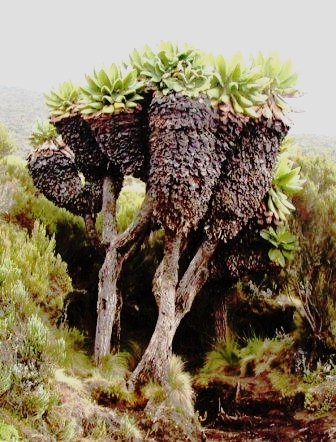
Dendrosenecio is a genus of flowering plants in the daisy family, Asteraceae (order Asterales), segregated from the large genus Senecio. Known as the giant groundsels, its roughly ten to eleven recognized species (species limits are debated, with some populations ranked as subspecies or varieties instead) are endemic to the alpine zones of ten isolated mountain groups in equatorial East Africa, including Kilimanjaro, Mount Kenya, the Aberdare Range, the Rwenzori Mountains, and the Virunga Mountains, where they are one of the most conspicuous elements of the afroalpine flora.
The genus is defined by an unmistakable giant-rosette growth form: a stout, woody stem topped by a terminal leaf rosette. When a rosette flowers, it produces a single large terminal inflorescence and, afterward, dies back while two to four new lateral rosettes sprout from its base, so that old individuals branch into candelabra-like plants the size of telephone poles. Reproduction is infrequent and synchronized — whole mountain populations may flower together only once every five to twenty-nine years — and most plants complete no more than three to five reproductive cycles in a lifetime before dying. Wind-dispersed, plumed achenes carry the seed.
Dendrosenecio's mountains function as volcanic "sky islands" rising above the tree line, exposed to daily rather than seasonal extremes ("summer every day, winter every night"). Between about 3,400 and 4,500 metres, the plants show some of the most striking cold-climate adaptations known in flowering plants: water-storing pith in the stem, insulating layers of retained dead leaves, ice-nucleating antifreeze compounds secreted around the growing tip, and leaves that fold shut at night. Molecular studies suggest the genus radiated from an ancestral population on Kilimanjaro within roughly the last million years, dispersing and speciating altitudinally across the East African mountain chain — a process that, alongside the parallel evolution of giant lobelias in the same habitats, is considered a textbook case of convergent adaptation to isolated alpine environments. Cytologically the genus is uniform, with a base chromosome number of n = 50 and presumed decaploidy, despite marked divergence from its closest known relative, Cineraria deltoidea.
Distribution
Native to the alpine zone of ten mountain groups in equatorial East Africa, including Mount Kilimanjaro and Mount Meru in Tanzania, Mount Kenya, the Aberdare Range and Cherangani Hills in Kenya, Mount Elgon on the Uganda-Kenya border, and the Rwenzori, Virunga and Mitumba Mountains along the Uganda-DRC-Rwanda borders. Most species are confined to a single mountain, with a few shared between neighboring ranges.
Ecology
Grows in the afroalpine zone (roughly 3,400-5,000 m) of isolated volcanic "sky island" peaks, where daily rather than seasonal temperature swings drive extreme adaptations: massive insulated rosettes, pith water storage, ice-nucleating antifreeze secretions, and nightly leaf closure. The genus radiated across the mountain chain via altitudinal and geographic speciation, and its giant-rosette form is a well-known example of convergent evolution shared with East Africa's giant lobelias.
Taxonomy Notes
Species and subspecies limits within Dendrosenecio are actively disputed among botanists. The genus is cytologically uniform (n = 50, presumed decaploid) despite being molecularly distinct from its closest relative, Cineraria deltoidea. One included species is treated under two different accepted combinations depending on source: Wikipedia's species list uses "D. brassiciformis (R.E.Fr. & T.C.E.Fr.) Mabb.", while GBIF's backbone accepts "D. brassica (R.E.Fr. & T.C.E.Fr.) B.Nord." for the same basionym.










