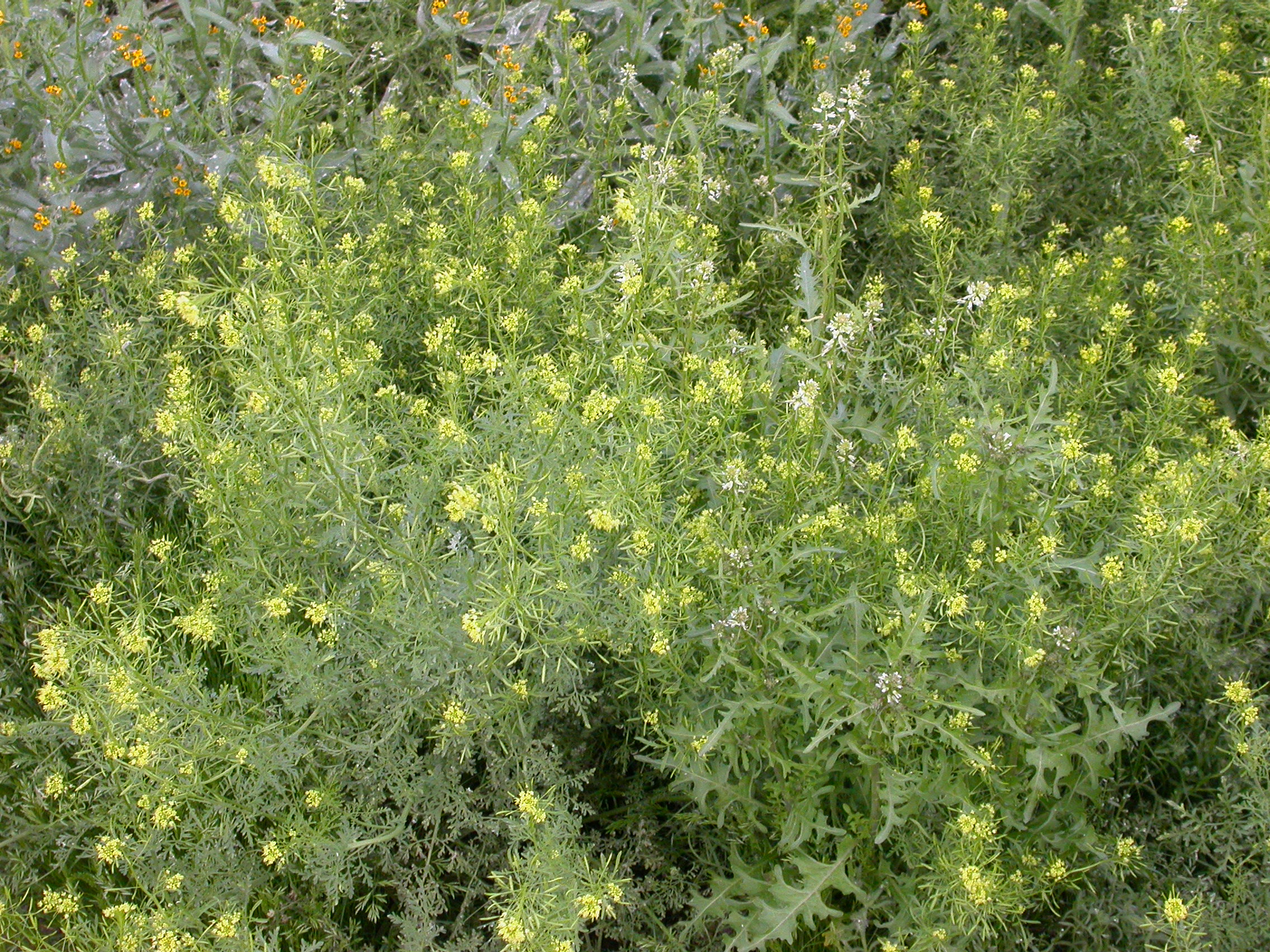
Descurainia is a genus of about 47 species of flowering plants in the mustard family (Brassicaceae), collectively known as the tansymustards. The genus belongs to the order Brassicales and is distributed across temperate regions worldwide, with species occurring in North and South America, Europe, and the Canary Islands. Plants are typically annual or biennial herbs that send up long, erect stems clothed in finely divided, pinnate or bipinnate leaves reminiscent of tansy — a resemblance that gives the group its common name. Flowers are small and yellow or whitish, arranged in elongated racemes characteristic of the Brassicaceae, and fruits are narrow siliques or silicles. Many species colonize disturbed habitats and are regarded as noxious weeds; some, notably Descurainia pinnata (western tansymustard), can accumulate compounds toxic to livestock, causing a condition known as "paralytic staggers" in sheep. Descurainia sophia (flixweed or herb-Sophia) is the type species and has a long history of medicinal use in Europe and Asia. The genus was named in honor of François Descurain (1658–1749), a French botanist and apothecary.
Etymology
The genus name Descurainia commemorates François Descurain (1658–1749), a French botanist and herbalist. The common name "tansymustard" refers to the finely divided, tansy-like foliage combined with the mustard-family flowers typical of the group.
Distribution
Species of Descurainia are found throughout temperate regions worldwide, with centers of diversity in western North America and the Andes of South America. The genus also includes island endemics in the Canary Islands (e.g., D. gilva, D. lemsii) and has a widespread Eurasian representative in D. sophia.
Ecology
Many tansymustard species are opportunistic colonizers of disturbed ground, roadsides, and overgrazed rangeland, functioning as weedy annuals or biennials. Some species, particularly Descurainia pinnata, are associated with livestock toxicity (notably in sheep) when consumed in quantity in grazing fields.
Taxonomy Notes
Descurainia is placed in the family Brassicaceae (order Brassicales). Circumscription of the genus has been revised by Ihsan Al-Shehbaz and colleagues; Descurainia sophia is the type species. The genus currently comprises approximately 47 accepted species following modern molecular-based reclassification of the Brassicaceae tribe Descurainieae.










