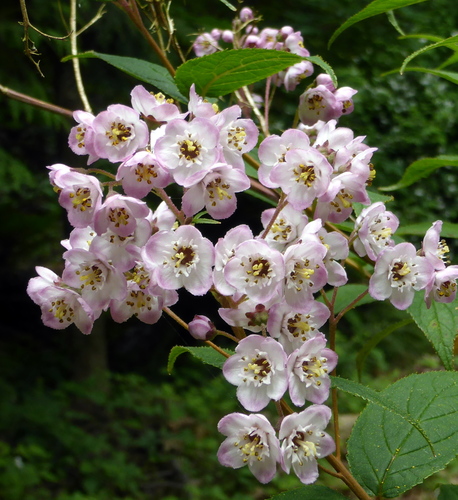
Deutzia is a genus of roughly 60 species of deciduous and semi-evergreen flowering shrubs in the family Hydrangeaceae, placed in the order Cornales. The genus is native to eastern and central Asia — from the Himalayas east to Japan and the Philippines — as well as Central America and parts of Europe. China is by far the centre of diversity, supporting approximately 50 of the roughly 60 recognised species.
Plants are shrubs typically 1–4 metres tall. Most species are deciduous, though a few subtropical members are evergreen. The leaves are opposite, simple, and have a serrated margin. Flowers are borne in panicles or corymbs and are white in the majority of species, occasionally pink or reddish. The fruit is a dry capsule containing many small seeds. Species identification is notably difficult, often requiring microscopic examination of leaf hairs and seed-capsule structure.
Deutzia has long been valued in horticulture: Deutzia scabra was recorded in Japanese gardens by Engelbert Kaempfer (1712) and Carl Peter Thunberg (1784) and reached European gardens in the 1830s, while most other species were introduced from the wild during the 20th century. Many cultivars and hybrids have been developed for garden use, including double-flowered selections; the hybrid Deutzia × lemoinei (a cross of D. gracilis and D. parviflora) has gained particular popularity. Several cultivars hold the Royal Horticultural Society's Award of Garden Merit. In Japan, D. scabra wood has traditionally been used by craftsmen to polish wooden surfaces.
Etymology
Deutzia was named by the Swedish botanist Carl Peter Thunberg in honour of his friend and patron Johann van der Deutz, an 18th-century Dutch botanist. The name has been in botanical use since Thunberg's publications in the late 18th century.
Distribution
The genus is native primarily to eastern and central Asia, ranging from the Himalayas east to Japan and the Philippines, with additional representatives in Central America and Europe. China hosts the greatest concentration of species diversity, with approximately 50 of the roughly 60 known species occurring there.
Cultivation
Deutzias are widely grown as ornamental garden shrubs for their abundant white or pink flowers. Temperate species are generally hardy in regions with reliably cold winters; in milder climates such as much of England, early-flowering forms can be induced into premature bloom by warm spells and then damaged by subsequent frosts — siting them in the garden's coldest microclimate is often recommended. Numerous cultivars and hybrids have been selected for double flowers and improved garden performance, including the widely grown Deutzia × lemoinei. Several cultivars have received the Royal Horticultural Society's Award of Garden Merit.










